


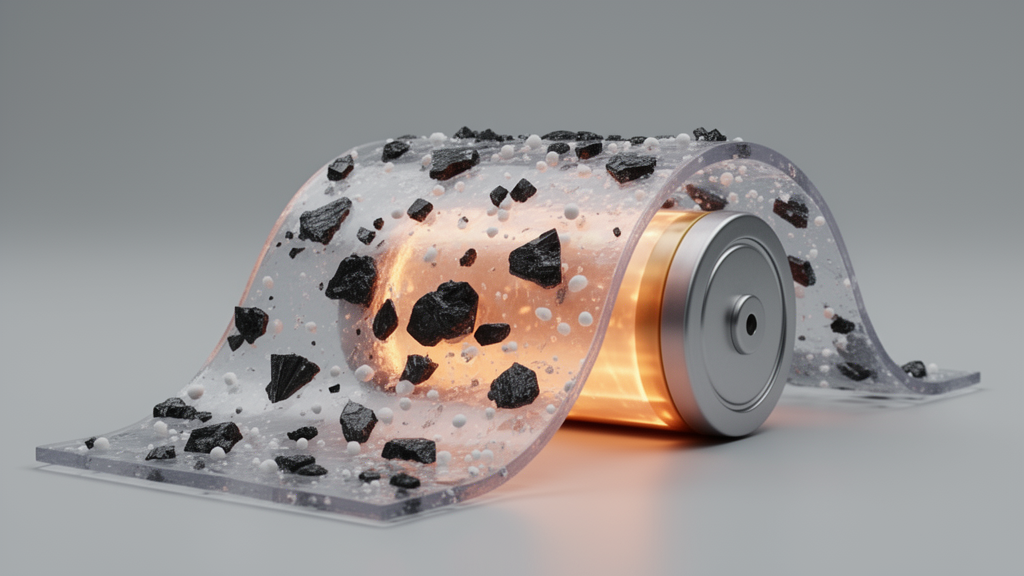
Electric vehicle battery packs are crowded electromagnetic environments. Traction inverters, DC-DC converters and battery management systems switch currents rapidly and can radiate broadband interference from kilohertz to gigahertz frequencies, so the enclosure around a high-voltage pack is not just a mechanical box but part of the vehicle’s electromagnetic compatibility strategy. Traditionally that job has fallen to aluminium or steel, which shield strongly by reflection but add mass, cost energy to fabricate and complicate recycling. A new open-access study in Discover Vehicles reports a recyclable thermoplastic alternative: a high-density polyethylene hybrid nanocomposite engineered so that conductive and dielectric fillers work together rather than relying on brute-force conductivity.
The research team, led by Mohammed Iqbal Shueb with collaborators including Norinsan Kamil Othman, prepared three formulations using a solvent-free melt-processing route followed by compression moulding, producing sheets 3 millimetres thick. The baseline was neat HDPE. A second sample added 3 weight percent graphene nanoplatelets, chosen because their high aspect ratio allows conductive networks to percolate at low loadings. The third, hybrid sample combined the graphene with 7 weight percent barium titanate, a ferroelectric ceramic with high permittivity. The design logic is impedance engineering: graphene platelets form semi-percolated pathways that support surface currents and partial reflection, while barium titanate particles act as polarization centres that promote absorption, so the material attenuates waves through a balanced reflection-absorption mechanism instead of maximal conductivity, which would cause severe impedance mismatch with free space.
The shielding measurements, made with a vector network analyzer and coaxial fixture according to ASTM D4935 across 0.1 to 1.0 GHz, showed a clear progression. Neat HDPE managed roughly 10.7 to 12.6 dB, essentially behaving as the transparent insulator it is. Adding graphene raised the total shielding effectiveness to about 17.9 dB at 1 GHz, and the hybrid composite reached approximately 20.2 dB, with reflection and absorption contributing comparably. That is roughly a 60 percent improvement over the unfilled polymer from fillers totalling only 10 weight percent, well below the 10 to 20 percent loadings at which conductive composites typically start losing melt processability and ductility.
The dielectric data support the intended mechanism. Broadband impedance spectroscopy from 1 kHz to 1 GHz showed the real permittivity rising from about 2.35 to 2.38 for neat HDPE to roughly 2.70 to 2.75 with graphene alone and 2.80 to 2.85 for the hybrid, while the loss tangent stayed low, peaking around 0.006 to 0.007. The authors attribute the enhancement to Maxwell-Wagner-Sillars interfacial polarization: charge accumulates at the boundaries between conductive graphene, high-permittivity ceramic and the insulating matrix, creating localized fields that store and dissipate electromagnetic energy without significant ohmic loss. A modified Bruggeman effective-medium model and a Cole-Cole-type relaxation description reproduced the measured permittivity trends, and the team fitted a semi-empirical log-linear relation linking shielding effectiveness to the product of conductivity and permittivity at 1 GHz.
Mechanically, the fillers reinforced rather than embrittled the matrix outright, though a familiar trade-off appeared. Tensile strength, measured on five replicates per formulation under ASTM D638, climbed from about 28 MPa for neat HDPE to roughly 34 MPa with graphene and 36 MPa for the hybrid, while Shore D hardness rose from 52.3 to 58.6 and 61.4. Young’s modulus increased by nearly 30 percent with graphene alone. The cost was ductility: elongation at break fell from about 160 percent for the neat polymer to 60 to 80 percent with graphene and roughly 30 percent for the hybrid, where microvoids around rigid ceramic particles promote earlier crack initiation. Fracture surfaces examined by field-emission scanning electron microscopy showed a transition from smooth ductile tearing to roughened, heterogeneous morphologies with crack deflection and particle-matrix interaction zones.
Thermogravimetric analysis under nitrogen told a more nuanced story than the abstract’s phrase “enhanced thermal stability” might suggest. Onset degradation temperatures actually shifted slightly downward, from about 456.6 degrees Celsius for neat HDPE to 452.0 degrees for the hybrid, differences the authors consider within typical experimental variability. What changed substantially was residual mass at 800 degrees Celsius: negligible residue of roughly 0.2 percent for neat HDPE versus about 4.75 percent with graphene and 6.9 percent for the hybrid. The authors are explicit that this higher char yield primarily reflects thermally stable, non-volatile filler phases, a carbon-ceramic barrier residue, rather than a genuine improvement in the polymer’s intrinsic degradation temperature.
To demonstrate manufacturability, the collaborators, including the Malaysian Nuclear Agency, International Battery Center Sdn. Bhd. and NanoMalaysia Berhad, produced a 3D-printed prototype battery-module enclosure from the HDPE-based hybrid material. The prototype is a feasibility demonstration of geometry, not a tested shielding product, but it illustrates the practical appeal: HDPE’s density of about 0.95 grams per cubic centimeter against aluminium’s 2.7 offers substantial mass savings, the material is corrosion-resistant, halogen-free and re-meltable, and the whole route uses standard extrusion and compression moulding rather than solvents or surface-treated fillers.
The authors are candid about the gap between coupon and product. Automotive EMC standards such as CISPR 25 specify shielding effectiveness requirements of roughly 40 to 80 dB depending on the subsystem, so the hybrid’s roughly 20 dB at 1 gigahertz on a 3 mm coupon falls short of enclosure-level targets. They argue the result is nonetheless meaningful: 20 to 30 dB suffices for many secondary housings and submodules to suppress cross-talk, and polymer pre-shields can be combined with metallic coatings or conductive gaskets to reach combined attenuation above 70 dB. Their semi-empirical model predicts that improvements in graphene alignment, percolation efficiency and controlled ceramic orientation, or multilayer architectures exploiting multiple internal reflections, could push performance past 40 dB, but those remain predictions and design proposals rather than demonstrated results.
What the study actually establishes is a structure-property demonstration at laboratory coupon scale: that a modest, melt-processable filler package of 3 percent graphene and 7 percent barium titanate can lift HDPE’s shielding effectiveness by about 7.6 dB at 1 GHz while simultaneously raising strength and hardness, with the mechanism consistent with interfacial polarization rather than conductivity alone. The claim that maximizing conductivity is neither necessary nor desirable for polymer EMI shields is the paper’s central design lesson, and the fitted conductivity-permittivity-shielding correlation is offered as a quantitative guide for future formulations. Whether such impedance-engineered thermoplastics can close the remaining 20 to 60 dB gap to automotive enclosure requirements, survive vibration, thermal cycling and humidity in service, and do so economically at production volume are questions the prototype and coupon data cannot yet answer. For now, the work marks a credible, recyclable starting point rather than a finished replacement for the aluminium battery box.
Subject of Research: Impedance-engineered HDPE hybrid nanocomposites for electromagnetic interference shielding in electric vehicle battery enclosures
Article Title: Impedance-engineered HDPE hybrid nanocomposites for electromagnetic interference shielding in high-voltage electric vehicle battery enclosures
Article References: Shueb, M. I., Umar, K. N. K., Ahmad, H., Jalal, R. I. A., Sapuan, S. Z., Kee, Y. S., Esa, F., Aziz, M. Z. A. A., Takenaka, M., Munusamy, S. R., Mohamed, M., Ismail, S. I. M., Dzulkurnain, N. A., Shamsudin, S. A., & Othman, N. K. (2026). Impedance-engineered HDPE hybrid nanocomposites for electromagnetic interference shielding in high-voltage electric vehicle battery enclosures. Discover Vehicles, 2(1), Article 30. https://doi.org/10.1007/s44465-026-00034-z
Image Credits: AI Generated
DOI: 10.1007/s44465-026-00034-z
Keywords: HDPE, graphene nanoplatelets, barium titanate, EMI shielding, electric vehicle battery enclosures, nanocomposites, impedance matching, Maxwell-Wagner-Sillars polarization, melt processing, dielectric properties, automotive EMC, recyclable thermoplastics
News Source: Neil Sanderson. (October 30, 2026). Graphene and Ceramic Fillers Push Recyclable Plastic Toward EV Battery Shielding. Scienmag.



