


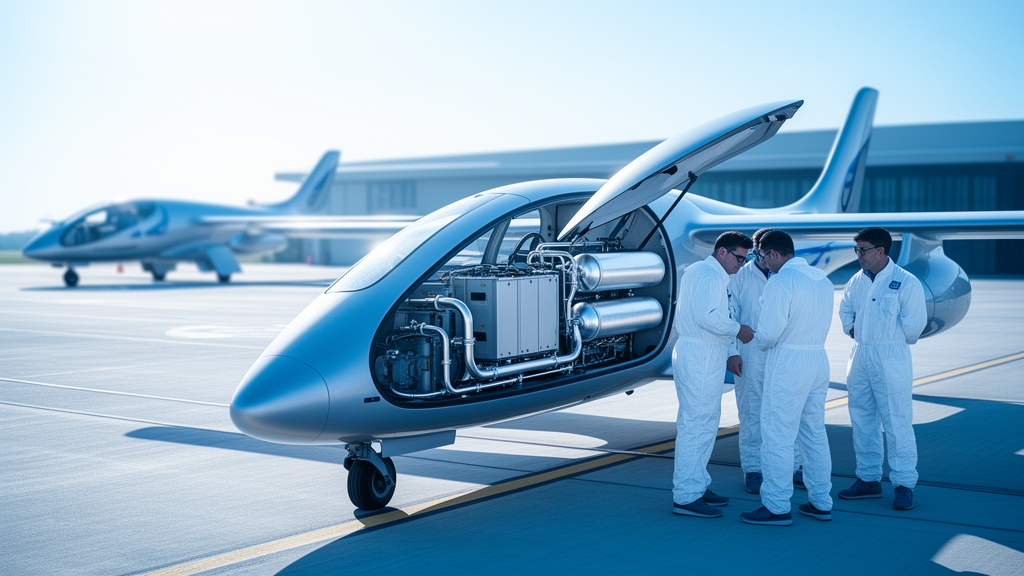
A fuel cell powerful enough to help propel an aircraft must be light enough to leave the ground—and durable enough to keep working in the demanding conditions of flight. That challenge is now the focus of a new collaboration between University of British Columbia Okanagan researchers and Unilia (Canada) Fuel Cells Inc., a BC-based company, who are teaming up to explore how to build hydrogen fuel cells designed specifically for aviation rather than adapted from road vehicles.
The $10.6-million collaborative project includes a $3.7-million contribution from the Initiative for Sustainable Aviation Technology (INSAT), which is supported by the Government of Canada and administered by Strix, a non-profit organization promoting innovation and collaborative research in Canada’s aerospace and related sectors. The partnership also draws on expertise from Dr. Előd Gyenge, a professor in the UBC Vancouver Department of Chemical and Biological Engineering, who will lead research on fuel cell materials, while Harbour Air Aerospace Services Ltd. will provide technical advice informed by its experience with aircraft design and electrification.
Designing fuel cells for aviation presents fundamentally different problems than building them for cars, trains or ships, explains Dr. Joshua Brinkerhoff, an associate professor of mechanical engineering at UBC Okanagan. Aircraft propulsion systems need to deliver substantial power while remaining light and dependable through changing temperatures and operating conditions. Working with Unilia, he says, gives the researchers an opportunity to connect fundamental research with fuel cell development and create new designs tailored specifically for aviation.
The technical barrier is well defined. Hydrogen fuel cells generate electricity without the emissions produced by combustion engines during operation, but fuel-cell stacks developed for the automotive and heavy-duty vehicle sectors have yet to meet the demanding weight, performance and durability requirements of commercial aircraft. A stack that works well in a truck may simply be too heavy, too bulky or too fragile for the skies.
The division of labour reflects that problem. UBC researchers will model and optimize fuel cell–battery hybrid configurations, study the supporting systems needed aboard an aircraft, and test materials under conditions relevant to flight. Unilia, for its part, will pair high-performance fuel cell cores with lightweight components to build a compact, high-power stack that runs at high temperatures and low humidity—operating conditions chosen with aviation’s weight and thermal constraints in mind.
Together, the partners aim to demonstrate the technical viability of a fuel-cell-stack prototype with enough power density to suit short- and medium-range commercial aircraft. Dr. Carmen Chuy, manager of the Technology Development Program at Unilia, says some of the most meaningful advances happen when expertise from different industries and disciplines comes together. The company brings many years of experience developing fuel cells for demanding heavy-duty applications, while drawing on UBC’s aerospace, materials and systems expertise—a diversity of perspective, she notes, that will help rethink fuel cell design around aviation’s very different requirements.
Denis Godin, Chief Technology Officer and Deputy CEO of Strix, describes the project as a reflection of the strength of Canada’s aerospace innovation ecosystem, bringing together leading researchers and industry experts to advance promising hydrogen fuel cell technologies. Through INSAT’s support, he says, the goal is to accelerate development of solutions that can enhance Canada’s competitiveness while contributing to a more sustainable future for aviation.
The team will develop aviation-specific designs intended to improve fuel cell performance and durability, and their findings could help address technical barriers to using hydrogen fuel cells in future aircraft. Both sides are careful about what the project can and cannot deliver: Brinkerhoff emphasizes that further development and testing would be required before the technology could be used in commercial flight. Even so, he calls the collaboration a crucial step in advancing fuel cell technology for aviation, noting that there is a huge need and potential for the technology. For now, the work remains at the research and prototyping stage—but it marks a concrete move toward hydrogen propulsion for the aircraft of the coming decades.
Subject of Research: Development of lightweight, durable hydrogen fuel cell technology for aviation
Article Title: Researchers, industry teaming up to help hydrogen fuel cells take flight
Article References: Researchers, industry teaming up to help hydrogen fuel cells take flight. Original publication (Bibliographic details unavailable.)
Image Credits: AI Generated
DOI: Not provided
Keywords: hydrogen fuel cells, aviation, UBC Okanagan, Unilia Fuel Cells, sustainable aviation, fuel cell stacks, power density, INSAT, Harbour Air, emissions-free propulsion, Researchers, industry
News Source: Victoria Harrison. (October 30, 2026). Hydrogen Fuel Cells Aim for the Sky in New Aviation Research Push. Scienmag.



