


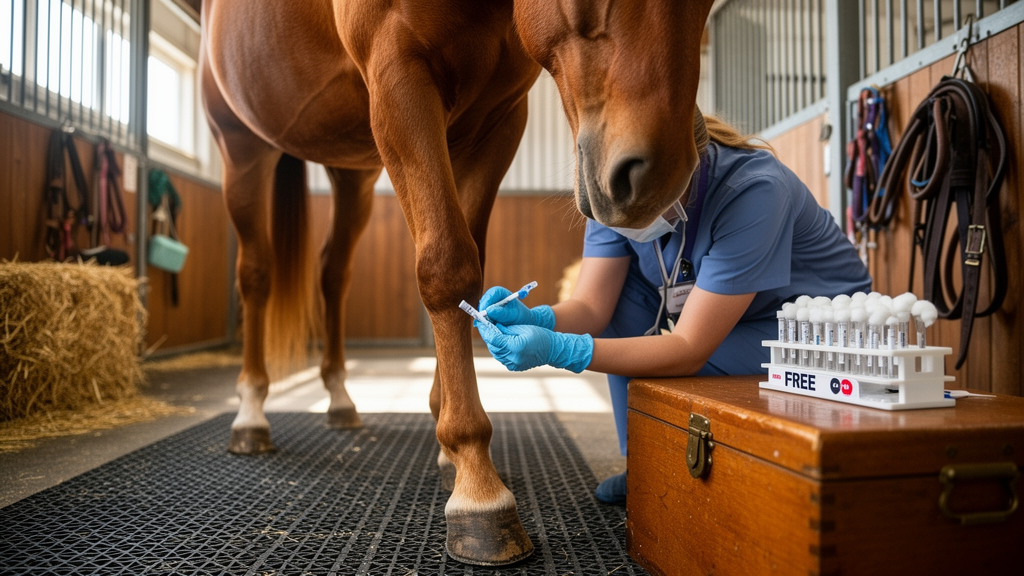
A new outbreak of equine parapoxvirus (EqPPV) swept through Finnish trotting stables in early 2025, and researchers who sampled the stable environment found the virus’s genetic material almost everywhere they looked: on grooming tools, bedding, stall doors, drinking bowls, clippers, scissors, brooms, wash box fixtures, and even on the hands, gloves, and shoes of the people caring for the horses. The findings, published in Acta Veterinaria Scandinavica, document how extensively the virus contaminates shared equipment and common spaces during an outbreak, and point to multiple possible indirect routes by which it may move between horses.
EqPPV was first identified in a sick horse in Finland in 2013. Since then, it has been associated with recurring wintertime outbreaks of pastern dermatitis, a skin condition affecting the lower legs, occurring roughly every few years. The largest documented outbreak struck in winter 2021–2022, potentially affecting hundreds of horses, with on average one-third of horses in infected stables developing clinical signs. Many horses suffered long-lasting lesions and had to be withdrawn from training, causing economic losses for trainers and owners. Field reports described similar outbreaks in 2015 and 2019, and suspected cases have also surfaced in Sweden and the Netherlands, where EqPPV was recently laboratory-confirmed.
To track the virus after the 2021–2022 event, researchers ran PCR diagnostics on skin swabs from horses showing compatible clinical signs between April 2022 and May 2025, testing 25 horses from 20 stables. For nearly three years, from April 2022 to January 2025, no new cases were detected. That changed in February 2025, when reports of pastern dermatitis from stable owners and veterinarians surged again. Between February and May 2025, eight out of ten stables submitting diagnostic samples tested positive, with 9 of 11 horses PCR-confirmed. The affected trotters came from the Tampere, Lahti, and Ylivieska sub-regions in southern and western Finland, although field reports suggested spread across much of the country.
The environmental investigation focused on six of these PCR-positive case stables, labeled A through F, plus two control stables in the Helsinki sub-region. One control had experienced a PCR-confirmed outbreak in 2022 but showed no cases in 2025; the other, a riding stable, had no history of EqPPV. In total, 161 environmental samples were collected from surfaces in direct or indirect contact with horses, spanning the boxes of infected and neighboring horses, common spaces, individual and shared equipment, and personnel, including gloves, shoes, and wounds or scabs on handlers’ hands.
The results were striking. Five of the six case stables—83.3 percent—had at least one EqPPV PCR-positive environmental sample, and overall 17.4 percent of the 138 environmental samples from case stables tested positive. No positive samples were found in either control stable. Positive findings included a caretaker’s healing scab, a wound on an owner’s hand, a sampler’s glove, a bandage pad used on an affected horse, bedding from PCR-positive horses, a door handle in the tack room, a box door, the wall between boxes adjacent to an affected horse, a drinking bowl, a blanket, a knee pad, the drain and faucet of a wash box, scissors, clippers, stable aisle robes, a broom, wash box walls, and field shelter walls.
The researchers emphasize that PCR detection confirms viral DNA, not necessarily infectious virus. EqPPV has never been successfully propagated in the laboratory, so the environmental persistence of viable virus remains uncertain. However, related parapoxviruses are known to survive harsh conditions: orf virus can remain infectious in soil for at least six months under winter conditions and persist in dried scabs and contaminated farm materials for prolonged periods. Given that precedent, the authors argue that PCR-positive environmental findings should be treated as a potential infection risk pending viability studies.
Some evidence hints at persistence in horses themselves. A leg bandage sample remained PCR-positive even weeks after being used outdoors. Scabs containing virus could fall off near the hooves and contaminate bedding, manure, or track surfaces, creating reservoirs of viral material in the horse’s immediate surroundings.
The study also collected circumstantial evidence bearing on the long-standing question of whether EqPPV can infect humans. In three of the six case stables, personnel reported skin symptoms resembling those seen in horses. A groom at stable A had a circular, purple, papulovesiculopustular lesion on the back of her hand, which was borderline PCR-positive. At stable D, two employees had hand wounds that healed unusually slowly, one of which was PCR-positive. At stable E, one employee developed a minor wrist lesion, though no sample was taken. Notably, the three stables that reported glove use when handling infected horses reported no human symptoms. The authors caution that PCR-positive signals could reflect surface contamination rather than true infection, and zoonotic transmission by EqPPV remains unproven, requiring targeted clinical sampling, serology, and sequencing in future outbreaks. Two human cases reported from the United States around the time of the virus’s discovery—a poxvirus sharing 99–100 percent nucleotide identity with EqPPV over a short sequence fragment—keep the question open.
The investigation also probed whether wild animals might serve as reservoirs. Samples from rodents trapped at a racetrack heavily affected in 2021–2022, along with feces from birds, rabbits, and unidentified rodents and snow contaminated with rabbit urine, all tested negative for EqPPV DNA, and rodent heart extracts were negative for antibodies. The authors stress this component was exploratory with a very small sample size, so a wildlife reservoir cannot be excluded. Arthropods such as ticks and flies can mechanically carry parapoxvirus DNA on farms, but Finnish outbreaks have occurred in winter when arthropod activity is minimal, suggesting a limited role.
The study had real limitations. Sampling was not standardized, intensity varied across stables depending on size, accessibility, and available personnel, and the study was not powered for formal statistical comparisons. Stable-level prevalence estimates are not directly comparable without adjusting for differing denominators—stable C, the only case stable with no positive environmental samples despite housing a PCR-positive horse, was likely under-sampled rather than genuinely uncontaminated. The PCR assay was validated for equine samples, and performance in environmental matrices may suffer from inhibitors, so negative results should be interpreted cautiously. Ct values should not be considered quantitative, and some case numbers rested on stable reports rather than laboratory confirmation, although EqPPV was PCR-confirmed in every case stable.
In the absence of a treatment or vaccine, interrupting transmission is the central control strategy, and current recommendations are largely extrapolated from orf virus and bovine papular stomatitis virus. Based on their findings, the researchers recommend isolating affected horses, using separate or disinfected equipment for their care, cleaning infected horses’ boxes last, washing and disinfecting hands after handling, disinfecting shoes, and disinfecting shared tools such as clippers between horses. Contaminated bedding should be removed and discarded. Until EqPPV-specific disinfectant testing is available, they suggest agents proven against other poxviruses, such as 5 percent sodium hypochlorite or Virkon, as recommended by the World Organization for Animal Health. Regular checking of horses’ legs during winters, and consideration of routine testing of racetrack environments, could enable earlier recognition of the next outbreak—one that, given the roughly three-year gap between the last two, may not be far off.
Subject of Research: Environmental detection of equine parapoxvirus DNA in Finnish trotting stables during a pastern dermatitis outbreak
Article Title: Detection of equine parapoxvirus in the stable environment during pastern dermatitis outbreak in Finland
Article References: Tervo, S., Aaltonen, K., Hautala, K., Utriainen, M., Pennström, L., Sironen, T., Kinnunen, P. M., & Pettersson, J. (2026). Detection of equine parapoxvirus in the stable environment during pastern dermatitis outbreak in Finland. Acta Veterinaria Scandinavica, 68(1), Article 39. https://doi.org/10.1186/s13028-026-00870-9
Image Credits: AI Generated
DOI: 10.1186/s13028-026-00870-9
Keywords: equine parapoxvirus, pastern dermatitis, Finland, trotting stables, PCR diagnostics, environmental contamination, virus transmission, zoonosis, poxvirus, veterinary epidemiology, biosecurity, outbreak surveillance
News Source: William Thompson. (October 30, 2026). Equine Parapoxvirus DNA Found Throughout Stables During Finnish Pastern Dermatitis Outbreak. Scienmag.



