


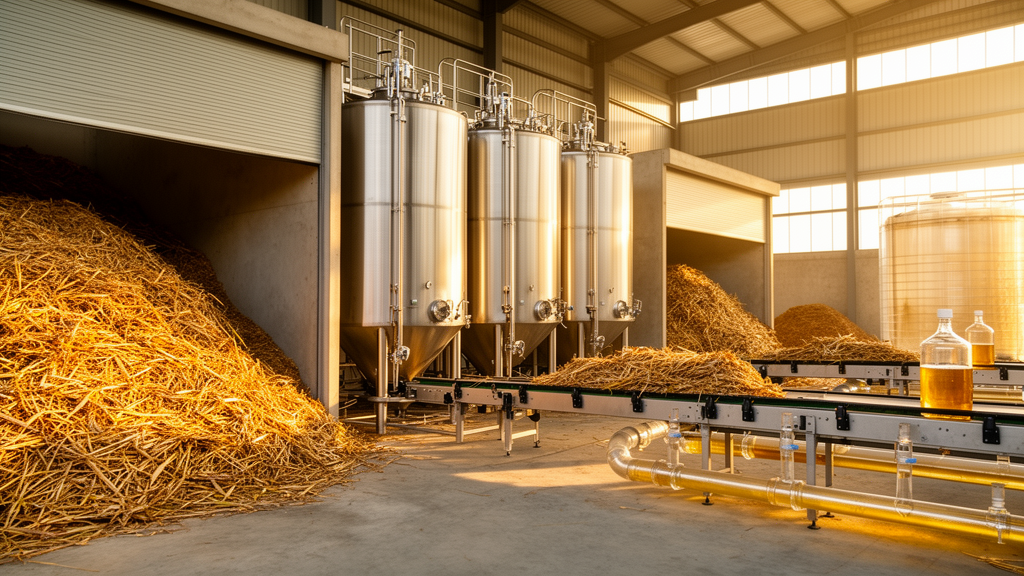
Sugarcane tops, the leafy residue left behind after harvest, are usually burned in the fields of India, polluting the air and wasting a renewable resource. A new open-access study published on 29 December 2025 in Biotechnology for Sustainable Materials reports an integrated, optimized process that converts this agricultural waste into bioethanol, reaching 7.4 grams of ethanol per liter within 24 hours in a 5-liter bioreactor with 97 percent fermentation efficiency.
The feedstock is abundant. Worldwide sugarcane production in 2021 was around 1.9 billion tonnes, of which India contributed roughly 18.4 percent. Sugarcane tops are among the most abundant agricultural residues in India, with each hectare of sugarcane field generating an estimated 7 to 12 tonnes of this residue. About 250 kilograms of sugarcane tops and 140 kilograms of bagasse are produced per tonne of harvested crop, and roughly half of the tops can be collected from the field without depleting soil nutrients. The dried stubble that remains after collection is commonly burned, contributing to greenhouse gas emissions and representing a lost opportunity for renewable fuel production.
Compositionally, raw sugarcane tops contain about 43 percent cellulose, 27 percent hemicellulose, and 19 percent lignin. Because lignin shields cellulose from enzymatic attack, pretreatment is the crucial first step. The researchers first removed water-soluble extractives from 1,000 grams of raw biomass using hot water, yielding 778 grams of extractive-free solid. This material was then subjected to alkaline pretreatment with 10 percent sodium hydroxide and 1 percent boric acid at 60 degrees Celsius for 3 hours, conditions optimized in earlier work. The pretreatment selectively removes lignin while preserving cellulose, improving enzymatic digestibility. The alkaline hydrolysate yielded 265 grams of commercial-grade xylan and 86 grams of lignin as separable co-products, consistent with a biorefinery approach in which every fraction of the biomass finds a use.
The remaining 426 grams of alkali-pretreated sugarcane tops, or apSCT, consisted predominantly of glucose residues, 87 percent by weight, with smaller amounts of xylose, glucuronic acid, and arabinose determined by high-performance liquid chromatography. Enzymatic saccharification, the step that breaks cellulose into fermentable sugars, was then optimized in 20-milliliter bench-scale reactions at pH 4.5 and 45 degrees Celsius using a commercial cellulase from Trichoderma reesei. Four combinations of biomass loading, 3 or 5 percent weight per volume, and enzyme loading, 17.5 or 35 Filter Paper Units per gram of apSCT, were tested over reaction times of 24 to 96 hours, with every experiment run in triplicate.
The winning condition was 3 percent biomass loading with 35 FPU per gram of enzyme, which achieved 67.2 percent cellulose conversion and 18.6 grams per liter of total reducing sugars at 48 hours. Although the 5 percent loading with the same enzyme dose produced slightly more sugar in absolute terms, 19.3 grams per liter, its cellulose conversion was lower, at 41.1 percent, because higher solids loadings caused the buffer to be absorbed by the biomass, forming clumps that impeded mixing and enzyme access. The team notes that raising solids generally increases ethanol titers but reduces yield unless enzyme dosing and mixing are adapted, which is why they deliberately chose the condition with the highest conversion efficiency for scale-up.
Validation at larger scale confirmed the bench results. When 120 grams of apSCT were saccharified in 3.6 liters at the optimized conditions, cellulose conversion reached 68.7 percent with 18.8 grams per liter of total reducing sugars, equivalent to 687 milligrams of sugar per gram of pretreated biomass, closely matching the 672 milligrams per gram obtained at bench scale. Expressed differently, one kilogram of alkali-pretreated sugarcane tops yielded 687 grams of reducing sugar. These values compare favorably with previously reported saccharification yields for sugarcane tops under different pretreatment regimes, which ranged from 216 to 780 milligrams per gram depending on the pretreatment chemistry and enzyme cocktail used.
The fermentation step addressed a well-known bottleneck in lignocellulosic ethanol production: most natural yeasts ferment glucose efficiently but leave the pentose sugars, chiefly xylose, untouched. Rather than relying on genetically modified strains, the researchers assembled a consortium of three yeasts in a 1:1:1 ratio, each at about 10 million colony-forming units per milliliter. Saccharomyces cerevisiae handles hexose fermentation, Pichia stipitis metabolizes pentoses such as xylose and arabinose, and Pachysolen tannophilus can co-ferment both sugar classes. The authors state that this specific tri-culture has not previously been reported for fermentation of sugarcane-top-derived biomass. Co-culture strategies are not without challenges, since glucose can repress xylose utilization through catabolite repression and the strains may have conflicting oxygen requirements, making the empirical optimization reported here particularly relevant.
Bench-scale fermentation was carried out in 20-milliliter flasks using hydrolysate containing 15 grams per liter of total reducing sugars, with sugar loading, nitrogen source, and fermentation time as variables. Without nitrogen supplementation, the consortium produced 7.3 grams per liter of ethanol with 95 percent fermentation efficiency after 96 hours. Adding 1.5 grams per liter of urea raised ethanol slightly to 7.4 grams per liter, while 3 grams per liter of yeast extract proved best, delivering 7.6 grams per liter of ethanol, corresponding to 99 percent fermentation efficiency. At the 5-liter bioreactor scale with a 3-liter working volume, the same conditions produced 7.4 grams per liter of ethanol within just 24 hours and 97 percent fermentation efficiency, prompting the team to terminate the run early to save process costs. Ethanol concentrations were measured by the dichromate colorimetric method throughout.
The complete mass balance traces one kilogram of raw sugarcane tops through the entire chain: 778 grams of extractive-free biomass, 426 grams of apSCT, 288 grams of reducing sugar, and finally 143 grams of ethanol, a total process efficiency of approximately 66.3 percent relative to the theoretical maximum from the 423 grams of cellulose in the original biomass. Every gram of reducing sugar fermented yielded roughly 0.5 grams of ethanol, close to the theoretical limit of 0.511 grams per gram of glucose. The authors emphasize that pretreatment and hydrolysis accounted for most of the losses, while fermentation efficiency above 96 percent showed that the microbial consortium consumed nearly all the sugars released.
The researchers are candid about the limitations. The ethanol titer of 7.4 grams per liter is far below the concentration of at least 4 percent by weight generally required for economically viable distillation, which would demand sugar concentrations of at least 8 percent and lignocellulose loadings of at least 15 percent, well above the sub-10 percent solids used in this proof-of-concept. Future work, they write, should focus on increasing solids content to 15 to 20 percent, exploring fed-batch or simultaneous saccharification and fermentation configurations to mitigate viscosity and inhibition, optimizing enzyme loading, characterizing the rheology of high-solids slurries, and conducting techno-economic assessments. Even so, the study demonstrates that an abundant field residue, currently burned as waste, can be converted to renewable fuel with near-complete sugar utilization, offering sugarcane-growing regions a circular-bioeconomy pathway that simultaneously reduces air pollution and displaces fossil fuels.
Subject of Research: Bioethanol production from alkali-pretreated sugarcane tops using optimized enzymatic saccharification and a three-yeast consortium
Article Title: Bioethanol production from alkali-pretreated sugarcane tops by optimized saccharification and microbial consortium fermentation
Article References: Khaire, K. C., Pathak, P., Moholkar, V. S., Bhardwaj, N. K., & Goyal, A. (2025). Bioethanol production from alkali-pretreated sugarcane tops by optimized saccharification and microbial consortium fermentation. Biotechnology for Sustainable Materials, 2(1), Article 28. https://doi.org/10.1186/s44316-025-00047-w
Image Credits: AI Generated
DOI: 10.1186/s44316-025-00047-w
Keywords: bioethanol, sugarcane tops, alkali pretreatment, enzymatic saccharification, microbial consortium, Saccharomyces cerevisiae, Pichia stipitis, Pachysolen tannophilus, lignocellulosic biomass, fermentation efficiency, biorefinery, agricultural waste
News Source: Gregory Coleman. (October 30, 2026). Yeast Trio Turns Sugarcane Field Waste into Bioethanol at Scale. Scienmag.



