


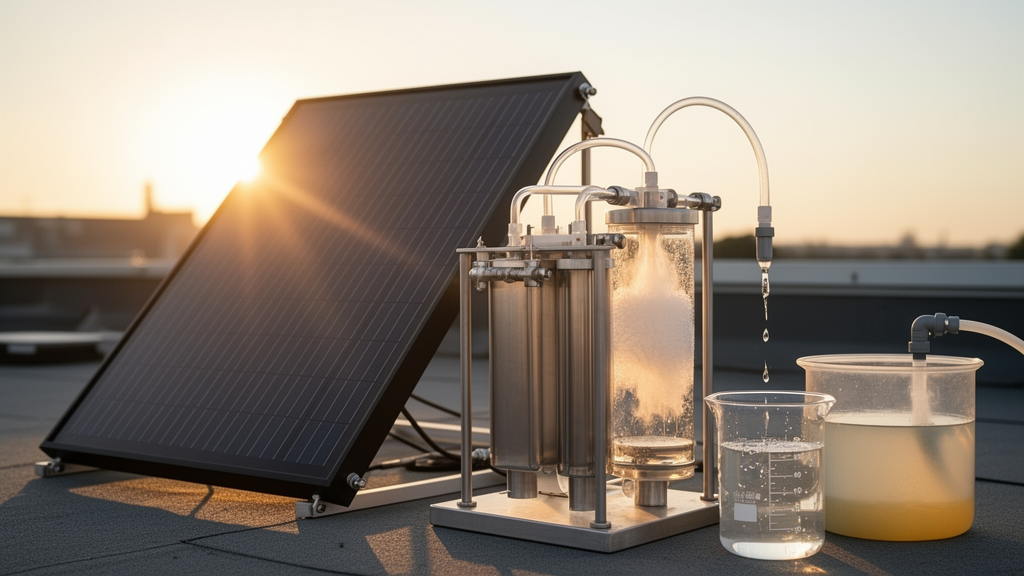
Freshwater scarcity and energy insecurity increasingly arrive together, and nowhere is that pairing more punishing than in remote, arid regions where conventional desalination demands steady electricity, careful brine disposal, and expensive infrastructure. A new open-access review in Discover Applied Sciences argues that solar-powered membrane distillation, or SPMD, could answer that challenge, but only if engineers stop judging the technology by a single flashy number and start designing it as one integrated system. Drawing on 107 studies screened from an initial pool of 612 records, the review maps the path from laboratory promise to deployment readiness, and its verdict is both encouraging and sobering.
Instead of pushing seawater through a membrane at high pressure, MD drives water vapor across a microporous hydrophobic membrane under a vapor-pressure gradient created by a temperature difference. Because evaporation can occur well below the boiling point of water, the process runs happily on low- to moderate-temperature heat, exactly the kind that flat-plate solar collectors, evacuated tubes, solar ponds, or hybrid photovoltaic-thermal systems can supply. Photovoltaic modules, meanwhile, can power the pumps, control units, and vacuum assistance that keep the system running. That thermal compatibility is the core reason the technology attracts so much attention for solar-rich regions.
The review’s central contribution is a configuration-by-configuration assessment of where each MD variant wins and loses. Direct-contact membrane distillation, the simplest arrangement, keeps the membrane touching both hot feed and cold permeate, delivering high flux but suffering the greatest conductive heat loss through the membrane matrix. Air-gap membrane distillation inserts an insulating air layer that slashes conductive losses and boosts thermal efficiency, at the price of slower vapor transport and reduced permeate flux. Permeate-gap variants fill that gap with water instead, raising flux above AGMD levels while keeping thermal resistance between the two extremes. Newer conductive-gap and material-gap concepts attempt to recover internal heat with thermally bridging spacers; under similar operating conditions, a CGMD system can reportedly reach a gained output ratio twice that of a comparable PGMD system, though sensible heat losses may climb toward DCMD levels.
The authors insist that none of these configurations is universally superior. Configuration choice must be application-specific, because each arrangement redistributes mass-transfer resistance, heat loss, and condensation duty differently. Their integrative framework links the collector’s temperature window to the feasible MD configuration, which in turn dictates membrane and module requirements, and finally ties everything to key performance indicators: permeate flux, salt rejection, the temperature polarization coefficient, gained output ratio, specific thermal energy consumption, and levelized cost of water. Judging any SPMD design by flux alone, they warn, is how promising laboratory systems become disappointing field systems.
Collector matching receives equally careful treatment. Flat-plate and evacuated-tube collectors emerge as the most practical options for the low- to moderate-temperature window MD actually needs, while concentrating systems such as parabolic troughs, which operate between 100 and 400 degrees Celsius, only make sense when higher heat input, storage integration, or hybrid power production is the goal. Higher operating temperature is not automatically better, since collector cost, tracking complexity, and module heat loss must be balanced against the extra vapor-pressure driving force. Solar ponds occupy a distinctive niche: they store heat across diurnal and even seasonal cycles, and desalination brine can supply the salt gradient that keeps them stratified, turning a waste product into functional infrastructure.
Membrane materials form the review’s third pillar. PVDF, PTFE, polypropylene, and inorganic or hybrid membranes remain the dominant families, with surface modification and composite design increasingly used to balance flux, fouling resistance, and hydrothermal durability. One highlighted result shows Teflon-coated PVDF in solar-powered DCMD reaching a maximum flux of 45.18 kilograms per square meter per hour with evaporative efficiency near 80 percent under a 75-degree feed and 30-degree permeate. Omniphobic and low-surface-energy membranes look promising for complex feeds, but the authors stress they still need longer durability validation before field deployment. Contact angle alone does not determine performance; pore structure, liquid entry pressure, and surface nanostructure jointly set the accessible operating window.
Module engineering emerges as an underappreciated commercialization variable. Hollow-fiber modules offer high packing density and large membrane area per unit volume, with recent AGMD and water-gap analyses reporting maximum average fluxes of about 24 and 27 kilograms per square meter per hour respectively under optimized conditions. Spiral-wound modules combine high packing density with cost-effectiveness, plate-and-frame designs simplify laboratory maintenance, and tubular modules resist fouling but carry low packing efficiency and high operating expenditure. Across all geometries, spacer design and local hydrodynamics control temperature polarization, and gains in mixing must always be weighed against pressure drop and pumping energy.
The techno-economic analysis delivers the review’s sharpest warning. Solar-powered MD studies report flux under wildly different salinities, irradiance levels, collector areas, storage assumptions, and operating hours, so direct comparison of levelized cost of water values is misleading unless feed condition, capacity, solar fraction, thermal storage, and auxiliary energy are all stated. Cost analyses show LCOW is highly sensitive to capacity, collector area, membrane replacement, and the assumed value of thermal and electrical energy. A system with spectacular laboratory flux can still be unattractive if it demands enormous collector area, unstable thermal storage, high pumping power, or frequent membrane replacement, while moderate-flux AGMD and PGMD systems can become competitive when heat recovery and maintenance requirements cooperate.
The barrier list is long and specific: membrane wetting, scaling, module heat loss, limited membrane lifetime, collector and storage costs, inconsistent reporting of gained output ratio and specific thermal energy consumption, and, above all, scarce long-duration outdoor validation. Pilot-scale evidence illustrates both the promise and the nuance: raising AGMD feed temperature from 50 to 70 degrees Celsius improved thermal efficiency and cut specific thermal energy consumption from 82 to 57 kilowatt-hours per cubic meter, yet higher feed temperature can worsen apparent performance when heat loss to the surroundings outpaces distillate production. Prototype PV/T-coupled systems have sustained outdoor fluxes of roughly 8 to 16 kilograms per square meter per hour, with indoor values of 22 to 30, but storage, intermittency, and balance-of-system losses remain decisive for off-grid use.
The review’s conclusion is a research agenda rather than a victory lap. Future progress, the authors write, should prioritize collector-module co-design, durable omniphobic or low-impact membranes, standardized performance normalization, brine-management strategies, and field demonstrations that report reliability under real solar variability. Multi-hundred- to multi-thousand-hour trials with realistic feed waters are needed before SPMD can be credibly positioned as a field-ready alternative or complement to reverse osmosis and conventional thermal desalination. The technology, in short, has proven it can make clean water from sunlight; the remaining question is whether it can do so, hour after hot, cloudy, interrupted hour, at a cost the world’s driest communities can afford.
Subject of Research: Solar-powered membrane distillation for sustainable desalination
Article Title: Solar powered membrane distillation for sustainable desalination from configuration selection to deployment readiness
Article References: Elma, M., Rahma, A., Zaurida, E. S., Ghani, R. A., Nugroho, A. D., Bilad, M. R., Darmawan, A., Cahyono, G. R., Iqbal, R. M., Lestari, R. A., Fikri, H. N., & Kurniawan, A. (2026). Solar powered membrane distillation for sustainable desalination from configuration selection to deployment readiness. Discover Applied Sciences, 8(11), 1287. https://doi.org/10.1007/s42452-026-09135-6
Image Credits: AI Generated
DOI: 10.1007/s42452-026-09135-6
Keywords: membrane distillation, solar desalination, water scarcity, SPMD, DCMD, AGMD, solar collectors, techno-economic analysis, membrane fouling, desalination technology, renewable energy, water treatment
News Source: Denise Maddox. (October 30, 2026). Solar-Powered Membrane Distillation Moves Closer to Real-World Desalination. Scienmag.



