


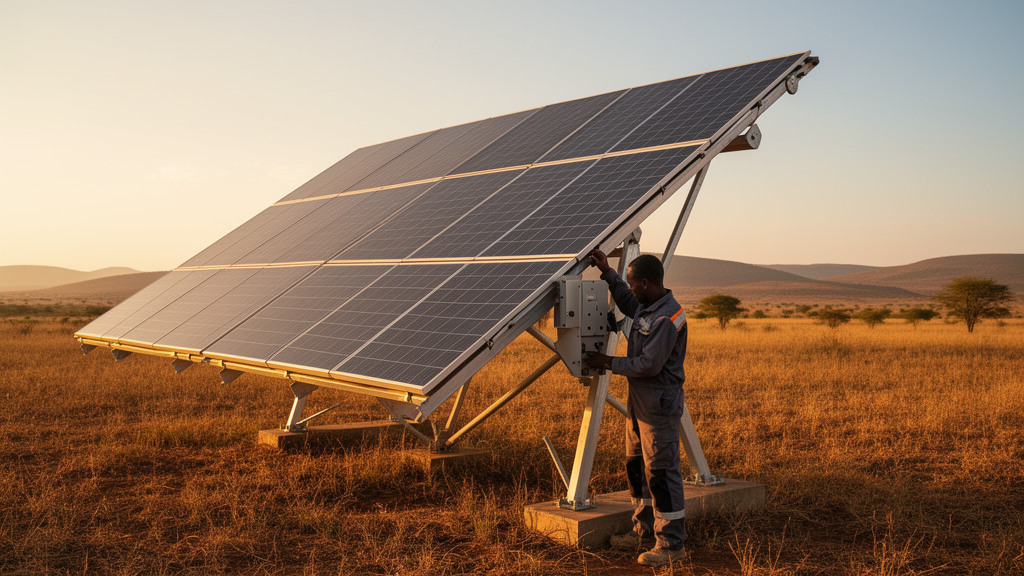
Engineers in Ethiopia have built and field-tested a dual-axis solar tracker that follows the sun using satellite positioning and an inertial sensor instead of the light-dependent resistors found in most low-cost designs, and their prototype harvested roughly 45 percent more energy per day than a fixed-tilt panel over a fifteen-day outdoor campaign. The work, carried out at Bahir Dar Institute of Technology in Bahir Dar, Ethiopia, and published in Discover Energy, describes a complete system built from an Arduino Uno microcontroller, a NEO-7M GPS module, an MPU6050 gyroscope, and two NEMA 17 stepper motors driving a 25-watt monocrystalline panel. The full prototype cost about 14,580 Ethiopian birr, roughly 94 US dollars, a figure the authors argue places the design within reach of the low- and middle-income contexts where conventional trackers remain too expensive or too maintenance-intensive to deploy.
The central problem the researchers set out to solve is the angular mismatch that limits every stationary photovoltaic array. Because the sun’s position relative to a fixed panel changes continuously through the day and across seasons, a fixed-tilt installation spends much of its operating life pointed away from the optimal orientation, and the resulting cosine losses cut directly into energy yield. Dual-axis trackers address this by rotating a panel on two independent axes, azimuth and elevation, to keep the surface nearly perpendicular to incoming radiation. Published studies generally report gains of 30 to 45 percent over static installations and 8 to 15 percent over single-axis trackers, but these systems bring greater mechanical complexity, more actuators, and higher initial and maintenance costs, a trade-off that has slowed adoption in resource-constrained regions.
Existing low-cost trackers mostly fall into two camps, and each carries a distinctive weakness. Light-sensor-based closed-loop systems use pairs of light-dependent resistors to find the brightest direction, but they perform poorly under the dusty, humid, and overcast conditions common in sub-Saharan environments. Purely astronomical open-loop systems compute the sun’s position from location and time, making them weather-independent, but they accumulate mechanical pointing errors because nothing checks where the panel actually is. GPS-only designs lack orientation feedback, GPS-LDR hybrids retain the fragile optical components, and inertial systems corrected by Kalman filtering demand computational resources beyond what an 8-bit ATmega328P microcontroller, with its 32 kilobytes of flash memory and 2 kilobytes of SRAM, can deliver. The Bahir Dar team’s contribution is a closed-loop hybrid that fits entirely on that inexpensive platform.
The architecture works in two layers. The NEO-7M GPS module, which delivers latitude, longitude, and UTC time at one hertz, feeds a solar position algorithm executed on the microcontroller roughly once per second. The algorithm computes reference solar azimuth and elevation angles with sub-degree theoretical accuracy, and because it depends only on orbital mechanics rather than on measured light, it remains stable under cloud cover, dust, or diffuse radiation. In the second layer, the MPU6050 inertial measurement unit samples angular velocity along three axes at 50 hertz, and the firmware numerically integrates those readings to estimate the panel’s actual orientation. The difference between the computed solar reference and the estimated panel angle becomes an error signal, which a proportional correction law with an empirically tuned gain of 0.2 converts into corrected motor targets for the stepper drivers.
Gyroscope integration on cheap MEMS sensors drifts, typically at 0.1 to 1.0 degrees per minute for uncorrected angular rate integration, so the team applied gravity-vector corrections from the accelerometer to partially mitigate cumulative drift, and the periodic SPA-referenced correction pulls the estimate back toward the true solar position. The authors are explicit that this reduces but does not eliminate drift, and that long-term drift behavior over extended outdoor periods has not been fully characterized. Limit switches on both axes prevent over-rotation and define the home position, and micro-stepping at one-sixteenth resolution improves positioning while reducing motor vibration. A worked example from solar noon on September 29 shows the controller correcting a 1.5-degree elevation error and a 1.6-degree azimuth error with motor adjustments of roughly eleven steps.
Tracking accuracy was validated against reference solar positions from the United States Naval Observatory for the Bahir Dar site. Across the fifteen test days, mean signed tracking error was minus 0.53 degrees in elevation and minus 0.32 degrees in azimuth, with maximum absolute deviations of about 2.07 degrees and 5.00 degrees respectively, figures drawn from a representative single-day comparison on September 29. The team also distinguishes these error metrics from a separate statistical quantity, the mean angular position magnitude, which for the dual-axis tracker reflects its broader two-dimensional operating range of 22.67 degrees with a standard deviation of 2.70 degrees, indicating more consistent angular coverage throughout the day rather than larger error.
The energy results came from simultaneous measurement of three collocated systems, the dual-axis tracker, a single-axis tracker, and a fixed-tilt panel, all using identical 25-watt modules of the same age at the same GPS location. Data were recorded from 09:00 to 16:00 local time at five-minute intervals, yielding 84 samples per day, on fifteen test days spanning September 29 to December 14, 2025. Energy was computed by integrating measured power over those samples. On the representative first day, the dual-axis system harvested 180.14 watt-hours against 110.89 watt-hours for the single-axis tracker and 104.63 watt-hours for the fixed panel. Averaged across all fifteen days, the dual-axis tracker improved daily energy yield by 45.53 percent over the fixed installation and 29.12 percent over single-axis tracking, and it frequently operated near the panel’s 25-watt rated output for extended periods.
The tracker’s own energy appetite proved small. Measured under controlled repositioning trials and scaled proportionally, the two stepper motors consumed between 0.0367 watt-hours for three daily movements and 0.952 watt-hours for 78 movements, while the control electronics, the Arduino, GPS module, and gyroscope, drew about 6.8 watt-hours over the eight-hour operating window. Total daily overhead ranged from 6.84 to 7.75 watt-hours, or 3.71 to 4.37 percent of the 177.46 to 184.15 watt-hours harvested, leaving the net gain substantial. An illustrative economic scenario, linearly scaled to a hypothetical 200-watt system with a performance ratio of 0.85 and diesel displacement at 117 birr per liter, suggested annual savings of about 5,218 birr and a base-case payback of roughly 3.1 years, with sensitivity analysis spanning about 2.7 to 4.7 years. The authors stress this is a preliminary illustration, not a validated projection, resting on unverified assumptions of linear scalability, stable fuel prices, and constant irradiance.
Several important caveats frame the findings. Because no calibrated pyranometer was available, irradiance-normalized metrics such as performance ratio or specific yield could not be computed; all comparisons rest on absolute energy yield measured under simultaneous, identical conditions at one site. The validation used a small 25-watt prototype over fifteen days distributed across four months, so seasonal variability, component aging, and year-round performance remain untested. The 3D-printed PETG structural parts were not evaluated for long-term ultraviolet degradation, thermal cycling fatigue, or mechanical creep, and the authors state that extended validation, reliability testing, and comprehensive economic sensitivity analysis are required before any scalable deployment recommendation can be confirmed. Even with those limits, the demonstration that a sub-degree-accurate, weather-independent, closed-loop dual-axis tracker can be assembled from locally available components for under a hundred dollars is a concrete data point for off-grid photovoltaics in low- and middle-income countries, and the team recommends future work on multi-season field trials, fuller environmental monitoring, larger-capacity and networked multi-panel configurations, and advanced sensor-fusion control strategies.
Subject of Research: Design and field validation of a low-cost GPS and gyroscope dual-axis solar tracker in Ethiopia
Article Title: A hybrid cost effective dual axis tracking system for enhanced solar yield in Ethiopia
Article References: Wondafrash, F. T., Nagarajan, S., Fentaw, B. A., Umamaheswaran, S., & Degu, B. B. (2026). A hybrid cost effective dual axis tracking system for enhanced solar yield in Ethiopia. Discover Energy, 6(1), Article 67. https://doi.org/10.1007/s43937-026-00190-z
Image Credits: AI Generated
DOI: 10.1007/s43937-026-00190-z
Keywords: solar tracker, dual-axis tracking, photovoltaics, GPS, gyroscope, MPU6050, Arduino, Ethiopia, Bahir Dar, energy yield, off-grid power, renewable energy
News Source: Faith Mcneil. (October 30, 2026). Low-Cost Dual-Axis Solar Tracker Boosts Energy Yield 45 Percent in Ethiopian Field Tests. Scienmag.



