


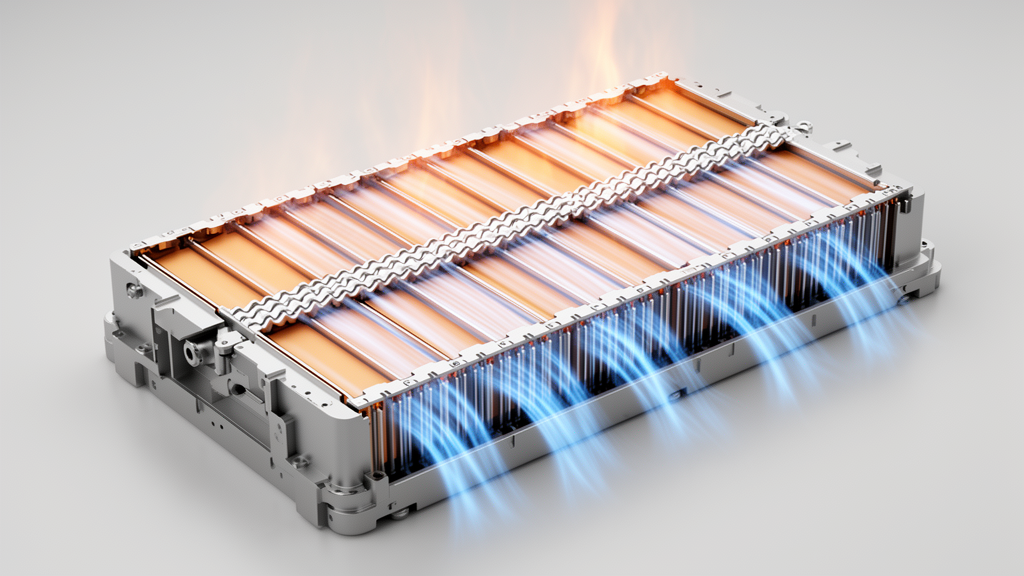
Lithium-ion batteries have transformed how the world stores and moves energy, powering everything from electric cars to grid-scale storage installations. Yet the same electrochemical reactions that make these cells so energy-dense also generate heat, and managing that heat remains one of the central engineering challenges of the electrification era. A new open-access study published in Discover Mechanical Engineering on 19 October 2026 explores a deceptively simple question: how much can the cooling performance of an air-cooled battery pack be improved by reshaping the airflow around the cells? The answer, according to a team of researchers led by Ramesh K. Donga, Aman Aggarwal, Yash Ajay Zankhariya and Gurunadh Velidi, is that a carefully chosen combination of fins and turbulators can measurably lower peak cell temperatures while keeping the energy cost of the cooling system remarkably low.
The research, which is entirely computational rather than experimental, employed three-dimensional numerical simulations to examine the thermohydraulic performance of a finned air-cooled battery module with and without turbulence-inducing features. The modelled battery pack consisted of fifteen cylindrical 18650 lithium-ion cells, the same familiar format found in many consumer and industrial applications, arranged in a T-shaped flow configuration with five rows and three columns. The cells were placed close together with a narrow gap of just one millimetre, a layout chosen to make the pack compact, and forced convection was used to carry heat away. The cooling system comprised an air inlet plenum, the battery cell array, cooling fins, optional turbulators, and an outlet plenum.
Air-based battery thermal management systems, or BTMS, dominate the field for good reasons. Although air has a low heat-carrying capacity compared with liquids, air cooling is popular because of its simplicity, light weight, cost savings, ease of integration and modularity. These systems typically use fans and simple air channels, but they suffer from weak convective heat transfer and non-uniform battery temperatures. That non-uniformity matters: temperature differences between individual cells can cause increased capacity loss and cell aging, batteries degrade at higher temperatures, battery life is reduced, and energy efficiency suffers. Excessive heat generation can even cause irreversible internal damage and lead to catastrophic thermal runaway in practice, making effective thermal management a safety issue as much as a performance one.
The study systematically varied three parameters: the inlet air velocity, which ranged from 2 to 6 metres per second; the number of fins, either two or three; and the presence or absence of turbulators, small internal features that disturb the flow to enhance mixing. The researchers evaluated the effects of these variables on airflow characteristics, temperature distribution, maximum battery temperature and pressure drop. All simulations were performed under steady-state conditions at a fixed discharge rate of 2 C, using a finite-volume-method-based solver in Fluent with a pressure-based coupled solver, second-order upwind discretisation schemes, and the Realizable k-epsilon turbulence model incorporating enhanced wall treatment.
The modelling effort was anchored by a heat generation model that accounted for the three main sources of heat inside a lithium-ion cell: Ohmic heating from internal resistance, electrochemical reactions, and polarisation losses. The irreversible heat was calculated from the square of the current multiplied by the internal resistance, while the reversible heat depended on the battery temperature and an electrochemical coefficient expressed as a function of the state of charge. Boundary conditions were straightforward: the inlet air temperature was fixed at 298.15 kelvin, the outlet was treated as a pressure outlet, and all walls were adiabatic. A mesh independence study showed that variations in temperature difference and pressure difference became negligible after 2.5 million elements, so a mesh of that size was selected to balance accuracy and computational cost, with local refinement near battery surfaces, fins and turbulators to capture steep velocity and temperature gradients.
Validation lent credibility to the numerical approach. The model was benchmarked against the experimental results of Sutheesh and colleagues, and the predicted temperatures showed good agreement with the reference data, with an error below one percent. With that foundation in place, the team turned to the flow field itself. Streamline analysis of the two-fin configuration without turbulators revealed that the airflow was uniformly distributed at the inlet of the airbox but uneven within the pack: flow was low at the centre and high at the sides, because the gap between batteries was smaller than the gap between battery columns. That lower airflow velocity in the inner area of the module produced higher temperatures there compared with the surrounding region.
The temperature distributions confirmed the pattern. For every configuration examined, the middle column of batteries ran hotter than the columns on the left and right, a direct consequence of the reduced airflow in the interior. At an inlet velocity of 2 metres per second, the two-fin configuration without turbulators exhibited the highest maximum temperature and a considerable temperature gradient. Integrating turbulators reduced hot spots and improved temperature uniformity by enhancing flow mixing. The three-fin configuration outperformed the two-fin design because the additional fin increased the heat-transfer surface area. Among all cases, the three-fin configuration with turbulators demonstrated the smallest hotspot region, the most uniform temperature distribution and the lowest maximum temperature.
The numbers behind those qualitative observations are telling. In the absence of turbulators, the maximum temperature was lower by 3.35 kelvin for the three-fin configuration compared with the two-fin design at 2 metres per second. Adding turbulators decreased the maximum temperature by up to 1.68 kelvin for the two-fin configuration and 1.77 kelvin for the three-fin configuration. The largest decrease, 5.2 kelvin, was found for the three-fin configuration with turbulators compared with the two-fin baseline without them. Yet even in that best case, the maximum temperature reached 331.58 kelvin, above the safe operational temperature of the battery, which is why the researchers emphasise that higher inlet velocities are required to push heat transfer further.
At 6 metres per second the picture changed considerably. The temperature contours indicated that the battery pack operated in a thermally well-controlled regime, with the thermal field dominated by cooler regions and only small localised hotspots remaining. The enhanced airflow strengthened forced convection, suppressed thermal accumulation and improved temperature uniformity throughout the pack. But the relative benefit of the geometric enhancements shrank dramatically: without turbulators, the three-fin configuration was only 0.42 kelvin cooler than the two-fin design, and the maximum decrease for the three-fin turbulator case over the two-fin baseline was just 0.64 kelvin. The study’s conclusion section reports that the best configuration achieved a lowest maximum temperature of approximately 316.9 kelvin at 6 metres per second. In other words, fins and turbulators deliver their largest gains precisely where cooling is hardest, at low airflow, while their incremental advantage diminishes as velocity rises.
Pressure drop, the hydraulic price of thermal performance, told a complementary story. Because a higher pressure drop demands more fan power, keeping it low is desirable, yet peak temperature and pressure drop moved in opposite trends across the parameter space. Hydraulic resistance increased monotonically with inlet velocity for all configurations, and adding a third fin increased flow resistance owing to the reduced hydraulic diameter and increased wetted perimeter. The turbulators, however, caused only a marginal increase in pressure loss: the pressure-drop curves with and without turbulators for a fixed fin configuration nearly overlapped at each velocity. This suggests the selected turbulator geometry enhanced thermal mixing while imposing only minor additional hydraulic resistance, a notable contrast with many conventional heat-transfer enhancement techniques, where significant thermal improvements come with substantial pressure-drop penalties.
Weighing the trade-offs, the researchers identified a clear optimum. The three-fin configuration with turbulators achieved the lowest maximum battery temperature while imposing the highest pressure drop, but the additional pressure-drop penalty associated with the turbulators was negligible compared with the thermal benefits obtained. Although the lowest temperatures occurred at 6 metres per second, the incremental temperature reduction beyond 5 metres per second was relatively small compared with the corresponding increase in pressure drop. The team therefore recommends a three-fin configuration with turbulators operating at an inlet velocity of 4 to 5 metres per second as the optimum design, providing an effective balance between thermal management performance and pumping power requirements for lithium-ion battery cooling applications.
The authors are careful to frame the contribution within the existing literature. Substantial progress has been made in battery cooling technology, they note, but research on integrating surface-enhancement techniques such as fins with turbulence-inducing features within compact air-cooled battery modules remains limited. Previous studies have generally focused either on channelised airflow and its associated pressure drop, or on augmenting the heat-transfer surface area in conjunction with the module’s power capability. By combining both strategies in a single T-type airflow configuration and evaluating them across a range of airflow conditions using computational fluid dynamics, this study offers a systematic picture of how fins and turbulators interact. As a numerical investigation, its findings describe simulated behaviour validated against reference data rather than new laboratory measurements, and the steady-state, single-discharge-rate scope leaves room for future experimental confirmation. Still, for designers of lightweight, low-cost battery thermal management systems, the message is concrete: a third fin and a set of well-chosen turbulators, running at a moderate fan speed, can buy meaningful thermal headroom at almost no hydraulic cost.
Subject of Research: Numerical simulation of fin and turbulator configurations in an air-cooled lithium-ion battery thermal management system
Article Title: Numerical Investigation of fin and turbulator configurations for air-cooled lithium-ion battery thermal management
Article References: Donga, R. K., Aggarwal, A., Zankhariya, Y. A., & Velidi, G. (2026). Numerical Investigation of fin and turbulator configurations for air-cooled lithium-ion battery thermal management. Discover Mechanical Engineering, 5(1), Article 198. https://doi.org/10.1007/s44245-026-00385-7
Image Credits: AI Generated
DOI: 10.1007/s44245-026-00385-7
Keywords: lithium-ion batteries, battery thermal management, air cooling, turbulators, fins, computational fluid dynamics, pressure drop, temperature uniformity, electric vehicles, heat transfer, 18650 cells, numerical simulation
News Source: Faith Mcneil. (October 30, 2026). Fins and Turbulators Keep Air-Cooled Battery Packs Cooler in Simulations. Scienmag.



