


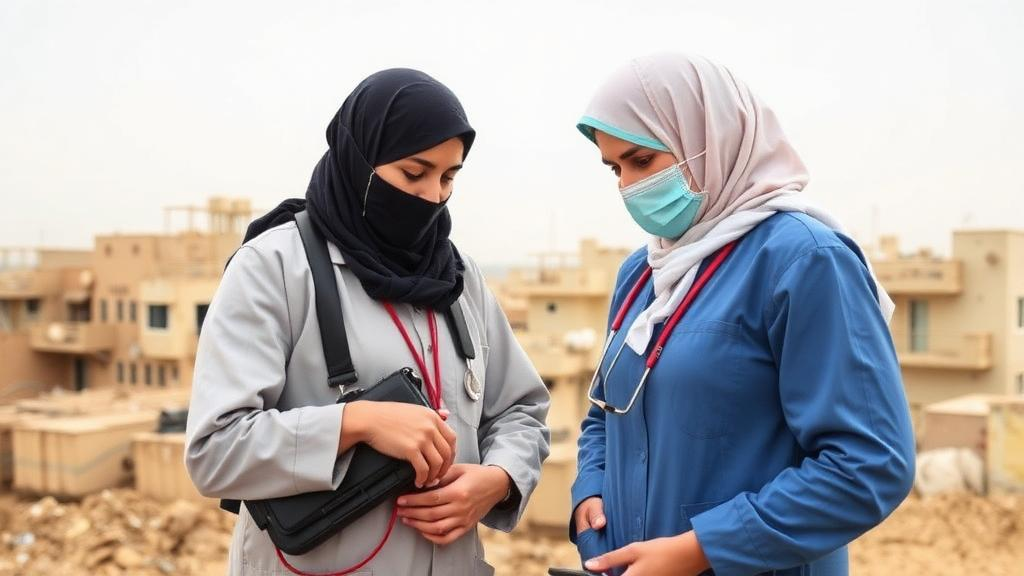
Nurses working in Gaza during the 2023–2025 war reported elevated levels of psychological distress, and a new cross-sectional study finds that the strongest statistical predictors of that distress were not direct exposure to bombardment or displacement, but the accumulating burdens of daily life and the workplace itself. The research, published in the journal Conflict and Health, examined the relative contributions of war exposure, daily-life stressors, and work-related stressors to mental health outcomes among frontline nurses.
The study was conducted between April and June 2025 among a convenience sample of 108 nurses working in Gaza, recruited through professional nursing networks using an electronic structured questionnaire. Psychological distress was measured with the validated Arabic version of the Depression Anxiety Stress Scales, known as the DASS-21, which assesses symptoms of depression, anxiety, and stress. The researchers used descriptive statistics and hierarchical regression analysis to test whether work-related stressors added explanatory power beyond war exposure and daily hardships.
The findings paint a stark picture of life for healthcare workers in the conflict. Ninety-five percent of participating nurses reported experiencing bombardment, and 92 percent reported forced displacement. Daily living hardships were nearly universal, with 97 percent reporting rising food prices, alongside widespread lack of safety. The authors note that systematic attacks on Gaza’s health system, including direct targeting of healthcare infrastructure and workers, have pushed the health system to the brink, leaving nurses facing cumulative and compounding stressors from war exposure and chronic adversities such as repeated displacement, overcrowded and unsafe living conditions, and persistent food insecurity.
Mean DASS-21 scores indicated elevated psychological distress across all three symptom domains. Nurses reported a mean stress score of 15.1 with a standard deviation of 4.1, a mean depression score of 14.6 with a standard deviation of 4.5, and a mean anxiety score of 13.0 with a standard deviation of 5.0.
The regression results are the study’s most consequential contribution. Daily-life stressors explained an additional 17.2 percent of the variance in psychological distress beyond earlier predictors, a statistically significant increment with a change in R-squared of 0.172 and a p-value below .001. Work-related stressors explained a further 9.3 percent of variance, also significant at p below .001. Strikingly, war-related exposure was not significantly associated with psychological distress in the final model, suggesting that once daily hardships and occupational strain were accounted for, direct conflict exposure added no additional explanatory power.
This pattern aligns with a broader body of research on the differential effects of war exposure and daily stressors, but the authors highlight that limited evidence had previously existed on the additional contribution of work-related stressors to psychological distress among frontline healthcare workers.
The authors caution that the study’s design carries important limitations. As a cross-sectional survey using a convenience sample of 108 nurses recruited through professional networks, the findings cannot establish causal relationships between stressors and distress, and the sample may not be representative of all nurses in Gaza. The DASS-21 measures symptoms of depression, anxiety, and stress rather than providing clinical diagnoses. The data were also collected at a single point in time during an ongoing conflict, so the results capture a snapshot rather than trajectories of mental health over the course of the war.
Despite these constraints, the authors argue the findings carry practical implications. Nurses working in Gaza during the ongoing conflict reported elevated levels of psychological distress symptoms, and the results highlight the importance of addressing occupational and daily-life challenges, alongside conflict-related conditions, when developing psychosocial support strategies for healthcare workers in humanitarian and conflict settings. In other words, support programs that focus solely on trauma from direct violence may miss the everyday and workplace pressures that statistically account for the largest shares of distress in this population.
Subject of Research: Mental health of nurses in Gaza during the 2023–2025 war and the relative contributions of war, daily-life, and work-related stressors to psychological distress
Article Title: The impact of war, work, and daily life stressors on the mental health of nurses in Gaza during the 2023–2025 war
Article References: Arafat, F., & Vallières, F. (2026). The impact of war, work, and daily life stressors on the mental health of nurses in Gaza during the 2023–2025 war. Conflict and Health. https://doi.org/10.1186/s13031-026-00822-0
Image Credits: AI Generated
DOI: 10.1186/s13031-026-00822-0
Keywords: Gaza, nurses, mental health, psychological distress, war exposure, work-related stressors, daily-life stressors, DASS-21, cross-sectional study, humanitarian settings, healthcare workers, Conflict and Health
News Source: Glenn Wilkins. (October 30, 2026). Research report: The impact of war, work, and daily life stressors on the mental health of nurses in Gaza during the 2023–2025 war. Scienmag.



