


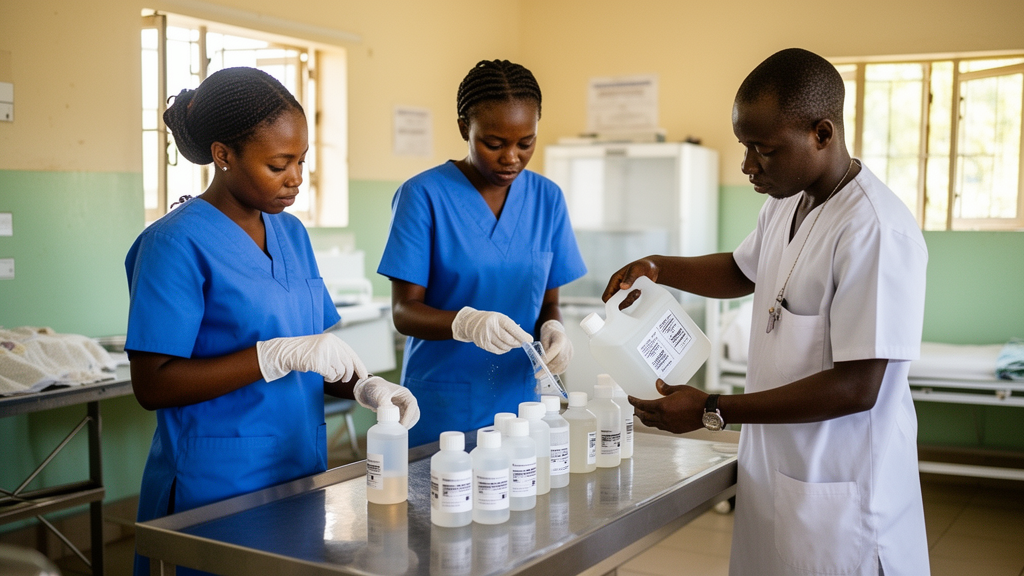
Nurses and medical attendants in selected Tanzanian healthcare facilities scored an average of 3.74 out of 5 on a composite measure of safe chemical disinfectant handling, according to a cross-sectional study published in BMC Public Health. The score, developed from five recommended practices, revealed strong adherence to some safety steps but marked weaknesses in others, particularly the use of complete personal protective equipment and adherence to standard operating procedures.
The study was conducted between April and May 2025 among 290 nurses and medical attendants working in regional referral hospitals, district-level hospitals, and health centers in Tanzania. Participants were recruited using a multistage sampling technique, and data were collected through structured self-administered questionnaires together with a structured observational checklist. The research team, led by Pius Komba and colleagues, used both bivariate analyses and multivariable linear regression to identify factors associated with the disinfectant-handling practice score.
The composite score ranged from 0 to 5 and was built from five recommended practices: appropriate use of all essential personal protective equipment, proper labelling, proper storage, spill and leak management, and adherence to standard operating procedures. Adherence varied considerably across these components. Proper labelling was the strongest performer, reported by 99.66 percent of participants, followed by proper storage at 93.10 percent and spill or leak management at 88.28 percent.
In contrast, only 50.34 percent of participants adhered to standard operating procedures, and just 42.76 percent used all essential personal protective equipment when handling disinfectants. These figures suggest that while basic organizational safeguards such as labelling and storage are widely followed, the practices that most directly protect individual workers from chemical exposure lag behind. Chemical disinfectants are widely used in healthcare facilities for infection prevention and control, and inappropriate handling may increase occupational exposure to chemical-related hazards among healthcare workers.
The analysis identified several factors associated with higher practice scores. Occupational health and safety training was linked to an increase of 0.46 points in the practice score (95% CI: 0.28 to 0.64; p < 0.001), while adequate workplace ventilation was associated with an increase of 0.33 points (95% CI: 0.09 to 0.57; p = 0.007). These associations come from a cross-sectional analysis, so they describe relationships measured at a single point in time rather than established causal effects.
Duration of disinfectant handling also showed a significant association with the practice score. Compared with participants who handled disinfectants for less than one hour per day, those handling them for two to less than four hours per day scored 0.49 points lower (95% CI: −0.80 to −0.19; p = 0.002), and those handling them for four or more hours per day scored 0.45 points lower (95% CI: −0.81 to −0.10; p = 0.012). The pattern suggests that longer daily exposure to disinfectant-handling tasks was associated with poorer adherence to recommended practices.
Work-section was another significant factor. Practice scores were lower in laundry units (β = −1.28; 95% CI: −2.24 to −0.32; p = 0.009) and mortuary units (β = −1.19; 95% CI: −1.71 to −0.67; p < 0.001) compared with other work sections. The authors note that particular attention should be given to supporting units such as laundry and mortuary, where handling practices were weakest.
Based on these findings, the study concludes that disinfectant-handling practices among nurses and medical attendants were associated with occupational health and safety training, workplace ventilation, duration of disinfectant handling, and work-section. The authors recommend that healthcare facilities strengthen occupational health and safety training, improve workplace ventilation, and review work organization to reduce prolonged disinfectant handling. As an analytical cross-sectional study of 290 workers in selected Tanzanian facilities, the findings describe associations within this specific population and setting and do not establish causal relationships or generalize to all healthcare workers.
Subject of Research: Chemical disinfectant-handling practices and associated factors among nurses and medical attendants in Tanzanian healthcare facilities
Article Title: Chemical disinfectant-handling practices and associated factors among nurses and medical attendants in selected healthcare facilities in Tanzania: a cross-sectional study
Article References: Komba, P., Mwakalasya, W., Kishinhi, S., Nyarubeli, I., & Mrema, E. J. (2026). Chemical disinfectant-handling practices and associated factors among nurses and medical attendants in selected healthcare facilities in Tanzania: a cross-sectional study. BMC Public Health. https://doi.org/10.1186/s12889-026-29807-7
Image Credits: AI Generated
DOI: 10.1186/s12889-026-29807-7
Keywords: chemical disinfectants, occupational health, Tanzania, nurses, medical attendants, healthcare facilities, personal protective equipment, cross-sectional study, infection prevention and control, workplace ventilation, standard operating procedures, Chemical
News Source: Ophelia Keating. (October 29, 2026). Tanzanian nurses and medical attendants show uneven disinfectant-handling practices in cross-sectional study. Scienmag.



