Credit: © KU Leuven – Junbin Qian
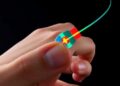
Human cells use a timer to divide: each cell gets at least 30 minutes to divide its genetic material between the nuclei of two daughter cells. Researchers at KU Leuven, Belgium, have unravelled how this timer is switched on and off. Their findings open up perspectives for the treatment of cancer, as keeping the timer going would stop cancer cells from dividing.
Our body is constantly building new tissue and replacing dead or damaged cells through cell division. Skin cells, for instance, only last about a month before they are replaced by newly divided cells. Scientists already knew that cells have a built-in timer ensuring that their division takes at least half an hour. But the underlying mechanism of this timer was still a mystery.
In cell division, it's all about evenly distributing the chromosomes between the daughter cells, says senior author Mathieu Bollen from the KU Leuven Laboratory of Biosignaling & Therapeutics. "First, the chromosomes of a cell are duplicated. Two spindles with so-called microtubules then attach to these chromosomes, allowing the two copies of each chromosome to be separated and pulled into opposite directions. This is how the chromosomes are evenly divided between two new cell nuclei. Then the actual division takes place, creating two daughter cells that are genetically identical to the parent cell."
If everything has gone well, that is. And that's not usually the case right away. "Temporary issues with attachment of microtubules to the replicated chromosomes are common. Sometimes there's a missing link so that a chromosome does not end up in a daughter cell. In other cases, the microtubules pull both copies towards the same daughter cell. The result is a daughter cell with one chromosome too few or too many. These little errors usually cause the cell to die. But they may also speed up the cell division process, as is sometimes the case in cancer cells."
Dr Junbin Qian, the first author of the paper, found that the timer gives cells the time to fix attachment-related problems. "At the start of the cell division process, the biochemical clock starts ticking when a phosphate group is attached to a key protein. About half an hour later, this phosphate group is removed again. All the while, the distribution of the chromosomes is on hold, allowing the cell to add missing links and fix wrong ones."
The timer has potential for cancer therapy, Bollen continues. "You want to prevent cancer cells from dividing and spreading. Some of the current cancer therapies target the microtubules in the cell. One example is the drug Taxol, which is produced from yew clippings. Unfortunately, such drugs are toxic and have many unwanted side-effects. Cancer cells are also building resistance to these substances. Now that we know how the cell division timer works, we can start looking for drugs that keep the timer switched on: this brings cell division to a standstill, eventually causing the cancer cells to die. Together with existing treatment methods, this could form an effective combination therapy, because you'd be attacking the cancer cells on several fronts."
###
Media Contact
Mathieu Bollen
[email protected]
Dr Junbin Qian
[email protected]
@LeuvenU
https://nieuws.kuleuven.be/en?
Original Source
https://nieuws.kuleuven.be/en/content/2017/cell-division-timer http://dx.doi.org/10.1016/j.molcel.2017.10.011