


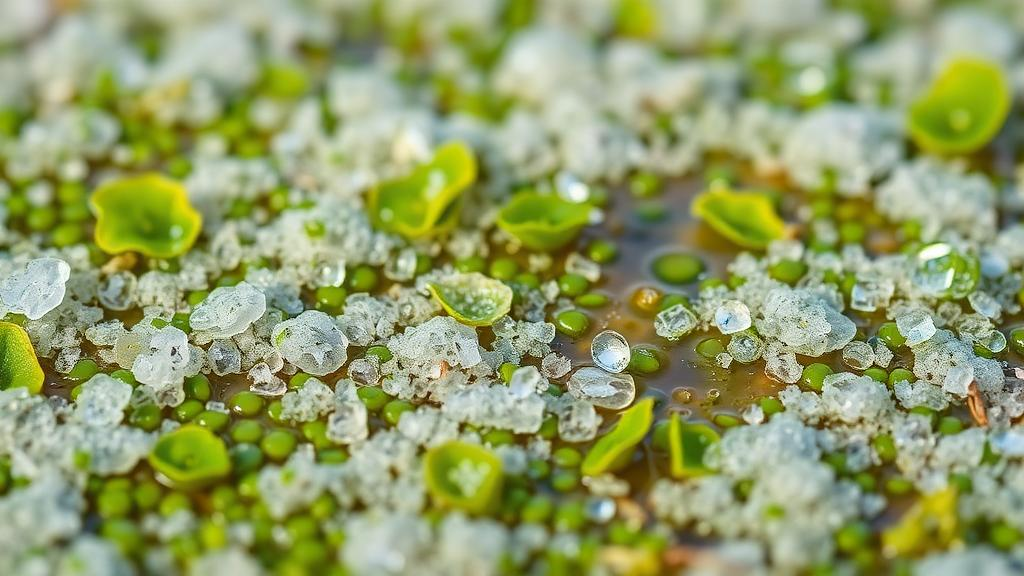
Microalgae can strip tetracycline, one of the world's most widely used antibiotics, out of wastewater while simultaneously building up stores of lipid suitable for biodiesel — and lipid accumulation within their cells peaks when the temperature drops. That is the central finding of a new open-access study published in the journal Carbon Neutrality, in which researchers grew the microalga Parachlorella kessleri R-3 at three temperatures, 15, 25 and 35 degrees Celsius, in the presence of 1 milligram per litre of tetracycline. The work combines growth measurements, metabolomics, transcriptomics and isotope-labelled carbon-flow tracing to explain why cold-stressed, antibiotic-exposed cells become such efficient lipid factories.
The headline number is striking. Under the combined low-temperature and tetracycline treatment, the algae reached a lipid content of 71.25 percent of their biomass, the highest value recorded in the experiment. At the two warmer temperatures, lipid content stayed lower, although tetracycline-treated cells still accumulated more lipid than untreated controls at 25 and 35 degrees Celsius. The boost in lipid content, however, came at a cost: because cold slows growth, the lipid productivity at 15 degrees Celsius with tetracycline was only 55.33 milligrams per litre per day, far below the 431.03 milligrams per litre per day achieved at 25 degrees Celsius, where biomass grew fastest. Low temperature, the authors conclude, favours lipid accumulation within cells but not the overall rate of lipid production per litre.
Growth itself told a temperature-dependent story. After nine days, biomass at 15 degrees Celsius reached only about 0.73 grams per litre in the control, with the tetracycline treatment slightly lower at 0.70 grams per litre. At 35 degrees Celsius, growth surged early and then levelled off, apparently because high temperature eventually impaired enzyme activity, while cultures at 25 degrees Celsius overtook them late in cultivation. Notably, at every temperature, tetracycline at 1 milligram per litre did not significantly reduce biomass compared with untreated controls, suggesting the strain tolerates this concentration well.
The pollutant-removal results are equally important for wastewater engineering. By day nine, the algae had removed tetracycline completely, to below the detection limit, at 25 and 35 degrees Celsius, and still achieved 90.79 percent removal at 15 degrees Celsius. Because the system relies on living, growing cells rather than added chemicals or energy-intensive catalysts, the authors position it as a low-input option for cold regions and seasonal operation, where conventional advanced oxidation or adsorption processes can be costly or generate saturated adsorbents that need disposal.
To understand how the cells coped, the team measured reactive oxygen species and the antioxidant glutathione. Antioxidant enzymes followed the same pattern, with superoxide dismutase reaching 3.57 units under cold tetracycline treatment, and peroxidase and catalase also elevated at 15 degrees Celsius. The authors interpret this as an adaptive stress response: low temperature induces oxidative damage, and the cells answer by ramping up their antioxidant defences rather than showing a large tetracycline-specific toxicity signal.
Metabolomics added a molecular layer to the story. Of 360 differential metabolites identified by ultra-high-performance liquid chromatography mass spectrometry, lipids and lipid-like molecules made up the largest share at 36.4 percent, and principal component analysis showed that temperature, not the antibiotic, was the main driver of metabolic differences, with the first two components explaining 60.1 percent of variance. Under cold tetracycline treatment, the cells strongly up-regulated gamma-aminobutyric acid, nicotinic acid, alanine and gamma-glutamylglutamic acid. Gamma-aminobutyric acid, a known stress-signalling metabolite, appears to help the cells resist abiotic stress by scavenging reactive oxygen species and supporting the tricarboxylic acid cycle.
Transcriptomic data reinforced the lipid-shift picture. The largest set of differential genes, 2,345 in total, appeared at 15 degrees Celsius between control and tetracycline treatments, with 2,214 down-regulated and 131 up-regulated, again pointing to temperature as the dominant determinant of gene expression. Tetracycline treatment up-regulated genes for fatty acid synthesis at all temperatures, including three unigenes encoding acetyl-CoA carboxylase, the rate-limiting enzyme of fatty acid synthesis, as well as malonyl-CoA decarboxylase and, most strongly at low temperature, diacylglycerol acyltransferase, the key enzyme of the final triacylglycerol synthesis step. Fatty acid desaturase expression rose under cold-plus-tetracycline but was highest at 35 degrees Celsius, consistent with its role in adjusting membrane fluidity.
Fuel-quality analysis suggested the cold-produced lipids are commercially relevant. Across treatments, C14-C18 fatty acids made up 75.6 to 95.0 percent of the total, and the calculated degree of unsaturation ranged from 98.3 to 103.8, below the European standard threshold of 137. The cold tetracycline condition yielded the highest cetane number, 61.8, meeting the ASTM D6751 biodiesel specification, an outcome the authors attribute to a favourable balance of saturated and monounsaturated fatty acids under low-temperature stress.
Using 13C isotope labelling, the researchers traced how carbon moves through central metabolism at low temperature. Labelled carbon flowed through glycolysis into pyruvate, then into the tricarboxylic acid cycle as acetyl-CoA, with citrate exported to the cytoplasm and cleaved by ATP-citrate lyase to supply acetyl-CoA for fatty acid synthesis. Carbon flow at low temperature was directed toward the tricarboxylic acid cycle, providing both energy and precursors for lipid production — a mechanistic explanation for why cold-stressed cells funnel photosynthetic carbon into storage lipids rather than carbohydrates or protein.
Finally, the team identified nine putative tetracycline degradation intermediates and proposed three degradation pathways involving dehydration, demethylation, ring opening, decarbonylation and dehydroxylation reactions, with possible roles for cytochrome P450 monooxygenases, dioxygenases and other enzymes, ultimately yielding small molecules such as carbon dioxide and water. The authors caution that the intermediate structures are hypothesised and the pathway assignments preliminary. Even so, the combined picture — near-complete antibiotic removal across a 20-degree temperature span, lipid contents above 70 percent under cold stress, and biodiesel-quality fatty acid profiles — suggests that coupling microalgal wastewater treatment with biofuel production could work reliably even in unfavourable thermal conditions, a conclusion the researchers say supports bioremediation and bioenergy applications in cold regions.
Subject of Research: Microalgae-based tetracycline removal and lipid production for biofuel under different temperatures
Article Title: New mechanistic insights into microalgae biofuel production and tetracycline removal under temperature stress
Article References: Song, X., Kong, F., Liu, B.-F., Song, Q., Tan, X., Ren, N.-Q., & Ren, H.-Y. (2026). New mechanistic insights into microalgae biofuel production and tetracycline removal under temperature stress. Carbon Neutrality, 5(1), Article 17. https://doi.org/10.1007/s43979-026-00167-w
Image Credits: AI Generated
DOI: 10.1007/s43979-026-00167-w
Keywords: microalgae, tetracycline, biodiesel, wastewater treatment, lipid accumulation, temperature stress, metabolomics, transcriptomics, carbon metabolism, bioremediation, Parachlorella kessleri, antioxidant response
News Source: Denise Maddox. (October 29, 2026). Microalgae Turn Antibiotic Pollution Into Biofuel Feedstock Even in the Cold. Scienmag.



