


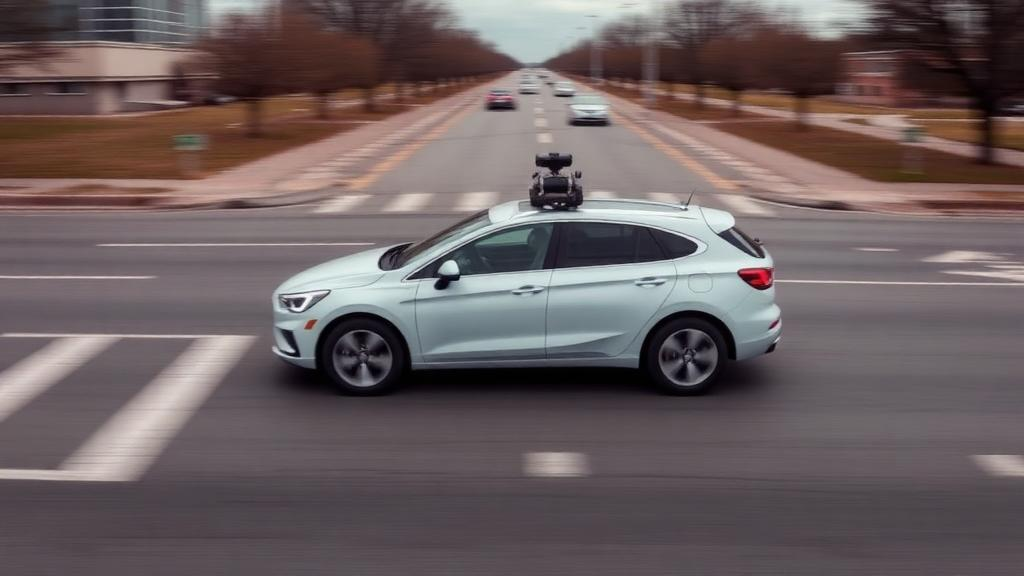
Getting an autonomous vehicle to stay neatly inside its lane sounds like a solved problem, until the road starts to curve, the speed estimate drifts, and the steering actuator stops doing exactly what it was told. A new simulation study tackles exactly this combination, presenting a safety-constrained nonlinear model predictive control (NMPC) approach for lane keeping and lane changing under disturbances. Published in Discover Vehicles, the work by Ali Mahmood and Róbert Szabolcsi demonstrates that a deliberately simple controller, built on a kinematic bicycle model and hardened with explicit safety constraints, can complete curved-road lane changes while keeping a virtual vehicle inside the road at every single simulation step, even when velocity and steering noise are injected into the loop.
The core idea behind model predictive control is straightforward: at every sampling instant, the controller predicts the vehicle’s motion over a finite future horizon, optimizes a sequence of control inputs to minimize tracking error while respecting constraints, applies only the first input, and then repeats the whole process. What distinguishes this formulation is how safety is handled. Rather than treating dangerous quantities as soft penalties in the cost function, the authors impose hard constraints on road boundaries, steering angle, vehicle speed, longitudinal acceleration, and lateral acceleration. In many existing designs, lateral acceleration in particular is managed indirectly through weight tuning, even though it is closely tied to passenger comfort and vehicle stability. Here it is treated as a primary hard constraint, enforced at every step of the prediction horizon.
The prediction model is a nonlinear kinematic bicycle model, a computationally efficient description of vehicle motion that assumes the vehicle sideslip angle is negligible, a standard approximation for moderate-speed path tracking. The model is discretized with a fourth-order Runge–Kutta method, which the authors note provides better prediction accuracy than simple Euler discretization and helps the controller satisfy constraints more reliably across the horizon. The lateral acceleration is computed from the kinematic relation involving speed, wheelbase, and steering angle, and the authors are careful to acknowledge that this is a kinematic approximation rather than the true lateral acceleration of a physical vehicle, where lateral tire forces would add further contributions.
To cope with uncertainty, the controller employs a conservative constraint-tightening strategy. Instead of enforcing the nominal road boundaries directly, the optimizer works with tightened boundaries pulled inward by a lateral safety margin, keeping the predicted trajectory slightly away from the edges of the road. The same philosophy applies to speed and input constraints. The authors are explicit that these margins are fixed design parameters chosen to provide a practical safety buffer, not formally derived disturbance-invariant sets, and that the resulting formulation should not be confused with tube-based robust MPC, which offers formal guarantees on constraint satisfaction and recursive feasibility under bounded disturbances. The present work instead asks a more modest question: is a simpler margin-based tightening strategy sufficient to maintain acceptable safety performance in the scenarios tested?
The test environment is a sinusoidal two-lane road with an amplitude of 3.0 meters and a wavelength of 80.0 meters, giving continuously varying curvature rather than a trivially straight highway. The vehicle operates at a nominal speed of 10 meters per second. The study unfolds in four phases of increasing difficulty: nominal lane keeping, nominal lane change, lane change with a velocity disturbance, and lane change with simultaneous velocity and steering disturbances. The lane-change reference shifts smoothly from the right lane to the left lane over a 40-meter interval using a cubic Hermite smooth-step function that ensures continuity of both the reference trajectory and its slope at the zone boundaries. The same NMPC formulation is used throughout; only the reference trajectory changes between phases.
The results show a clear progression in tracking error as conditions grow harsher. In nominal lane keeping, the peak lateral tracking error stays below 0.05 meters throughout the simulation. During the nominal lane change, the peak error rises to approximately 0.13 meters, reflecting the transient deviation expected when the controller must simultaneously follow the road’s curvature and execute the lateral transition. Under a velocity disturbance modeled as zero-mean Gaussian noise with a standard deviation of 0.10 meters per second, the peak lateral error during the lane-change interval was approximately 0.10 meters for the particular disturbance realization applied, marginally smaller than in the nominal case due to the specific noise sequence used. The most demanding phase, with simultaneous velocity and filtered steering disturbances, saw the peak error grow to approximately 0.25 meters, partly because the actual steering input was clipped whenever necessary to prevent violation of the hard lateral-acceleration limit. In that phase, the controller used a dedicated, more conservative configuration with stronger steering penalties and a tightened internal lateral-acceleration bound. Crucially, road-boundary constraints were satisfied at every simulation step in all four phases.
The authors also confront the practical realities of running constrained nonlinear optimization online. The controller was implemented in CasADi with the IPOPT solver and warm starting, profiled on a laptop with an Intel Core i7-11800H processor. Across 800 control steps, the average solve time ranged from 13.9 to 44.7 milliseconds depending on the phase, well below the 100-millisecond sampling deadline, and 96.9 percent of steps completed within the interval. However, 25 steps exceeded the deadline, with a worst case of 1411.4 milliseconds, concentrated at solver initialization and around the activation of the lane-change reference. The prototype therefore achieves real-time performance on average but does not guarantee hard real-time execution in the worst case; a defined fallback hierarchy handles overruns by applying the last feasible command, clipped to the safety limits, or reverting to a conservative minimal-risk action. Notably, the number of infeasible or failed solver calls was zero across all 800 steps. A horizon-sensitivity study testing prediction horizons from 10 to 30 steps supported the chosen 20-step horizon, corresponding to a 2.0-second preview window, as a suitable balance between accuracy and computational burden, with shorter horizons degrading markedly under dual disturbances.
The authors are unusually candid about the limitations of their study, and these caveats matter for how the results should be read. Each disturbed phase was evaluated for a single realization of the stochastic disturbance process, so the results illustrate closed-loop behavior for the specific noise sequences applied rather than a statistical characterization of robustness across all possible realizations; multi-run Monte Carlo validation is identified as a priority for future work. The kinematic bicycle model omits tire lateral force dynamics, tire-force saturation, load transfer, and road-friction variation, so the conclusions are limited to the moderate-speed regime tested and should not be generalized to high-speed maneuvers, aggressive steering, emergency avoidance, or low-friction surfaces. The tightening margins are fixed design choices rather than formally derived quantities, and the framework provides no formal robust-stability or recursive-feasibility guarantees. The computational statistics, moreover, are specific to the software environment and hardware used for profiling.
Within those boundaries, the study makes a useful point about engineering pragmatism. Formal robust and tube-based MPC methods offer stronger uncertainty-handling guarantees, but they bring additional structure, conservatism, and computational cost. This work suggests that for moderate-speed curved-road maneuvers, an integrated, low-complexity NMPC formulation combining explicit hard constraints, fixed margin-based tightening, and a progressive disturbance evaluation can deliver safe and consistent closed-loop behavior in simulation, trading some tracking accuracy for stronger safety preservation in the most disturbed case. The authors outline a clear path forward: higher-fidelity vehicle models including sideslip and tire dynamics, more diverse road geometries and speeds, Monte Carlo statistical validation, hardware-in-the-loop or vehicle-platform testing, implementation of the infeasibility-handling policy under deliberately challenging conditions, and eventually more advanced robust formulations. Until then, the message is that careful constraint design, rather than elaborate robust architecture, carried a simulated car through every curve and lane change it faced, without ever touching the edge of the road.
Subject of Research: Safety-constrained nonlinear model predictive control for autonomous vehicle lane keeping and lane change under disturbances
Article Title: Safety-constrained NMPC for autonomous vehicle lane keeping and lane change under disturbances
Article References: Mahmood, A., & Szabolcsi, R. (2026). Safety-constrained NMPC for autonomous vehicle lane keeping and lane change under disturbances. Discover Vehicles, 2(1), Article 35. https://doi.org/10.1007/s44465-026-00038-9
Image Credits: AI Generated
DOI: 10.1007/s44465-026-00038-9
Keywords: autonomous vehicles, model predictive control, NMPC, lane keeping, lane change, constraint tightening, kinematic bicycle model, disturbance rejection, vehicle safety, simulation study, lateral acceleration, path tracking
News Source: Denise Maddox. (October 29, 2026). Safety-Constrained Model Predictive Control Keeps a Simulated Autonomous Car in Lane Under Disturbances. Scienmag.



