Credit: Gabriella Luongo
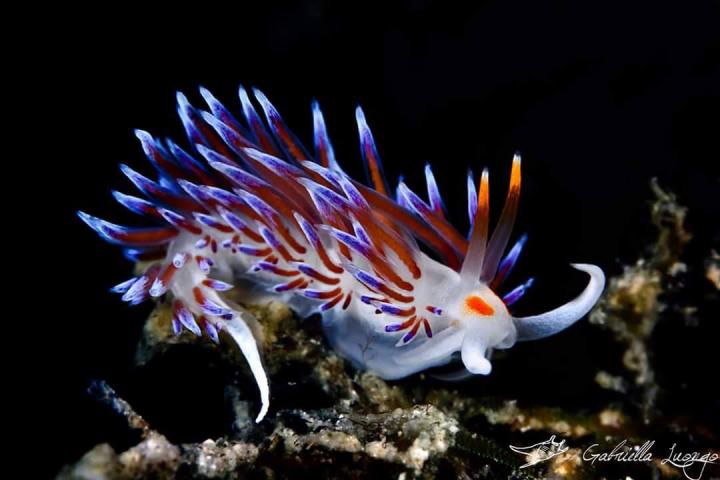
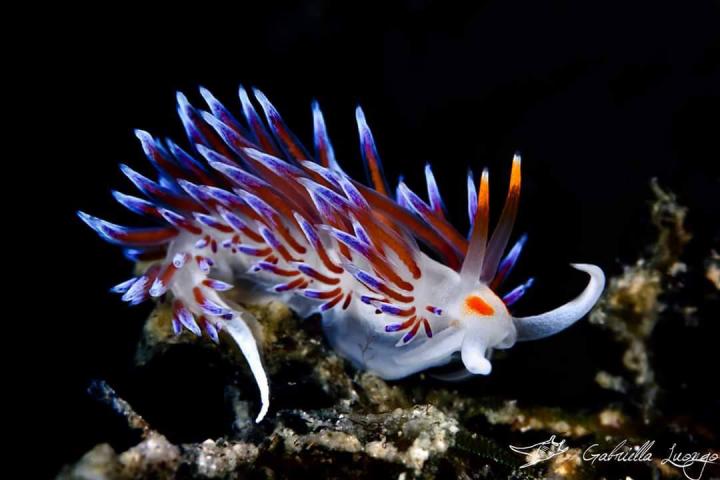
When it comes to feeding time sea slugs are the pirates of the underwater world – attacking prey that have just eaten in order to plunder their target's meal, new research has found.
University of Portsmouth scientists are the first to have observed this cunning and brutal feeding strategy in the natural world and have named the behaviour kleptopredation. Their paper has been published today in the Royal Society journal Biology Letters.
Dr Trevor Willis, a senior lecturer and course leader at the university, led the research into the behaviour of nudibranchs, a family of sea slugs, off the coast of Sicily. He said: "This is very exciting, we have some great results here that rewrite the text book on the way these creatures forage and interact with their environment."
The tiny brightly coloured sea slugs live and feed on hydroid colonies – a super organism, distantly related to corals, which consists of individual polyps that capture and feed on plankton and small crustaceans.
The researchers studying the nudibranch Cratena peregrina found that the creature preferred to eat polyps that had recently dined and that over half of the nudibranch's diet was made up of zooplankton – the prey of the polyp they were consuming. The research showed that the nudibranchs doubled their attack rate on prey that had gorged on zooplankton when compared with hungry counterparts.
Dr Willis said: "Effectively we have a sea slug living near the bottom of the ocean that is using another species as a fishing rod to provide access to plankton that it otherwise wouldn't have.
"People may have heard of kleptoparasitic behaviour – when one species takes food killed by another, like a pack of hyenas driving a lion from its kill for example. This is something else, where the predator consumes both its own prey and that which the prey has captured."
The behaviour is a combination of kleptoparasitic competition and direct predation.
Dr Willis first became curious about nudibranch feeding behaviour while pondering how a species of nudibranch in his native New Zealand seemed to have evolved to live and feed on hydroid colonies at the risk of depleting them.
He said: "There would always be the risk that the food would run out before the nudibranchs could reproduce, which didn't strike me as a particularly intuitive strategy. A colleague in Sicily had data to indicate that there we something going on other than a simple predator-prey relationship."
His research into Cratena peregrina aimed to investigate how the species balanced energy intake with the preservation of habitat.
Dr Willis and his team looked at nitrogen stable isotope levels in the nudibranchs, hydroid polyps and zooplankton, discovering that the nudibranchs had a significantly lower level expected if the polyps were their only prey. This indicated that the hydroid polyp represented a relatively low percentage of the total prey ingested.
The research implies that by consuming fewer hydroid polyps and increasing energy intake from their prey's plankton diet, nudibranchs may extend the life of the hydroid colony on which they live, feed and shelter.
It is not known how widespread this behaviour might be but it is hoped this and future research could contribute to a better understanding of the marine environment.
"Our ability to understand and predict ecosystems in the face of environmental change is impeded by a lack of understanding of trophic linkages," said Dr Willis, but he added there was still a lot to learn from research. "While we have some great results, like any science worth its salt, it raises more questions than it answers."
###
Media Contact
Rachel Jones
[email protected]
0239-284-5350
http://www.port.ac.uk