


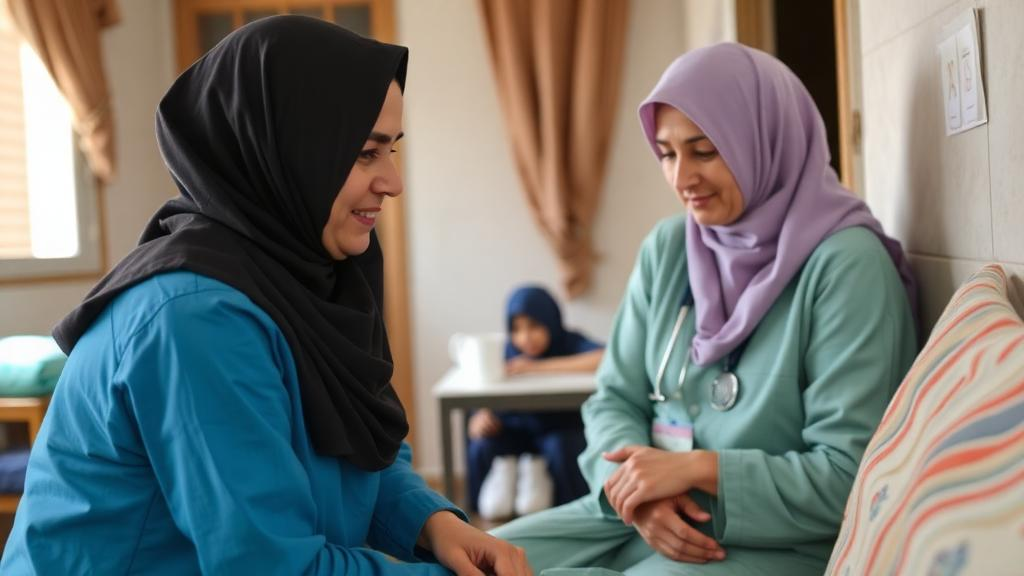
People confined to their homes in dense urban refugee camps face some of the steepest barriers to healthcare anywhere: hazardous infrastructure, scarce transport, and a rising burden of chronic disease. A mixed-methods study published in Conflict and Health reports that a multidisciplinary nurse-led home-based care program operating in the Shatila and Bourj el Barajneh refugee camps in Beirut, Lebanon, was feasible, retained most participants, and was associated with significant improvements in mental health for both patients and their informal caregivers.
The program ran between June 2021 and October 2023 and targeted people with restricted mobility who were homebound or bed-ridden. Researchers analysed routinely collected operational data for 105 patient-caregiver dyads, for which verbal retrospective consent was obtained. To explore how participants experienced the service, the team conducted semi-structured in-depth interviews with a purposive subsample of 16 dyads, corresponding to 32 participants: 16 patients and 16 informal caregivers, who gave written prospective consent.
Quantitative outcomes were analysed for the 79 dyads who completed the full intervention. The program achieved a high retention rate of 82 percent, which the authors present as evidence that the model is operationally feasible and acceptable in a complex humanitarian setting where continuity of care is notoriously difficult to maintain.
The clearest quantitative signal concerned mental health. Enrolment was accompanied by statistically significant reductions in depression, measured with the PHQ-9, and anxiety, measured with the GAD-7, among both patients and caregivers, with both comparisons reaching p < 0.001.
Physical outcomes also moved in a favourable direction. The researchers documented statistically significant gains in physical dependency as measured by the Basic Activities of Daily Living scale, with a p-value of 0.003, alongside documented wound healing and maintenance of high medication adherence among patients receiving the home-based service.
The qualitative interviews suggested that participants valued the program for reasons that extended beyond clinical nursing tasks. Respondents described the service’s primary value as alleviating profound social isolation, restoring dignity, and providing emotional and practical support, elements that participants often prioritized alongside the clinical interventions themselves.
The authors are careful about what the design can and cannot show. Because the study was single-arm, with no comparison group, it precludes definitive causal attribution: the observed improvements in mood, dependency, wounds and adherence are trajectories recorded after enrolment, not effects proven to be caused by the intervention.
Even so, the study addresses a documented gap. People with restricted mobility in humanitarian settings face extreme barriers to healthcare access, which contribute to functional decline, social isolation and significant mental health distress. In Lebanon’s dense urban refugee camps, hazardous infrastructure and a rising burden of non-communicable diseases further exacerbate the vulnerability of homebound individuals and the informal caregivers who look after them.
The conclusion drawn by the research team is that multidisciplinary nurse-led home-based care is a feasible and acceptable model for delivering care to highly vulnerable populations in complex humanitarian settings. They add that, in contexts of chronic distress, the psychosocial and relational components of care appear to be as vital as clinical nursing intervention for fostering resilience in both patients and caregivers.
For humanitarian agencies weighing where to invest scarce resources, the findings suggest that bringing nurses into the homes of the least mobile patients may yield benefits that reach beyond the individual patient to the household members who carry the daily burden of care, though confirming that will require controlled evaluations the present study did not include.
Subject of Research: Feasibility and outcomes of nurse-led home-based care for patients with restricted mobility and their caregivers in Lebanese refugee camps
Article Title: Feasibility and outcomes of nurse-led home-based care (HBC) in refugee settings: a mixed-methods study on improving well-being for patients with restricted mobility and their caregivers
Article References: Soukarieh, D., Elias, J., Moussally, K., El-Hawari, N., Hajj, M., Sawan, C., & Tarantini, F. (2026). Feasibility and outcomes of nurse-led home-based care (HBC) in refugee settings: a mixed-methods study on improving well-being for patients with restricted mobility and their caregivers. Conflict and Health. https://doi.org/10.1186/s13031-026-00845-7
Image Credits: AI Generated
DOI: 10.1186/s13031-026-00845-7
Keywords: refugee health, home-based care, nurse-led care, mental health, caregivers, Lebanon, humanitarian settings, non-communicable diseases, mixed methods, social isolation, Feasibility, outcomes
News Source: Glenn Wilkins. (October 29, 2026). Nurse-led home care eases depression and isolation in Beirut refugee camps. Scienmag.



