


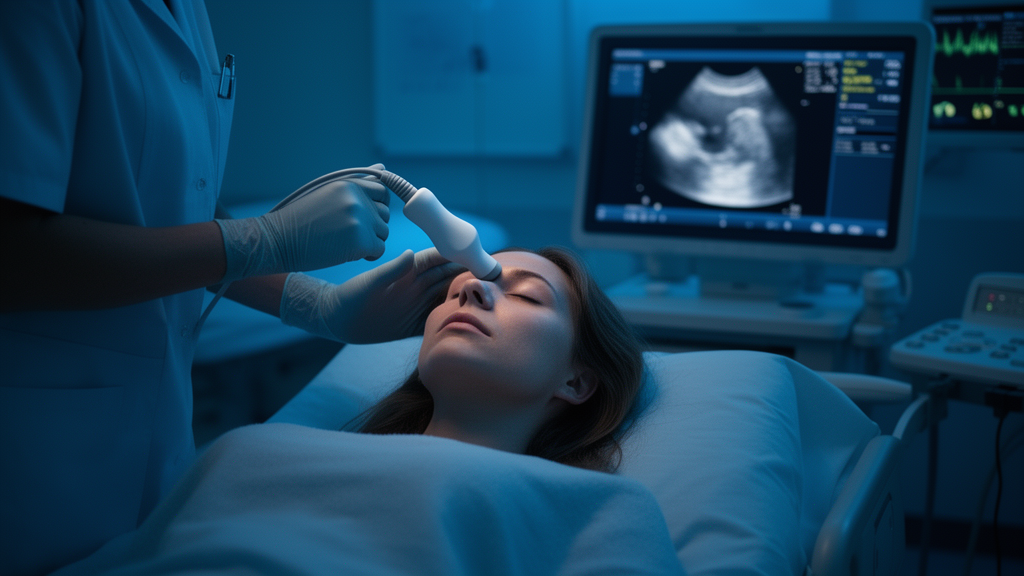
A letter published in the Egyptian Journal of Neurosurgery is prompting clinicians to think more carefully about one of the most promising bedside tools in traumatic brain injury care: measuring the diameter of the optic nerve sheath through the eyelid with ultrasound. Writing in response to a study by Elnokaly and colleagues, researchers Bhoomeeka Jayramdass, Syeda Kashaf Batool Zaidi and Muskan Khalid argue that the technique is genuinely useful, but that two of its most celebrated findings may be being over-interpreted.
The original study evaluated transorbital ultrasonographic measurement of the optic nerve sheath diameter, or ONSD, in adults with traumatic brain injury. The authors reported a strong inverse correlation between ONSD and Glasgow Coma Scale scores, meaning that patients with wider nerve sheaths tended to have lower, more severe scores. They also found a significant reduction in ONSD after surgical intervention. Taken together, these results appear to support the idea that a quick, non-invasive scan of the eye can reveal dangerous pressure building inside the skull.
The letter writers, however, point out a subtle but important logical gap. The correlation between ONSD and Glasgow Coma Scale scores does not, by itself, validate ONSD as a surrogate for intracranial pressure. The two measures describe fundamentally different things: the coma scale reflects a patient’s neurological status, while intracranial pressure is a physiological measurement of hypertension inside the rigid skull. Crucially, in the study in question, intracranial pressure was never directly measured.
This does not mean the technique lacks scientific grounding. Previous meta-analyses have reported that ultrasonographic ONSD can identify raised intracranial pressure when compared against invasive reference standards, although diagnostic performance varies across patient populations and measurement techniques. The letter’s authors acknowledge this evidence base but stress that, in the present study, the ONSD-GCS correlation supports an association with neurological severity rather than established validity against actual pressure readings.
The second concern is more quantitative and, arguably, more surprising. In the surgical subgroup of the original study, mean bilateral ONSD decreased from 5.86 to 5.16 millimetres after surgery, a difference of 0.70 millimetres. That figure sounds meaningful, but its interpretation depends heavily on how precisely the measurement can be repeated. If the inherent noise of the technique is large, a change of that size could reflect measurement variability rather than a genuine physiological response to decompression.
The reproducibility data cited in the letter are eye-opening. A systematic review reported intraobserver standard errors of measurement ranging from 0.10 to 0.41 millimetres, and interobserver values from 0.14 to 0.42 millimetres. Minimal detectable differences ranged from 0.28 to 1.1 millimetres for single observers and 0.40 to 1.1 millimetres for multiple observers. More recently, Pansell and colleagues reported minimal detectable changes of 0.47 to 0.87 millimetres in patients with acute brain injury, with approximately 0.5 millimetres representing a detectable change beyond measurement error for their bilateral mean ONSD technique.
Because Elnokaly and colleagues did not determine the measurement error or the minimal detectable change for their own acquisition protocol, the letter concludes that the clinical significance of the 0.70-millimetre postoperative reduction remains uncertain. In other words, the change sits in a range where, depending on the protocol, it may or may not exceed the noise floor of the method itself.
The letter also addresses measurement consistency in the original study. The authors attempted to improve reliability by obtaining repeated bilateral measurements with two trained neurosurgeons, applying a 5 percent coefficient-of-variation threshold as quality control. The responders note that this threshold provided quality control but did not quantify interobserver agreement. International consensus recommendations emphasize standardized acquisition and measurement procedures for ONSD ultrasonography, reflecting how much technical consistency matters in both clinical practice and research. A formal reliability measure, such as an intraclass correlation coefficient with appropriate confidence intervals, would have added valuable information about the protocol’s reproducibility.
The overall verdict is balanced rather than dismissive. The letter’s authors describe the original work as prospective evidence that bedside ONSD measurement is feasible and associated with neurological status in adult traumatic brain injury.
The path forward, the letter suggests, is methodological rather than conceptual. Future studies incorporating invasive intracranial pressure measurements, standardized ONSD acquisition, formal reliability estimates and serial within-patient assessments could better define the technique’s clinical role. Until then, the widening and narrowing of the optic nerve sheath should be read as a promising signal of neurological severity, not yet as a validated window onto the pressure inside the skull.
Subject of Research: Optic nerve sheath diameter ultrasound measurement in adult traumatic brain injury and its interpretation as a marker of intracranial pressure
Article Title: Understanding transorbital optic nerve sheath diameter measurements in traumatic brain injury
Article References: Jayramdass, B., Zaidi, S. K. B., & Khalid, M. (2026). Understanding transorbital optic nerve sheath diameter measurements in traumatic brain injury. Egyptian Journal of Neurosurgery, 41(1), Article 168. https://doi.org/10.1186/s41984-026-00678-9
Image Credits: AI Generated
DOI: 10.1186/s41984-026-00678-9
Keywords: traumatic brain injury, optic nerve sheath diameter, transorbital ultrasound, intracranial pressure, Glasgow Coma Scale, measurement reproducibility, minimal detectable change, bedside ultrasonography, neurocritical care, interobserver reliability, Understanding, transorbital
News Source: Cassandra Pierce. (October 29, 2026). Ultrasound Eye Measurement Tracks Brain Injury Severity, But ICP Validity Remains Unproven. Scienmag.



