


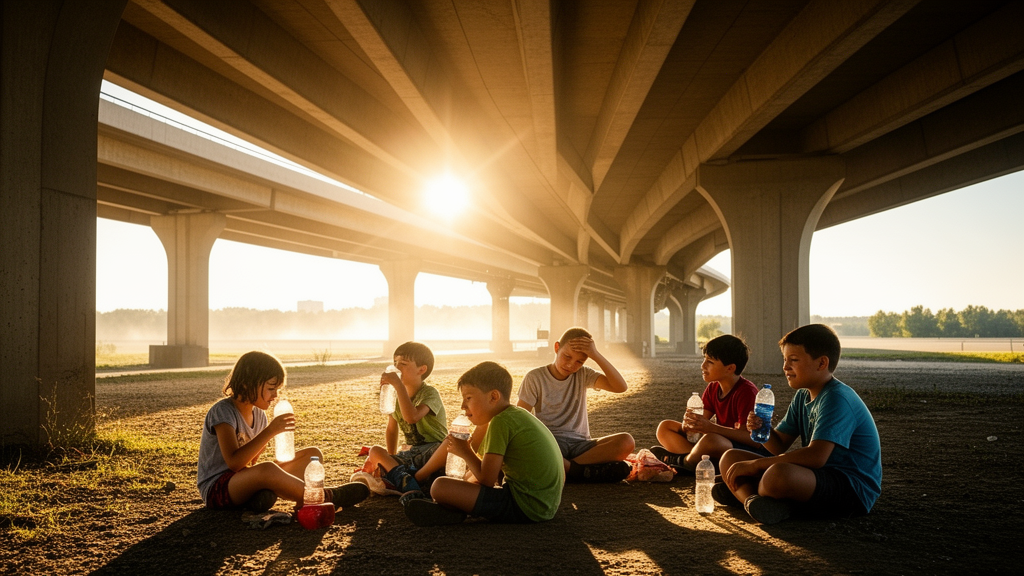
Beneath the concrete decks of two busy parks in Guangzhou, researchers spent a summer and a winter measuring something that is easy to overlook: how children’s bodies and their feelings about heat diverge. In a cross-seasonal field investigation published in Architectural Intelligence, a team led by Zhaosong Fang and Xuanbin Qiu recorded air temperature, radiation, humidity and wind alongside tympanic temperature and thermal sensation votes from children under twelve and their accompanying adults. Their central finding is quietly unsettling for anyone who designs or manages outdoor play spaces: in hot-humid summer conditions, children tended to show higher tympanic temperatures than adults at similar reported thermal sensation levels, meaning their subjective warmth may lag behind their physiological heat load.
The study sites were the Sanyuanli Sports Park in Baiyun District and the Nangang River Yuedong Park in Huangpu District, both typical semi-enclosed recreational spaces under overpasses. Bridge clearance heights ran roughly five to six metres over deck widths of sixteen to eighteen metres, with reinforced concrete structures and synthetic running-track surfaces. Sky view factors at the central activity areas were around 0.5, indicating strong overhead shading. That shading matters: it blocks direct solar radiation, so the radiant environment under the bridges was dominated by diffuse and longwave radiation from surrounding surfaces rather than sunshine.
Data collection took place in July 2024 and January 2025 using random sampling of park visitors. In summer, 864 questionnaires were distributed and 822 valid responses collected, including 357 from children and 465 from adults. The winter survey yielded 359 valid responses from 432 questionnaires, comprising 190 children and 169 adults. Participants had to be healthy, resident in Guangzhou for at least a year, free of chronic illnesses such as hypertension or cardiovascular disease, and not taking medication affecting thermal perception. Children answered through face-to-face interviews with trained investigators using age-appropriate language, with parents assisting, and a pilot survey refined the wording beforehand.
The measurement protocol combined an SSDZY-1 thermal comfort meter positioned at 1.1 metres beside each participant, recording air temperature, black globe temperature, relative humidity and air velocity, from which mean radiant temperature was calculated. Tympanic temperature was taken with an infrared ear thermometer as a proxy for core body temperature, justified by the tympanic membrane sharing the hypothalamus’s arterial blood supply. Two consecutive readings were averaged, with a third taken if they differed unusually. Questionnaires captured demographic details, clothing insulation and activity over the previous twenty minutes, with metabolic rates matched to ISO 8996 and ASHRAE Standard 55 values. Thermal sensation was reported on a nine-point scale from very cold at minus four to very hot at plus four.
The summer environment was brutal by any standard: average air temperature of 32.6 degrees Celsius peaking at 37.8, relative humidity averaging 71.7 percent and reaching 96.2, intense radiant heat from the surrounding ground and structures, and wind speeds mostly below one metre per second, which would have impeded convective cooling. Winter was a different world, with temperatures averaging 18.3 degrees, dipping to 12.2, and drier air with humidity between 22.7 and 40.8 percent. Under these contrasting conditions, warm-side thermal sensation votes of plus two to plus four accounted for 71.4 percent of children’s summer votes and 60.0 percent of adults’, while in winter neutral votes dominated at 47.0 percent for children and 51.0 percent for adults.
Mann-Whitney U tests confirmed statistically significant differences between the age groups in both seasons, at p below 0.001, though the direction flipped: adults reported significantly stronger heat sensation rankings than children in summer, while children ranked warmer than adults in winter. Regression modelling of grouped mean thermal sensation votes against environmental parameters revealed strikingly strong linear relationships under summer conditions, with coefficients of determination generally between 0.89 and 0.93. Notably, models based on air temperature and mean radiant temperature alone performed as well as or slightly better than composite indices such as PET, SET* and UTCI, with the radiant-temperature models reaching roughly 0.91 for both groups. The authors attribute this to the shaded setting, where radiant temperature tracked air temperature closely, and caution that these relationships should not be assumed to hold in open, sun-exposed spaces.
The physiological measurements told a more nuanced story. In summer, tympanic temperature rose significantly with air temperature and mean radiant temperature for both groups, with children’s response slopes slightly steeper than adults’. Among the composite indices, UTCI showed the strongest association with children’s and adults’ tympanic temperatures under hot-humid summer conditions, and the authors highlight UTCI and SET* as better predictors of children’s physiological responses than PET. In winter, all these relationships weakened dramatically, with coefficients of determination falling as low as 0.12 for adults’ radiant-temperature model, presumably because increased clothing insulation and behavioural adjustment buffer the body from the mild environment.
The most consequential result emerged when sensation and physiology were plotted against each other. In summer, the regression between mean thermal sensation vote and tympanic temperature was strong for both groups, at 0.93 for children and 0.95 for adults, though the authors note that grouping tympanic temperature into 0.1-degree bins and averaging votes inflated these fits by smoothing random variability. Within that relationship, however, sat the mismatch: as sensation climbed toward warm and hot, children carried higher tympanic temperatures than adults reporting the same feelings, and at comparable tympanic temperatures children reported weaker heat sensation. The authors suggest this may indicate a potential thermal risk, since children’s physiological heat strain could increase before they perceive a correspondingly strong urge to seek shade or water.
There is a plausible mechanism rooted in child physiology. Children have a higher surface-area-to-mass ratio, making them more susceptible to heat gain in hot environments, and their sweat gland systems are not fully developed, limiting evaporative heat dissipation. Previous research cited in the paper indicates children show higher rates of core temperature increase and weaker sweat regulation in high-temperature settings. The Guangzhou humidity likely compounds this, since high humidity reduces evaporative cooling efficiency. The authors are careful, however, to frame the finding as a potential mismatch observed in one climatic and architectural context, not a universal clinical conclusion.
The practical implications reach into the emerging field of intelligent architecture. Because conventional comfort models assume users accurately perceive and report their own thermal state, systems that rely on subjective feedback could underestimate children’s heat risk. The authors propose that their regression equations could seed sensor-driven systems in under-bridge parks, computing predicted physiological states in real time and triggering misting, adaptive shading or caregiver alerts before children consciously feel hot. They also flag machine learning approaches as a future avenue for capturing nonlinear interactions. For now, the caveats stand: the models derive from two shaded sites in one subtropical city, within a limited parameter range, and the authors stress that recalibration with local data is needed before extrapolating to other climates, bridge typologies or open, sun-exposed environments.
Subject of Research: Children's thermal perception and physiological responses in shaded urban under-bridge spaces
Article Title: Predictive modeling of children's thermal responses in urban under-bridge microclimates
Article References: Fang, Z., Qiu, X., Liu, J., Wu, W., & Feng, X. (2026). Predictive modeling of children's thermal responses in urban under-bridge microclimates. Architectural Intelligence, 5(1), Article 14. https://doi.org/10.1007/s44223-026-00122-w
Image Credits: AI Generated
DOI: 10.1007/s44223-026-00122-w
Keywords: thermal comfort, children, urban microclimate, under-bridge spaces, Guangzhou, tympanic temperature, thermal sensation vote, UTCI, heat stress, field study, hot-humid climate, regression models
News Source: Denise Maddox. (October 29, 2026). Children Under Bridges Feel Less Heat Than Their Bodies Show. Scienmag.



