


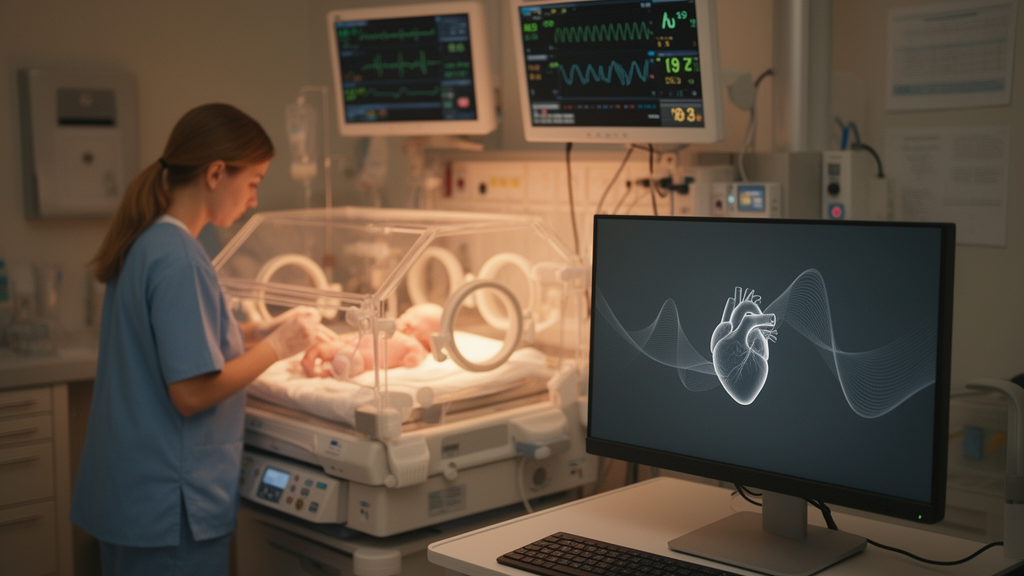
A machine-learning system can predict whether a heart condition in premature babies is severe enough to demand treatment, using only the routine clinical data already collected in intensive care units. The model, developed by researchers in South Korea, reached an area under the curve of 0.829 when tested on very low birth weight infants, according to a study published in Pediatric Research.
When the opening causes significant changes in blood flow, it is called hemodynamically significant PDA, and timely assessment matters for very low birth weight babies in the neonatal intensive care unit. Diagnosing its severity typically relies on echocardiography, which is not always immediately available in every unit.
The team retrospectively analyzed electronic medical record data from VLBW infants with PDA admitted to the Samsung Medical Center NICU between 2013 and 2022. Records of infants with congenital heart disease or missing critical echocardiographic parameters were excluded. The researchers then trained machine-learning models on 85 percent of the dataset and tested them on the remaining 15 percent.
The best-performing model was an algorithm called Extra Trees. On the held-out test set it achieved an AUC of 0.829, with a sensitivity of 0.767, a specificity of 0.766, a positive predictive value of 0.694, and a negative predictive value of 0.825. In practical terms, the model correctly identified most infants with hemodynamically significant PDA while also correctly clearing most infants whose ductus was not causing hemodynamic problems.
A key innovation addresses the fact that an infant’s hemodynamic status can shift over time. For transitional records in which the infant moved between hemodynamic states, the model’s performance dropped, as expected: the AUC was 0.700, with sensitivity of 0.722 and specificity of 0.606. The researchers proposed a transition-optimized threshold specifically to detect these dynamic changes, which they say enables closer monitoring during conservative management, the watchful approach many units take before deciding on intervention.
The study included 1,033 VLBW infants over ten years, and the model requires only 12 hours of routine data to generate its assessment. Because it draws on multimodal clinical data rather than a single test, the authors argue it advances beyond previous work that classified PDA only by binary presence or absence, instead predicting the actual hemodynamic severity.
The researchers suggest the tool could be most valuable in resource-limited NICUs that lack immediate access to echocardiographic expertise, helping clinicians optimize intervention timing and fluid management strategies. They also note it may help clinicians optimize conservative management and improve day-to-day decision-making at the bedside.
Important caveats apply. The analysis was retrospective and conducted at a single center, so performance in other hospitals with different patient populations and documentation practices remains to be demonstrated. The model’s positive predictive value of 0.694 means that a positive prediction would still require confirmation, and the reduced accuracy on transitional records shows the hardest cases, those actively changing state, remain challenging. The authors also state that the datasets are not publicly available due to patient privacy considerations, though they can be requested from the corresponding author.
As with any predictive model trained on historical records, the findings represent associations learned from past care rather than proof that AI-guided monitoring improves infant outcomes. Prospective validation would be needed before such a system could change clinical practice. Still, the study offers a concrete example of how artificial intelligence might support real-time neonatal decision-making using data that intensive care units already collect every day.
Subject of Research: Machine-learning prediction of hemodynamically significant patent ductus arteriosus in premature very low birth weight infants
Article Title: AI-enhanced hemodynamic prediction of patent ductus arteriosus severity in premature infants
Article References: Kim, T., Choi, J., Chung, M. J., Yang, M., Ahn, S. Y., Chang, Y. S., & Sung, S. I. (2026). AI-enhanced hemodynamic prediction of patent ductus arteriosus severity in premature infants. Pediatric Research. https://doi.org/10.1038/s41390-026-05507-1
Image Credits: AI Generated
DOI: 10.1038/s41390-026-05507-1
Keywords: patent ductus arteriosus, premature infants, very low birth weight, artificial intelligence, machine learning, neonatal intensive care, echocardiography, Extra Trees, hemodynamics, clinical prediction, AI-enhanced, hemodynamic
News Source: Harold Sullivan. (October 29, 2026). AI model predicts heart defect severity in premature infants from routine NICU data. Scienmag.



