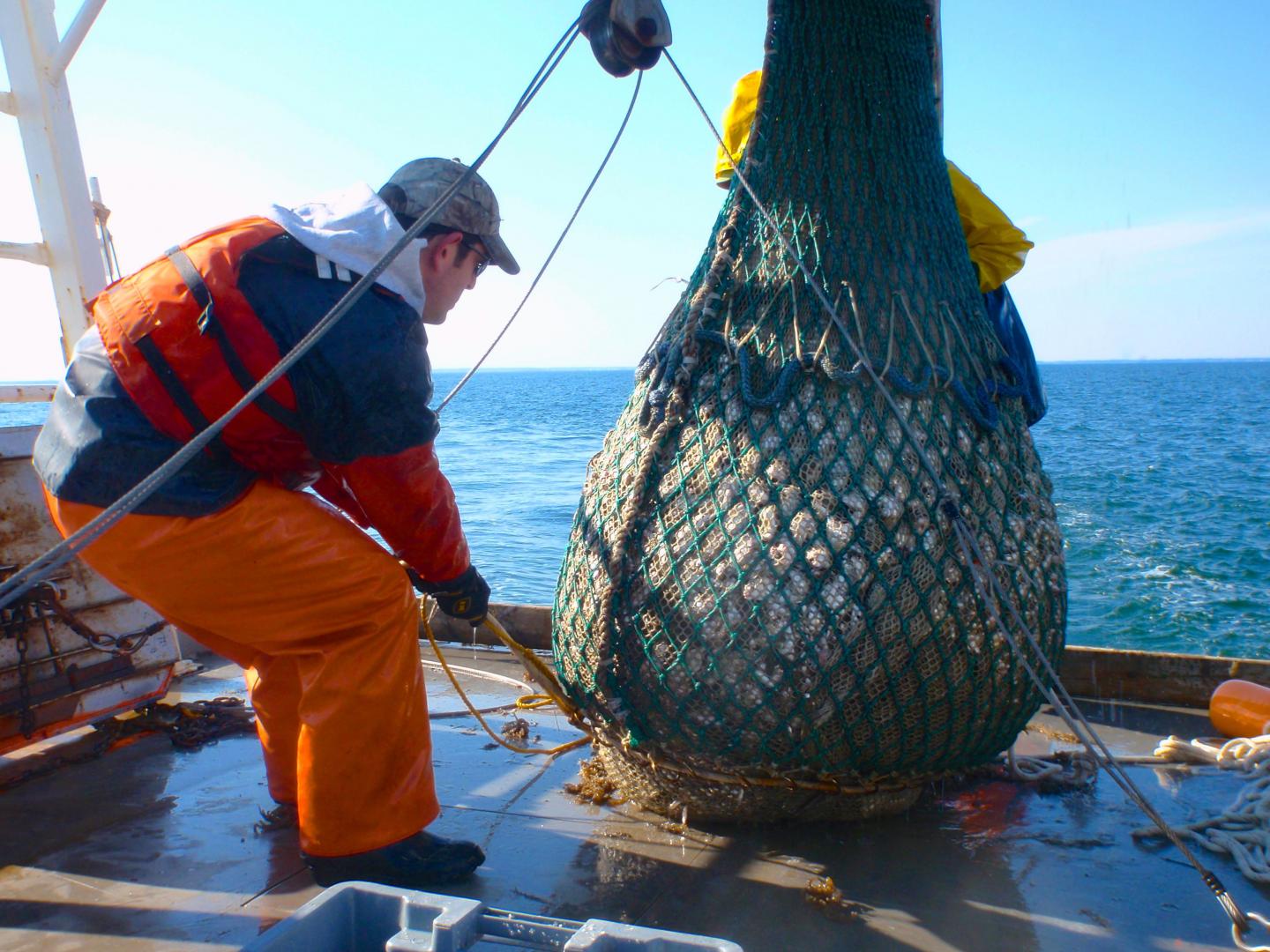
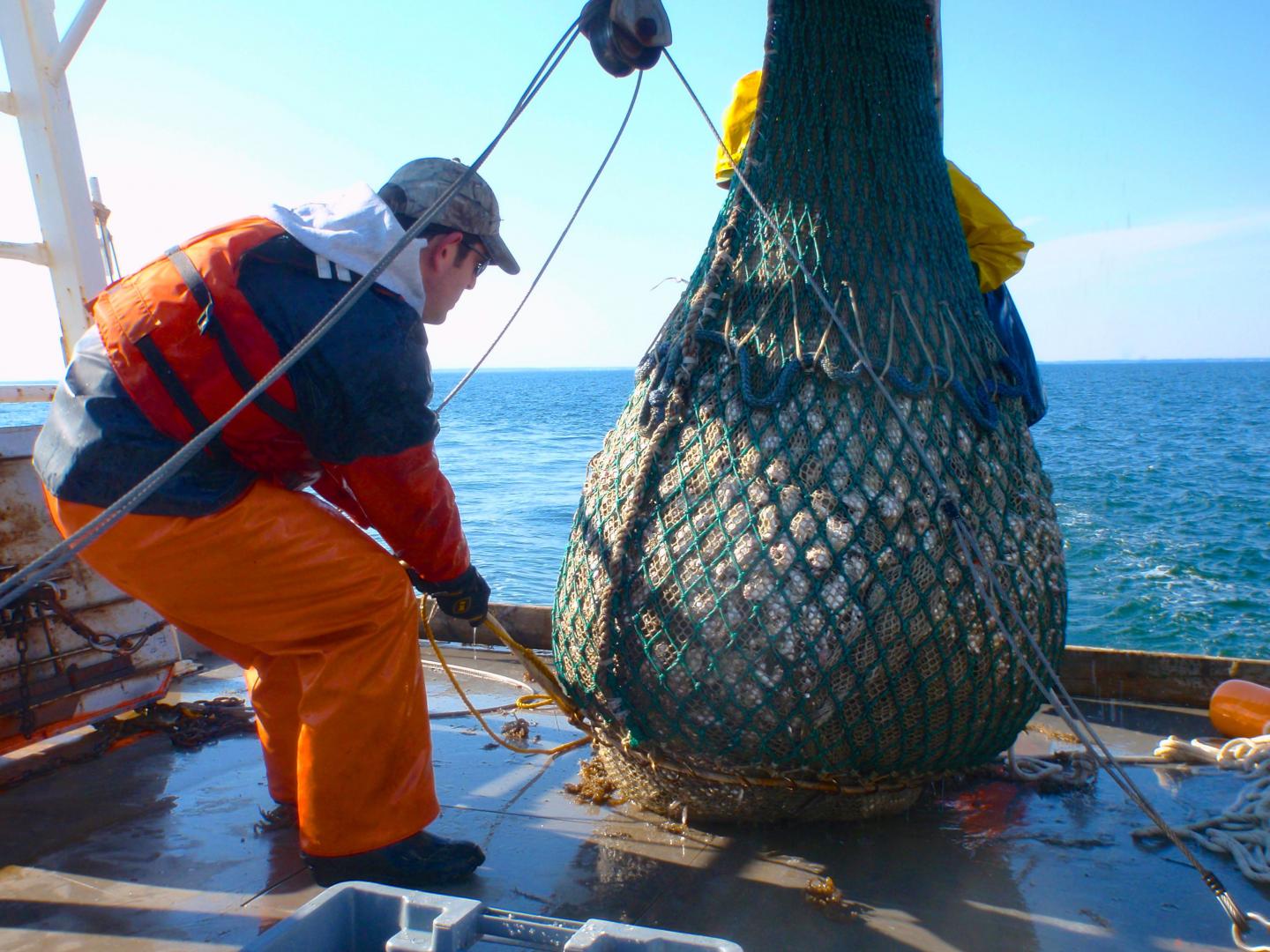
Credit: © ChesMMAP/VIMS.
A major study by researchers at William & Mary's Virginia Institute of Marine Science shows that many diverse species of Chesapeake Bay fishes–whether they eat zooplankton, other fishes, or bottom-dwelling invertebrates–exhibit similar year-to-year trends in a common measure of their overall health.
VIMS Professor Rob Latour says the study provides "useful indicators of fish health at time and space scales appropriate to guide management efforts for the Bay." He co-authored the study–the featured article in a recent issue of Marine Ecology Progress Series–with VIMS colleagues Jim Gartland and Chris Bonzek.
Latour, Gartland, and Bonzek direct and manage the Chesapeake Bay Multispecies Monitoring and Assessment Program, a trawl survey established at VIMS in 2002. Each year, ChesMMAP researchers sample juvenile and adult fishes throughout the Bay during 10- to 15-day cruises conducted every other month from March to November. Their goals are to assess the number, distribution, and seasonal migrations of the Bay's commercially, recreationally, and ecologically important fishes, and to figure out who is eating whom by examining stomach contents for all species sampled.
For the current study, the VIMS' ChesMMAP team calculated an average "condition index" for each year between 2002 and 2015 for 16 common Bay species. They did so by dividing weight by length measurements for thousands of fishes before releasing them back to the water–the greater the weight for a fish of a given length, the higher the index.
"Measures of condition in fishes are somewhat like the body mass index doctors use to gauge human health," says Latour. "We use them to assess the general well-being of a fish because they indicate its energy reserves. At the population level, better condition is associated with increased rates of survival and reproductive success, as well as the ability to withstand fishing pressure."
The team's results show that annual trends in condition index were surprisingly consistent among the species studied, with relatively high values during the early 2000s, lows during the mid-2000s, and a subsequent increase to a peak value in more recent years. "Even though the condition of individual species varied seasonally and from place to place in the Bay," says Latour, "we found that year-to-year trends were remarkably coherent at the community level."
The research team then analyzed how the observed trends in fish condition compared with changes in water quality, food availability, and climatic factors within the Bay. Here, they discovered a significant similarity between condition trends and year-to-year changes in levels of the photosynthetic pigment chlorophyll-a–which scientists often use as a measure of the abundance of phytoplankton at the base of food web.
For most of the species studied, this correlation was positive–the more plankton available to boost the food web in a given year, the healthier the fishes. But for two species–striped bass and alewife–the opposite held true. For striped bass the researchers suspect that environmental conditions that yield high levels of chlorophyll-a may also support larger striped bass populations, leading to overcrowding and increased disease; for alewife they suggest that prey abundance in the Bay may peak after adults of this species have already completed their annual migration into coastal waters.
Whether positive or negative, Latour says the correlation between phytoplankton abundance and fish condition suggests that measurement of the latter could provide a useful tool for resource managers. "By identifying a reference level for fish condition–where we would like a species to be in terms of its overall health–we could then use our ChesMMAP data to calculate an annual condition estimate and compare it to the reference to provide insight about Bay health trends and the status of restoration efforts."
Fish condition could thus expand and enhance the suite of indices currently used by federal and state resource managers to monitor and gauge the health of the Bay. These include other biological indices such as the abundance and distribution of underwater grasses and bottom-dwelling invertebrates, and physical indices such as water clarity and levels of dissolved oxygen and nutrients.
Looking forward, Latour and colleagues would like to explore how they might use the wealth of data generated by ChesMMAP to generate other fish-derived indicators of Bay health.
"There are potentially dozens of other indicators that we could use to provide a more multidimensional view of the ecosystem," says Latour. "Mean length, mean weight, maximum weight, changes in the age of maturity, and measures of population density are a few. There's a whole litany of other indicators we could bring into the fold."
###
Media Contact
David Malmquist
[email protected]
804-684-7011
@VIMS_News
http://www.vims.edu
Original Source
http://www.vims.edu/newsandevents/topstories/2017/fish_condition.php http://dx.doi.org/10.3354/meps12280