


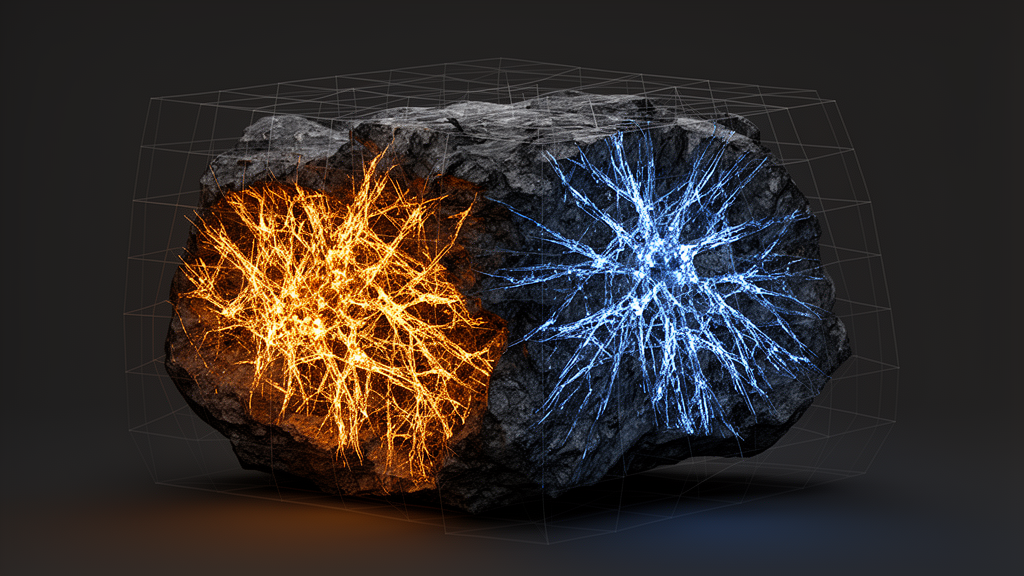
Deep coalbed methane has become an increasingly important target for exploration and development, and large-scale hydraulic fracturing is a key technology for extracting it efficiently. Yet coal is a difficult reservoir to stimulate. The widespread cleat and fracture systems woven through coal seams make fracture propagation far more complex than in conventional rocks, and the horizontal stress differences found in deep seams vary enough to frustrate efforts to control fracture geometry. A new numerical modeling study tackles this problem head-on by simulating how multi-cluster hydraulic fractures grow through fractured deep coal.
Researchers built a fluid–solid coupling hydraulic fracturing model for fractured coal seams using a three-dimensional lattice method, calibrated to the No. 8 coal of the Benxi Formation in the Ordos Basin. The 3D lattice approach allows the model to represent both the fluid injected during fracturing and the mechanical response of the rock, capturing how fractures nucleate, turn, and branch as they interact with pre-existing natural fractures. Using this framework, the team investigated how stress conditions, natural fracture interference, and engineering parameters shape the resulting fracture networks.
The central finding concerns the horizontal stress difference, or HSD, which the study identifies as a critical threshold determining the fracture propagation mode. Under a typical low HSD condition of 4 megapascals, fracture propagation is dominated by natural fracture induction: the growing hydraulic fractures are deflected and diverted by the seam’s natural fracture network, producing high-tortuosity, complex fracture networks. This behavior is fundamentally different from the planar propagation observed under high HSD, where fractures tend to extend as relatively simple, flat planes aligned with the stress field.
That distinction matters for field operations because the two propagation modes imply very different stimulation outcomes. Understanding where a given deep coal seam sits relative to the HSD threshold therefore informs how fracturing treatments should be designed.
On the engineering side, the simulations examined how cluster spacing and cluster number affect the Stimulated Reservoir Area and a fracture uniformity index. Cluster spacing showed a non-monotonic control on stimulation effectiveness: too little spacing allows stress interference between clusters to suppress fracture growth, while too much spacing sacrifices reservoir coverage. The study identified a spacing of 12 meters as the optimal window, balancing interference between adjacent clusters against the need to cover the reservoir adequately.
The number of perforation clusters also proved consequential.
The model integrates the influences of natural fractures and stress interference directly into the fracture propagation framework, which is what allows it to reproduce the transition between network-dominated and planar-dominated growth regimes. By quantifying the effects of horizontal stress difference, cluster number, and cluster spacing on both the stimulated area and fracture uniformity, the study offers a systematic picture of how these variables trade off against one another in deep coal conditions.
The authors position the work as enhancing the understanding of hydraulic fracture propagation mechanisms in deep coal seams and providing a theoretical reference for optimizing fracturing engineering designs. Because the findings come from numerical simulation rather than field trials, they represent model-based predictions for the specific Ordos Basin coal conditions studied, and their transfer to other seams would depend on local stress states and natural fracture characteristics. Still, for an increasingly critical deep CBM play, the identification of a stress-difference threshold and an optimal cluster-spacing window gives engineers a concrete, physically grounded starting point for treatment design.
Subject of Research: Numerical simulation of multi-cluster hydraulic fracture propagation in deep coal seams using a 3D lattice method
Article Title: Numerical simulation study of multi-cluster hydraulic fracture propagation in deep coal seams using the 3D lattice method
Article References: Jiang, S., Song, X., Zhang, J., Ali, S. N., Li, C., & Liu, G. (2026). Numerical simulation study of multi-cluster hydraulic fracture propagation in deep coal seams using the 3D lattice method. Geomechanics and Geophysics for Geo-Energy and Geo-Resources. https://doi.org/10.1007/s40948-026-01253-0
Image Credits: AI Generated
DOI: 10.1007/s40948-026-01253-0
Keywords: hydraulic fracturing, coalbed methane, deep coal seams, 3D lattice method, horizontal stress difference, cluster spacing, natural fractures, fracture propagation, Ordos Basin, stimulated reservoir area, numerical simulation, perforation clusters
News Source: Denise Maddox. (October 29, 2026). 3D Lattice Simulations Reveal How Stress Controls Fracturing in Deep Coal Seams. Scienmag.



