


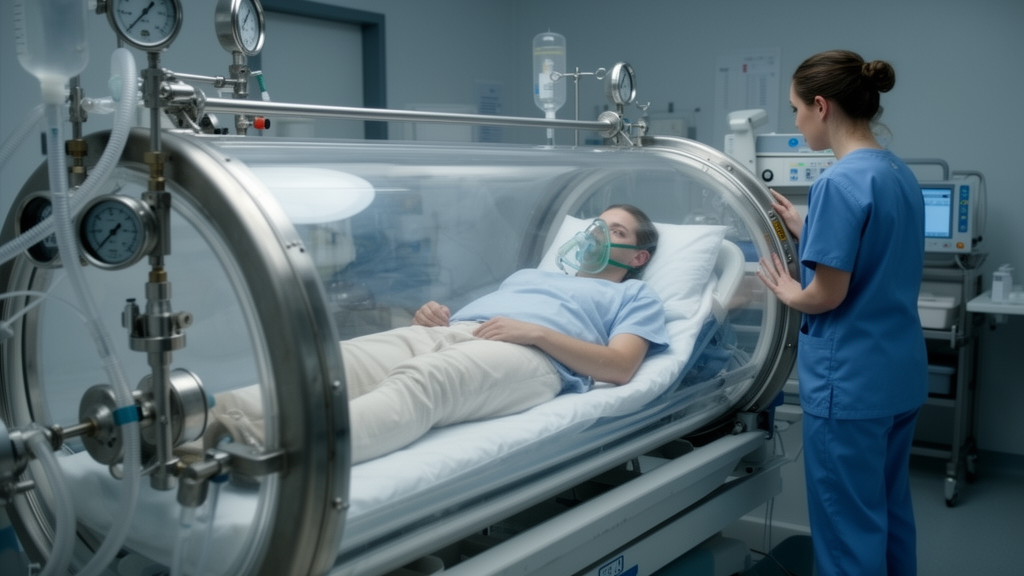
Carboxyhemoglobin, the compound that binds carbon monoxide to hemoglobin and starves tissues of oxygen, may not disappear from the blood at the steady rate that emergency medicine has long assumed. A retrospective study published in BMC Emergency Medicine reports that during normobaric oxygen therapy, the standard treatment for acute carbon monoxide poisoning, elimination slows measurably as time passes, challenging the routine use of a single constant half-life to describe clearance.
The research team, led by Yong Keun Park, Tae-Youn Kim and Je Seop Lee, analyzed records from 159 patients with acute carbon monoxide poisoning who were treated with continuous high-flow normobaric oxygen. To be included, patients needed at least two carboxyhemoglobin measurements and documented uninterrupted oxygen therapy. Using two-point log-linear kinetics, the investigators calculated an apparent elimination rate constant and half-life for each measured interval, then examined how those values changed over time.
The central finding was a consistent slowdown. Two-point interval analysis showed faster carboxyhemoglobin elimination in early intervals than in late ones, and the elimination rate constant decreased as time from rescue increased. The researchers split the data at the two-hour mark after rescue, comparing early intervals of less than two hours with later intervals of two hours or more.
In the primary mixed-effects model, the early-phase slope was −0.725 per hour. After the two-hour point, the slope changed by 0.525 per hour, yielding a late-phase slope of −0.200 per hour. In practical terms, the population-level rate of clearance in the later phase was roughly a quarter of the early-phase rate. A piecewise model capturing this break in slope fit the data better than a mono-exponential model that assumed a single constant elimination rate.
The attenuation held up under scrutiny. The post-two-hour slowdown remained consistent after the researchers adjusted for physiological factors and the source of carbon monoxide exposure, and it persisted across sensitivity analyses. This robustness matters because it suggests the pattern is not an artifact of one subgroup or a particular poisoning scenario, but a population-level feature of how carbon monoxide leaves the blood during oxygen therapy.
The authors offer a physiological rationale grounded in prior experimental work. Carbon monoxide does not remain confined to hemoglobin; it distributes beyond the blood into other body compartments. As the blood burden falls, redistribution and tissue binding may progressively limit how quickly the remaining carboxyhemoglobin can be cleared, producing elimination that is time-dependent rather than constant.
The study’s design imposes important limits on interpretation. Because each patient contributed only two-point measurements, individual biphasic clearance trajectories cannot be established from these data; the biphasic pattern is a population-level observation, not a demonstration that every patient follows the same two-phase curve. The retrospective design also means the analysis reflects recorded clinical measurements rather than a controlled sampling protocol.
The clinical implication is straightforward but cautious. If clearance genuinely attenuates over time, then a single constant half-life may inadequately describe carboxyhemoglobin elimination during normobaric oxygen therapy, and serial carboxyhemoglobin values should be interpreted in relation to how long after rescue each sample was drawn. A blood level measured four hours after rescue cannot be judged against benchmarks derived from the first two hours of treatment.
For emergency clinicians managing carbon monoxide poisoning, the finding adds nuance to a familiar number. Rather than relying on one half-life figure to project when a patient’s carboxyhemoglobin will fall, the study suggests that expected clearance rates should shift downward as elapsed time from rescue increases, with serial measurements timed and interpreted accordingly.
Subject of Research: Time-dependent attenuation of carboxyhemoglobin elimination kinetics during normobaric oxygen therapy for acute carbon monoxide poisoning
Article Title: Non-constant carboxyhemoglobin elimination kinetics during normobaric oxygen therapy in acute carbon monoxide poisoning
Article References: Park, Y. K., Kim, T.-Y., & Lee, J. S. (2026). Non-constant carboxyhemoglobin elimination kinetics during normobaric oxygen therapy in acute carbon monoxide poisoning. BMC Emergency Medicine. https://doi.org/10.1186/s12873-026-01820-4
Image Credits: AI Generated
DOI: 10.1186/s12873-026-01820-4
Keywords: carbon monoxide poisoning, carboxyhemoglobin, normobaric oxygen therapy, elimination kinetics, half-life, emergency medicine, retrospective study, mixed-effects model, toxicology, oxygen therapy, Non-constant, elimination
News Source: Ophelia Keating. (October 29, 2026). Carbon Monoxide Clears Slower Than Expected: Oxygen Therapy Half-Life Falters Over Time. Scienmag.



