


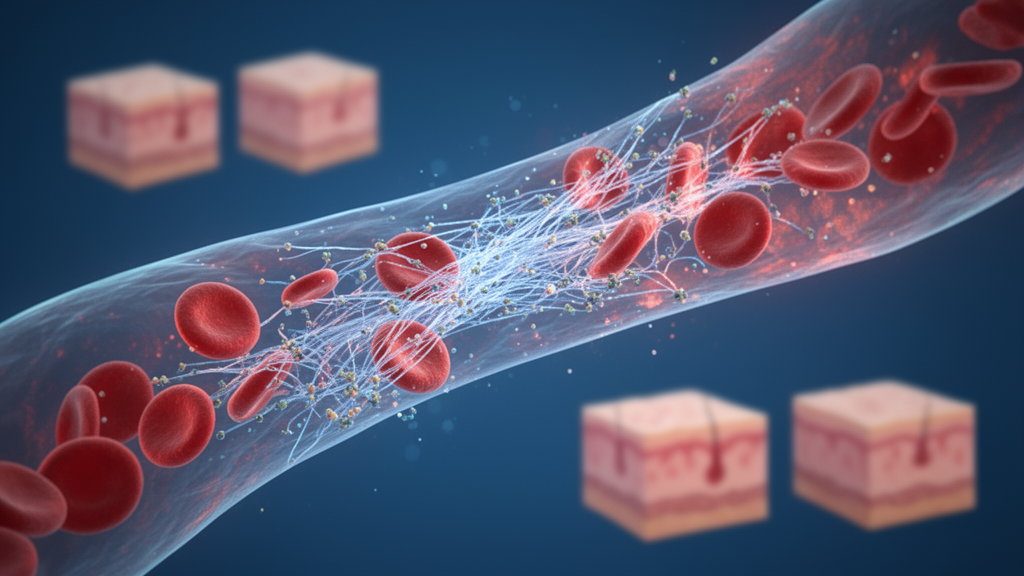
Serum markers linked to neutrophil extracellular traps, web-like DNA structures that neutrophils release as part of innate immunity, vary measurably across four chronic inflammatory skin diseases, according to an exploratory comparative study from researchers at the University of Warmia and Mazury in Olsztyn, Poland. The team compared hidradenitis suppurativa, pyoderma gangrenosum, vitiligo and psoriasis, four dermatoses with distinct immunopathogenic backgrounds, and found that no single NET-associated profile was shared across all of them.
The researchers measured three circulating parameters using ELISA-based assays. Serum MPO–DNA complexes served as remnants of NET formation, peptidylarginine deiminase 4 (PAD-4), an enzyme involved in NET formation, acted as a formation-associated marker, and DNase I concentration, an enzyme that degrades extracellular DNA, served as a NET-related regulatory marker. They also explored associations between these parameters and conventional inflammatory measures, including C-reactive protein and absolute neutrophil counts.
Between-group differences were assessed with the Kruskal–Wallis test followed by post hoc multiple comparisons, and correlations were evaluated using Spearman’s rank correlation with Benjamini–Hochberg false discovery rate correction. The authors explicitly framed the analyses as exploratory and hypothesis-generating rather than confirmatory.
The clearest signal emerged in moderate-to-severe psoriasis. MPO–DNA levels were significantly higher in this group than in healthy controls, and this was the only pairwise MPO–DNA difference that reached statistical significance. PAD-4 levels were also significantly higher in moderate-to-severe psoriasis than in vitiligo, mild psoriasis and healthy controls, while pyoderma gangrenosum showed higher PAD-4 levels than vitiligo.
DNase I followed a different pattern. Concentrations were higher in hidradenitis suppurativa, pyoderma gangrenosum and vitiligo than in selected psoriasis groups and/or healthy controls, suggesting that the regulatory side of NET handling may differ across these conditions rather than simply mirroring NET formation markers.
Correlations between the NET-associated parameters and conventional inflammatory or clinical measures were generally limited, and none remained statistically significant after correction for multiple testing. This indicates that the measured NET remnants did not simply track with CRP or neutrophil counts in these patients.
The authors conclude that circulating NET-associated parameters differed across the chronic inflammatory dermatoses studied, supporting heterogeneous rather than uniform NET-associated profiles. Moderate-to-severe psoriasis was characterized by higher MPO–DNA and PAD-4 relative to healthy controls, whereas hidradenitis suppurativa, pyoderma gangrenosum and vitiligo showed comparatively higher DNase I concentrations in selected between-group comparisons.
Important limitations temper these findings. Circulating surrogate markers cannot directly establish tissue-level NET formation or degradation within the skin, so the results describe blood-borne signatures rather than proven local NET activity. The pairwise differences beyond those noted did not reach statistical significance, and the exploratory design means the findings require replication.
The researchers call for further studies incorporating orthogonal NET-associated markers, functional assays and tissue-level analyses to clarify whether these circulating differences reflect genuine mechanistic distinctions among the diseases or secondary consequences of systemic inflammation.
Subject of Research: Comparative measurement of circulating neutrophil extracellular trap-associated markers in four chronic inflammatory skin diseases
Article Title: Circulating NET-associated parameters across chronic inflammatory skin diseases: a comparative study
Article References: Czerwińska, J., Markiewicz, A., Frączek, A., Kleniewska, M., Kasprowicz-Furmańczyk, M., & Owczarczyk-Saczonek, A. (2026). Circulating NET-associated parameters across chronic inflammatory skin diseases: a comparative study. Frontiers in Medicine, 13, Article 1918335. https://doi.org/10.3389/fmed.2026.1918335
Image Credits: AI Generated
DOI: 10.3389/fmed.2026.1918335
Keywords: neutrophil extracellular traps, psoriasis, hidradenitis suppurativa, pyoderma gangrenosum, vitiligo, PAD-4, DNase I, MPO-DNA complexes, ELISA, inflammatory dermatoses, exploratory study, Circulating
News Source: Ophelia Keating. (October 29, 2026). Blood markers of neutrophil traps differ across four inflammatory skin diseases. Scienmag.



