


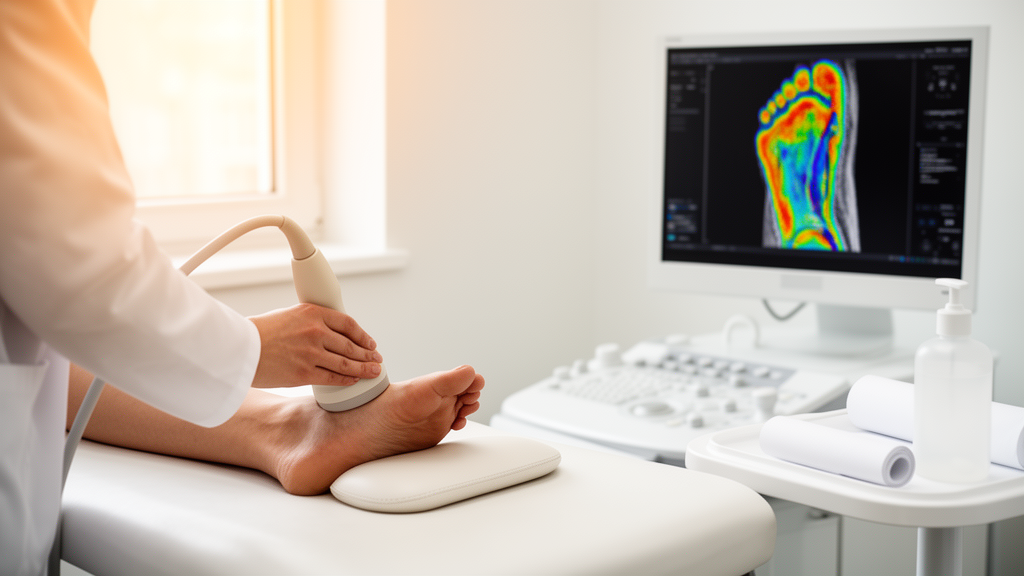
The soft tissues on the sole of the foot do quiet but critical work. With every step, the skin and the fat pad beneath it absorb and distribute mechanical stresses, protecting bone, joint and skin from the full force of body weight. When that cushioning system falters, as it often does in diabetes, the consequences can be severe: foot ulcers that precede the large majority of non-traumatic lower limb amputations. Yet for all the clinical importance of these tissues, researchers and clinicians have lacked a clear answer to a basic question, namely which of the many available measurement techniques actually produces trustworthy numbers. A new systematic review published in BMC Biomedical Engineering set out to settle that question by evaluating the reliability, validity and repeatability of every technique used to quantify the mechanical and morphological properties of plantar foot soft tissues.
The review, conducted according to PRISMA guidelines and registered on PROSPERO, searched MEDLINE, EMBASE and Web of Science from database inception up to April 12th 2025. Two reviewers independently screened 4115 papers, achieving excellent agreement with a Cohen’s kappa of 0.87 during title and abstract screening. Of these, 134 studies evaluated the mechanical or morphological properties of plantar soft tissues, and 37 of those investigated the clinimetric properties of the measurement techniques themselves. Fifteen studies examined mechanical properties such as stiffness and elasticity, sixteen examined morphological properties such as tissue thickness, and six examined both. Because the included studies differed so widely in design, populations and reported outcomes, the authors judged quantitative meta-analysis inappropriate and performed a narrative synthesis instead.
The search identified nine techniques for assessing mechanical properties, including elastography-based methods, indentation systems, the durometer and optical coherence tomography, and six techniques for morphological assessment, including computed tomography, MRI and ultrasound. Reliability was the most frequently reported clinimetric property, assessed in 29 of the 37 studies, and repeatability was reported in 23. Validity, by contrast, was evaluated in only four studies, a scarcity the authors attribute to the methodological difficulty of in-vivo validity testing and, above all, to the absence of an established reference standard for plantar soft tissue mechanics. Without a gold standard against which to compare new instruments, criterion validity remains the weakest link in the evidence base.
The methodological quality of the included studies left considerable room for improvement. Using the COSMIN Risk of Bias tool, the reviewers found that only two studies achieved a Very Good rating for reliability, while the majority were rated Doubtful or Inadequate. Inconsistent statistical approaches, reported in 26 of 37 studies, and doubtful blinding of assessors, also reported in 26 studies, were the most common limitations. Many studies did not calculate intraclass correlation coefficients, the preferred statistic for continuous reliability data, and 20 of the 37 were not primarily designed as clinimetric investigations at all. The authors note that the high proportion of doubtful or inadequate ratings reflects genuine gaps in methodological rigor rather than excessive stringency of the assessment framework.
Among mechanical assessment techniques, only Shear Wave Elastography, or SWE, had both reliability and validity comprehensively investigated. SWE uses ultrasound imaging to track the propagation of shear waves through tissue, converting their speed into quantitative stiffness maps in standardized kilopascal units. The review found excellent intra-rater reliability for SWE, with intraclass correlation coefficients between 0.93 and 0.97, and repeatability expressed as coefficients of variation between 6.1 and 8.8 percent. In the single validity study, SWE correlated strongly with finite element modeling, achieving a coefficient of determination of 0.91. However, the same study revealed a systematic problem: SWE underestimated the shear modulus by 64 percent, with a standard deviation of 16 percent, a bias likely related to tissue anisotropy, probe pressure and boundary condition effects. The authors conclude that SWE findings should be interpreted cautiously until this bias is better characterized.
Compression-based techniques told a more uneven story. The indentometer achieved inter- and intra-rater intraclass correlation coefficients of at least 0.99 and heel repeatability with coefficients of variation below 0.2 percent for displacement, while ultrasound coupled with a load cell exceeded intra-rater ICCs of 0.90 across the hallux, metatarsal heads and heel. The durometer, by contrast, showed intra-rater ICCs ranging from 0.60 to 0.90 and inter-rater ICCs from 0.29 to 0.80 depending on anatomical site, performing poorly in thinner regions such as the hallux and midfoot, and correlating only weakly to moderately with shear wave speed. Magnetic resonance elastography and reverberant shear wave elastography showed promising repeatability, with coefficients of variation between roughly 5 and 10 percent, but each rests on only a small number of studies. Strain elastography lacked any reliability or validity data. The review also notes that compression methods measure gross deformation of the composite fat pad and skin structure without distinguishing individual tissue layers, and cannot capture the time-dependent viscoelastic behaviors of stress-relaxation and creep.
For morphological assessment, ultrasound emerged as the most frequently and comprehensively evaluated technique. Across heel pad studies, intra- and inter-rater reliability ranged from moderate to excellent, with intraclass correlation coefficients between 0.75 and 0.99. Repeatability was generally high, with coefficients of variation between 1 and 3 percent. Validity assessments supported moderate to strong correlations with MRI and radiography, with correlation coefficients between 0.5 and 1.0 against MRI and between 0.847 and 0.880 against radiography. Yet ultrasound is also the most operator-dependent technique in the review. Reliability dropped noticeably under loading conditions: in one study, intra-rater ICCs fell from 0.74 to 0.96 in supine position to 0.49 to 0.75 when standing, and variable repeatability with ICCs of 0.30 to 0.81 was reported for the fifth metatarsal head under load. Small changes in probe positioning, pressure, inclination and the amount of coupling gel applied all influence measurement performance.
The comparison techniques fared variably. MRI demonstrated excellent intra- and inter-rater reliability, with ICCs between 0.976 and 0.991, and repeatability supported by Bland-Altman limits of agreement of plus or minus 0.5 and 0.8 millimeters, and it served as the reference method for validating ultrasound. The authors caution, however, that MRI’s role as a reference rests on its established standing in musculoskeletal imaging rather than on specific validation for plantar foot soft tissues, meaning ultrasound’s good validity against MRI should be understood in light of MRI’s assumed but unverified accuracy in this particular application. CT-based techniques, including spiral X-ray computed tomography and dual-energy CT, were each evaluated in single studies and showed excellent reliability, but radiation exposure limits their feasibility for routine clinical use.
The review’s conclusion is that SWE, for mechanical properties, and ultrasound, for morphological properties, are currently supported by the most consistent and comprehensive clinimetric evidence among the available techniques, making them the most suitable choices for research and clinical practice. That endorsement, however, comes with explicit conditions. Heterogeneity in study design, test conditions, measurement units and analysis methods limited comparisons across studies and techniques, and confidence in the findings remains conditional given the sparse validity testing and widespread methodological limitations. The authors call for standardized measurement protocols covering probe positioning and pressure, coupling medium and foot positioning, alongside consistent statistical reporting of reliability metrics such as ICC, standard error of measurement and limits of agreement. Future research should prioritize multicenter validity studies and direct head-to-head comparisons of elastography techniques under realistic loading, particularly in narrow, high-risk forefoot regions. Such work, the review argues, is an essential prerequisite for integrating quantitative plantar tissue monitoring into clinical care, especially for the people at greatest risk, those living with diabetic foot disease.
Subject of Research: Clinimetric properties of techniques for measuring mechanical and morphological properties of plantar foot soft tissues
Article Title: Quantifying mechanical and morphological properties of plantar foot soft tissues: a systematic review of techniques, methods and their clinimetric properties
Article References: Vicentini, A., Mens, M. A., Malekzadeh, A., van Netten, J. J., Maas, M., & Bus, S. A. (2026). Quantifying mechanical and morphological properties of plantar foot soft tissues: a systematic review of techniques, methods and their clinimetric properties. BMC Biomedical Engineering, 8(1), Article 4. https://doi.org/10.1186/s42490-026-00106-x
Image Credits: AI Generated
DOI: 10.1186/s42490-026-00106-x
Keywords: plantar foot soft tissues, systematic review, shear wave elastography, ultrasound, reliability, validity, diabetic foot disease, COSMIN, tissue stiffness, tissue thickness, MRI, clinimetrics
News Source: Gregory Coleman. (October 29, 2026). Ultrasound and Shear Wave Elastography Lead Review of Foot Tissue Measurement Techniques. Scienmag.



