


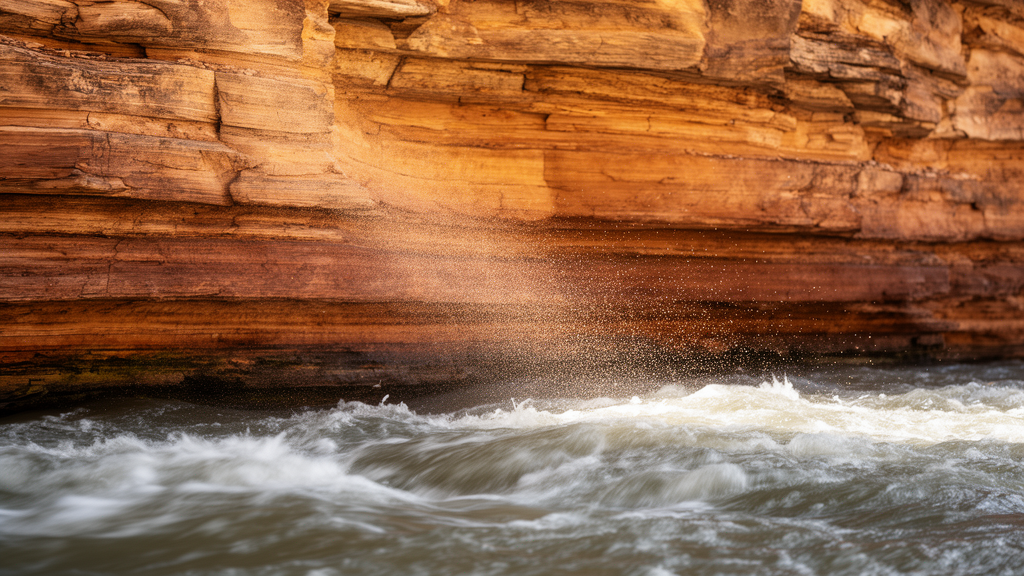
Layered sandstone loses far more of its strength when it is scoured by flowing water than when it simply soaks in still water, according to a new laboratory study published in Geomechanics and Geophysics for Geo-Energy and Geo-Resources.
The team subjected layered sandstone specimens to three treatments: drying in air, immersion in still water, and exposure to flowing water that scoured the rock surface. They then measured how each treatment changed the rock’s mechanical behavior using a combination of techniques that span scales, from the millimeter scale of whole specimens down to the micrometer scale of individual mineral grains.
At the macroscopic scale, the effect of flowing water was dramatic. Compared with dried specimens, the uniaxial compressive strength of layered sandstone dropped by 40.96 percent and its elastic modulus fell by 35.05 percent after hydrodynamic scouring. These two quantities describe how much load the rock can carry before failing and how stiffly it resists deformation, so both reductions point to a substantially weakened material.
The way the rock fractured also changed. Compared with dried specimens, the fracture surface roughness of layered sandstone was reduced by 43.5 percent after hydrodynamic scouring, meaning the broken surfaces became noticeably smoother. Smoother fracture surfaces generally indicate that failure followed weaker, more planar paths through the rock rather than tearing through stronger material.
Bedding planes, the layered internal structures characteristic of sandstone, played a central role in this behavior. Before the specimens reached instability, the relative slipping displacement between the two sides of a bedding plane increased by 240.1 percent under hydrodynamic scouring. In other words, the layers slid past one another far more readily once flowing water had acted on the rock, shifting the failure mode toward slip along bedding rather than fracture through the matrix.
To understand why, the researchers turned to nanoindentation, a technique that presses a microscopic tip into individual mineral grains to measure their local mechanical properties. By combining these micromechanical measurements with a heterogeneity coefficient, the team quantified how water–rock interaction widens the mechanical contrast between the bedding planes and the surrounding rock matrix.
This micro-scale finding offers a mechanistic explanation for the macro-scale observations. As water attacks the minerals, the bedding planes and the matrix degrade at different rates, and the resulting disparity concentrates deformation and slip along the layered interfaces. The evolution of fracture surface roughness, the authors argue, can be traced back to this growing micromechanical heterogeneity.
The study also found that the extent of micromechanical degradation depends on both mineral type and spatial location, meaning that different minerals within the rock respond differently to the same water exposure, and that the damage is not uniform throughout the specimen. By linking micro-mechanical properties, macro-mechanical response, and failure evolution in a single framework, the work delivers on its stated goal of a multiscale analysis.
The practical motivation is significant. Previous studies of water-induced deterioration in layered rock masses focused primarily on hydrostatic immersion, and the mechanism by which flowing water degrades mineral properties and drives rock failure had remained unclear.
The authors present the findings as a new perspective for multiscale analysis in rock mechanics and as a theoretical basis for assessing rock mass stability under flowing water conditions. As with all laboratory studies, the results come from prepared specimens under controlled conditions, and the published version is an early-release, peer-reviewed accepted manuscript that will be replaced by the final version of record. Even so, the message is clear: when water moves through layered sandstone, it does not merely wet the rock—it actively reshapes how the rock fails.
Subject of Research: How flowing water, still water, and drying affect the mechanical strength and failure behavior of layered sandstone at multiple scales.
Article Title: Multiscale mechanical degradation of layered sandstone under different water–rock interactions
Article References: Guan, S., Zhang, K., Bao, R., & Zhang, K. (2026). Multiscale mechanical degradation of layered sandstone under different water–rock interactions. Geomechanics and Geophysics for Geo-Energy and Geo-Resources. https://doi.org/10.1007/s40948-026-01255-y
Image Credits: AI Generated
DOI: 10.1007/s40948-026-01255-y
Keywords: layered sandstone, water-rock interaction, hydrodynamic scouring, uniaxial compressive strength, bedding planes, nanoindentation, fracture surface roughness, elastic modulus, rock mechanics, digital image correlation, bedding plane slip, Multiscale
News Source: Violet Maxwell. (October 29, 2026). Flowing Water Weakens Layered Sandstone More Than Still Water, Study Finds. Scienmag.



