


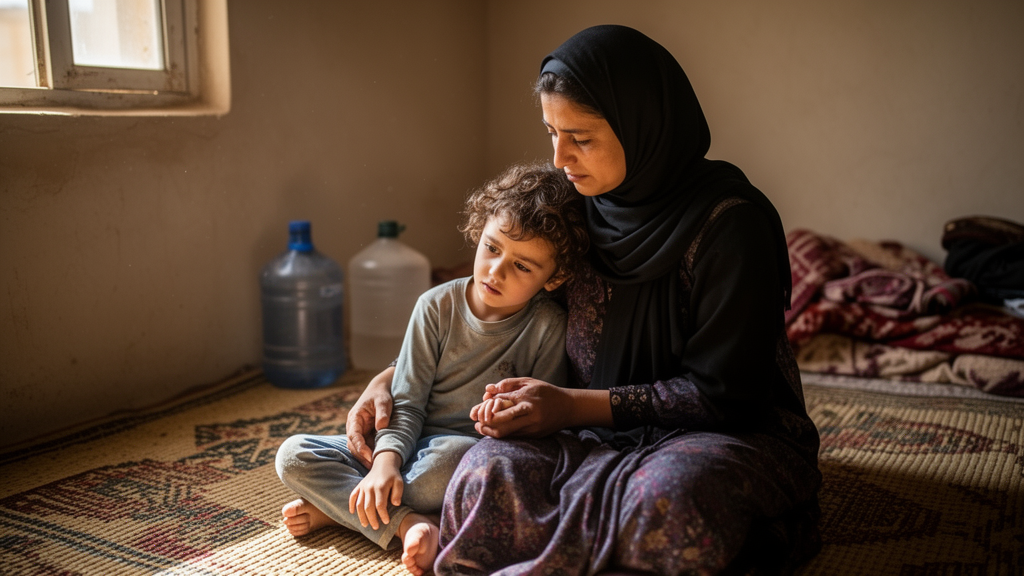
Children in conflict-affected Yemen who show more observable signs of psychological distress also tend to have lower hemoglobin levels, according to a community-based cross-sectional study published in Conflict and Health. The research, which examined 600 children aged 6 to 59 months across ten conflict-affected districts, found that 59.7 percent of the children were anemic, with a mean hemoglobin concentration of 10.2 g/dL.
The study did not rely on psychiatric diagnoses. Instead, researchers used a composite index built from caregiver-reported distress behaviors, drawing on the CPSS-5 and PFC instruments to capture observable behaviors that children display in response to war-related stress. Each standard deviation increase on this distress index was associated with a 0.38 g/dL lower hemoglobin level, with a 95 percent confidence interval of -0.45 to -0.31 g/dL.
The relationship followed a dose-dependent pattern. Children in the highest distress quartile had 2.74-fold higher odds of anemia compared with other children, with a confidence interval of 1.92 to 3.91. The association was not uniform across the population: the effect was stronger among displaced children, where the coefficient was -0.35 compared with -0.23 among non-displaced children, a difference the authors report as statistically significant at p = 0.02.
Food insecurity also appeared to modify the association. Among children experiencing severe food insecurity, the coefficient linking distress to hemoglobin was -0.41, compared with -0.21 among children in less severe circumstances, with a reported p value of 0.01. This pattern suggests that children already facing nutritional stress may be particularly vulnerable to the biological correlates of chronic psychosocial strain.
To investigate a possible biological pathway, the researchers measured high-sensitivity C-reactive protein, a marker of systemic inflammation, alongside hemoglobin. In mediation analysis using bootstrapping, CRP was consistent with a partial statistical mediating role, accounting for 31.6 percent of the total cross-sectional association between distress behaviors and anemia. The authors frame this as evidence consistent with an inflammatory pathway rather than proof of causation.
Latent class analysis added a further dimension to the findings. The technique identified a distinct phenotype, labeled High Distress/High Inflammation, comprising 28 percent of the children. This group had the lowest mean hemoglobin at 9.1 g/dL, and also contained the highest proportions of displaced children, at 78.6 percent, and food-insecure children, at 62.3 percent. The clustering of displacement, food insecurity, elevated inflammation and low hemoglobin within a single subgroup underscores how multiple forms of war-related adversity can converge in the same children.
The study’s design imposes important limits on interpretation. As a cross-sectional investigation, it captures a single point in time and cannot establish that distress behaviors cause anemia, that anemia influences distress, or that unmeasured factors drive both. The authors state this explicitly, noting that causal inference would require longitudinal studies. The reliance on caregiver reports also introduces a potential source of bias: caregiver mental health, which could shape how distress behaviors are reported, was not measured in the study.
The authors conclude that war-related caregiver-reported distress behaviors show a strong, dose-dependent cross-sectional association with childhood anemia, and that displaced and food-insecure children bear disproportionate burdens. They suggest that integrated mental health and nutritional interventions warrant consideration in humanitarian pediatric care, while emphasizing that the correlational nature of the evidence means such programs should be evaluated through appropriately designed studies.
The open-access article, published on 1 October 2026, is currently available as a peer-reviewed accepted version that will be replaced by the final Version of Record.
Subject of Research: Cross-sectional associations between war-related distress behaviors and childhood anemia in conflict-affected Yemen
Article Title: War-related proxy-reported distress behaviors are associated with childhood anemia: cross-sectional evidence consistent with inflammatory pathways in conflict-affected Yemen
Article References: Albani, G. F., Ali, N. T., Saleh, K. A., & Ahmed, W. A. (2026). War-related proxy-reported distress behaviors are associated with childhood anemia: cross-sectional evidence consistent with inflammatory pathways in conflict-affected Yemen. Conflict and Health. https://doi.org/10.1186/s13031-026-00844-8
Image Credits: AI Generated
DOI: 10.1186/s13031-026-00844-8
Keywords: childhood anemia, Yemen, psychosocial stress, inflammation, C-reactive protein, conflict zones, displacement, food insecurity, hemoglobin, cross-sectional study, humanitarian health, mediation analysis
News Source: Courtney Benton. (October 29, 2026). War-related distress behaviors linked to childhood anemia in Yemen study. Scienmag.



