


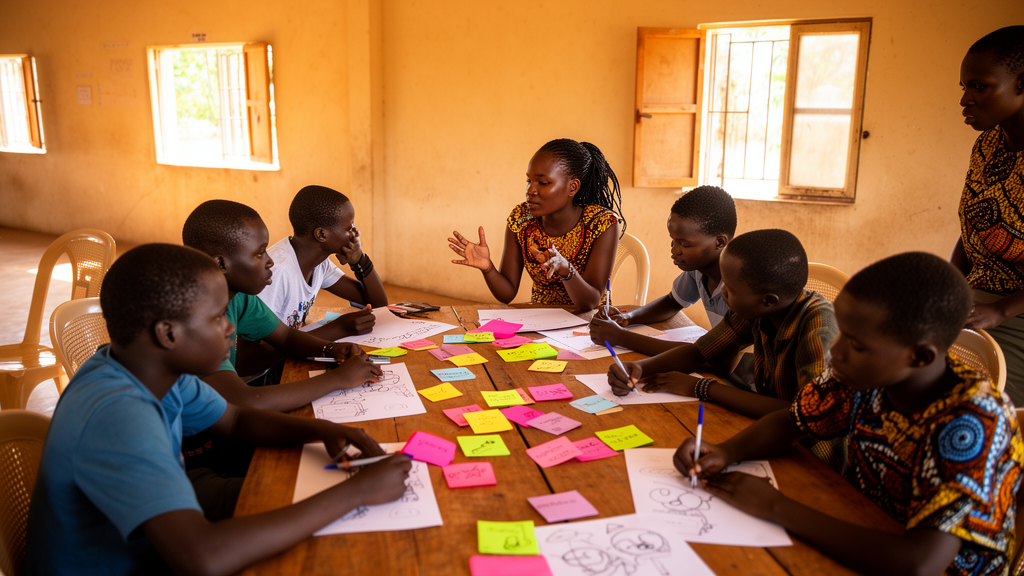
Adolescent and young people’s mental health remains a major public health concern in low-resource settings, where social and structural factors intersect. A new qualitative study from Chamwino, in Tanzania’s Dodoma region, set out to explore the context-specific challenges facing rural youth and to develop feasible, youth-driven solutions with the young people themselves rather than for them.
Over a two-day co-design workshop, 30 adolescents and young people worked alongside 16 adult stakeholders to identify mental health challenges and generate practical responses grounded in local realities.
Data collection relied on structured participatory techniques, including World Café discussions, Five Whys analysis, brainwriting, and prioritization matrices. The researchers then analyzed the material using a thematic approach guided by the social ecological model, which organizes influences on health across individual, family, community, and structural levels.
At the individual level, participants identified emotional distress, feelings of invisibility, and peer comparison as key challenges.
Within families, the workshop surfaced parental conflicts, sibling comparison, and challenges related to polygamous family settings. The community level added peer influence, bullying, and poverty, while at the structural level participants pointed to limited youth-friendly health services and unemployment as barriers to wellbeing.
The proposed solutions reflected the same multi-level framing. Participants prioritized the promotion of sports activities, strengthening peer support systems, utilizing digital communication platforms, and enhancing the role of teachers in addressing adolescent and young people’s mental health challenges.
The study’s authors conclude that mental health challenges among adolescents and young people are driven by interconnected individual, family, community, and structural factors. Addressing them, they argue, requires integrated interventions spanning youth-friendly services, peer support, recreational activities, digital health communication, and strengthened involvement of teachers and community health workers.
Because the study is qualitative and based on a single workshop in one rural district, its findings describe the perspectives of the participants involved rather than measuring the prevalence of mental health conditions or the effectiveness of any intervention. The proposed solutions represent priorities co-created by workshop attendees, and their feasibility and impact would need to be tested in future implementation research.
Nevertheless, the work offers a concrete example of how human-centered design can be applied to adolescent mental health in rural, low-resource settings. By engaging young people directly in both diagnosis and solution-building, the study provides a locally grounded starting point for designing services and programs that reflect what rural Tanzanian youth themselves identify as the pressures on their mental health and the responses most likely to work in their communities.
Subject of Research: Youth co-designed mental health challenges and solutions in rural Tanzania
Article Title: Adolescent and young people mental health challenges and community-based solutions in rural settings: findings from a human-centered design workshop in Dodoma, Tanzania
Article References: Dionis, I., Mosha, F., Kamata, C. C., Lyimo, G. S., Ruhighira, J. J., Adam, D., Mseke, E. P., Husein, A., Ismail, A., Munyogwa, M. J., Brandt, I., Breuer, E., McMahon, S., Bukenya, J., Rugendo, E., Mboya, I. B., Malero, A., Vuai, S., Mashili, F. L., … Nyundo, A. (2026). Adolescent and young people mental health challenges and community-based solutions in rural settings: findings from a human-centered design workshop in Dodoma, Tanzania. Child and Adolescent Psychiatry and Mental Health. https://doi.org/10.1186/s13034-026-01187-1
Image Credits: AI Generated
DOI: 10.1186/s13034-026-01187-1
Keywords: adolescent mental health, Tanzania, human-centered design, rural health, qualitative research, social ecological model, peer support, youth-friendly services, community health, Chamwino, Adolescent, young
News Source: Glenn Wilkins. (October 29, 2026). Rural Tanzanian Youth Co-Design Mental Health Solutions in Community Workshop. Scienmag.



