


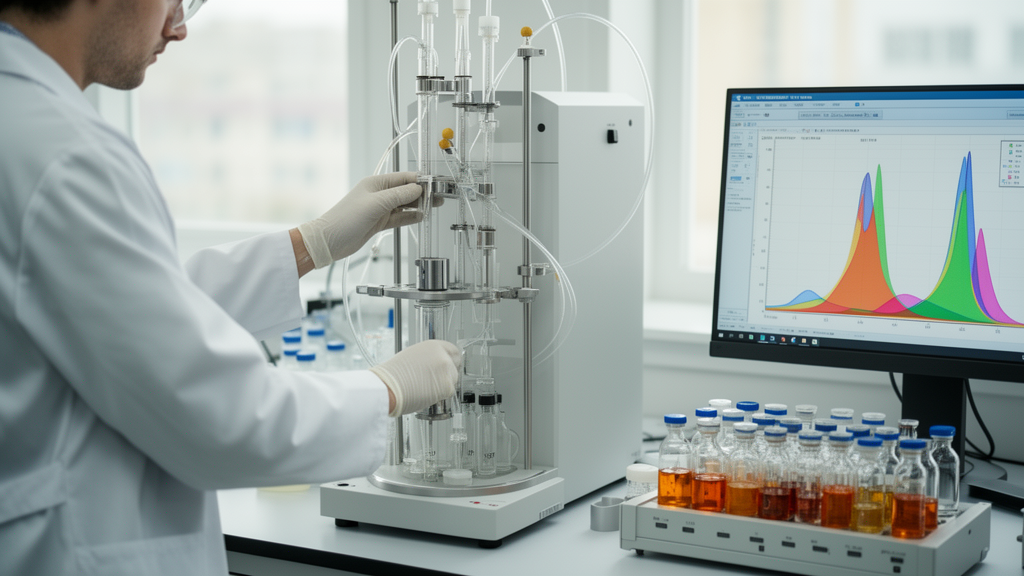
A new reverse-phase high-performance liquid chromatography method can measure the two anticancer drugs abiraterone and niraparib, together with eight of their known impurities, in a single 24-minute run. The method, developed and validated by researchers publishing in Future Journal of Pharmaceutical Sciences, is designed for pharmaceutical quality control of bulk drug substances and tablets, including the fixed-dose combination product marketed as Akeega.
Abiraterone and niraparib were approved together by the FDA in 2023 under the brand name Akeega for certain prostate cancers. Abiraterone is an antiandrogen that works by inhibiting CYP17, an enzyme central to androgen biosynthesis that is expressed in testicular, adrenal and prostatic tumor tissue. Niraparib is a poly-ADP-ribose polymerase inhibitor that selectively targets the PARP-1 and PARP-2 enzymes involved in repairing single-strand and double-strand DNA breaks, and it is used in patients with recurrent epithelial ovarian, fallopian tube or primary peritoneal cancer who have responded to platinum-based chemotherapy.
According to the authors, a review of the literature found no existing RP-HPLC procedure for the concurrent quantification of both drugs and all their related impurities in active pharmaceutical ingredient and finished formulation. Reported methods have covered abiraterone acetate and its degradants, niraparib impurity profiling, LC–MS/MS bioanalytical assays in plasma and dried blood spots, and UPLC assays of niraparib combinations, but none simultaneously addressed both drugs alongside all known impurities and degradation products in one run.
The optimized separation uses a Symmetry Shield RP-18 column measuring 250 by 4.6 mm with 5 µm particles, operated isocratically at ambient temperature. The mobile phase combines acetonitrile and a triethylamine buffer adjusted to pH 2.5 in a 40:60 volume ratio, delivered at 1 mL/min with a 10 µL injection volume. Detection occurs at 239 nm, a wavelength chosen after UV iso-absorption scans of the drugs and impurities, using a photodiode array detector.
Under these conditions the ten analytes resolve cleanly, with retention times of 3.186 minutes for impurity A, 4.771 for impurity B, 6.409 for abiraterone, 8.147 for impurity C, 10.132 for impurity D, 11.739 for niraparib, 13.456 for impurity 1, 15.166 for impurity 2, 16.976 for impurity 3 and 18.396 for impurity 4. The authors note that although impurities 1 and 3 carry relatively polar functional groups, retention in reversed-phase chromatography also depends on molecular conformation, hydrophobic region distribution, ionization state and specific interactions with the stationary phase, explaining their later elution.
Validation followed ICH Q2(R1) guidelines. Calibration curves were linear from 125 to 750 µg/mL for abiraterone and from 25 to 150 µg/mL for niraparab, with regression coefficients of 0.9997 and 0.9993 respectively, while all eight impurities were linear from 2.5 to 15 µg/mL. Accuracy was tested by recovery at 50, 100 and 150 percent concentration levels, yielding recoveries between 99.8 and 100.6 percent for both drugs. Precision, assessed with six replicate injections of 500 µg/mL abiraterone and 100 µg/mL niraparib, produced relative standard deviations of 1.00 and 0.30 percent, both below the conventional 2 percent threshold.
Robustness was examined by varying the flow rate and the organic phase proportion by plus or minus 10 percent, with no significant impact on results. Limits of detection and quantification were 1.50 and 5 µg/mL for abiraterone and 0.30 and 1 µg/mL for niraparib. Blank, placebo and standard chromatograms showed no interfering peaks, supporting the method’s specificity, and system suitability parameters including tailing factor and theoretical plates stayed within acceptable limits across replicate injections.
Forced degradation studies conducted under ICH Q1A(R2) stress conditions confirmed the method’s stability-indicating capability. Samples exposed to acid, base, peroxide, reduction, thermal treatment at 105 °C for six hours, photolysis and hydrolysis were analyzed, and degradation of abiraterone was observed under acidic, thermal and peroxide conditions, while niraparib degraded under acidic and peroxide conditions. In all stressed samples the PDA purity angle remained below the purity threshold, indicating that analyte peaks were spectrally pure and separated from degradation products.
The authors state that by enabling simultaneous detection and quantification in a single run, the method reduces analysis time and supports pharmaceutical quality control and regulatory compliance. They also acknowledge a limitation: robustness was tested only within plus or minus 10 percent variations in mobile phase composition and flow rate, which may restrict the method’s adaptability across different HPLC systems and laboratory environments. Within that scope, the validated procedure offers laboratories a consolidated approach for routine analysis of abiraterone, niraparib and their impurities in bulk material, tablets and stability studies.
Abiraterone’s chemistry underpins both its biological activity and the analytical challenge it presents. Known chemically as (3S,8R,9S,10R,13S,14S)-10,13-dimethyl-17-pyridin-3-yl-2,3,4,7,8,9,11,12,14,15-decahydro-1H-cyclopenta[a]phenanthren-3-ol, the molecule has the formula C24H31NO and a molecular weight of 349.509 g/mol. It appears as a white or off-white solid that dissolves in ethanol, dimethyl sulfoxide and dimethyl formamide. By blocking CYP17, or 17α-hydroxylase/C17,20-lyase, abiraterone interrupts androgen biosynthesis, and the authors note that this blockade may also lead to increased mineralocorticoid production by the adrenal glands.
Niraparib presents a different analytical profile. Its IUPAC name is 2-[4-[(3S)-piperidin-3-yl]phenyl]indazole-7-carboxamide, with the molecular formula C19H20N4O and a molecular weight of 320.396 g/mol. Like abiraterone it is a white to off-white crystalline solid, soluble in ethanol and dimethyl sulfoxide but insoluble in water. PARP enzymes normally identify and repair damage to cellular DNA, including single-strand and double-strand breaks, and niraparib’s inhibition of PARP-1 and PARP-2 exploits that repair pathway in cancer therapy.
The regulatory rationale for impurity profiling is set out in the source guidance the authors cite. Under ICH Q3B guidelines, the maximum allowable level of known and unknown contaminants in a drug product is 0.20 percent, while the permissible limit of all impurities is stated as 5 percent. Identifying impurities and degradation products matters, the authors argue, because of their significant pharmacological and toxicological implications, which makes accurate and reliable quantification essential for product quality and safety.
The practical work behind the method drew on standard laboratory instrumentation. Separations were performed on a Waters Alliance HPLC e2695 separation module equipped with an autosampler, binary pump and a 2998 photodiode array detector, with Empower-2 software handling data acquisition and processing. Supporting equipment included a Sartorius electronic balance, an Eutech digital pH meter, an Unichrome ultrasonic bath for sample sonication, a hot air oven for thermal degradation experiments, and a UV cross-linker with a fluorescence lamp operating between 200 and 300 nm for photodegradation studies. Reagents, including HPLC-grade acetonitrile, triethylamine, orthophosphoric acid, sodium hydroxide, hydrochloric acid and 30 percent hydrogen peroxide, were obtained from Merck Life Science, and HPLC-grade water was prepared with Millipore Milli-Q purification technology.
The reference standards came from Zydus Cadila Health Care in Ahmedabad, while the drug samples were sourced from Johnson & Johnson in Mumbai; the Akeega formulation, containing 500 mg of abiraterone and 100 mg of niraparib, was purchased from a local pharmacy. Stock solutions were prepared by dissolving 50 mg of abiraterone and 10 mg of niraparib working standard in 10 mL of diluent to give 5000 and 1000 µg/mL respectively, with acetonitrile serving as the diluent throughout. An impurity stock of 100 µg/mL was made by transferring 10 mg of each of the four abiraterone impurities and the four niraparib impurities into a 100 mL flask, sonicating for 30 minutes and diluting to volume. Spiked standard and sample solutions were then prepared by combining stock and impurity solutions in a 50 mL flask, yielding 500 µg/mL of abiraterone, 100 µg/mL of niraparib and 10 µg/mL of each impurity, filtered through 0.45 µm filters before injection.
The buffer itself was simple: 1 mL of triethylamine in 1000 mL of HPLC water, adjusted to pH 2.5 with orthophosphoric acid and filtered through a 0.45 micron membrane. Method development began by identifying the UV iso-absorption wavelengths of the drugs and impurities with a spectrophotometer, after which the stationary phase, mobile phase composition, flow rate and pH were optimized by varying individual parameters and analyzing the spiked standard solution, judging performance by peak response and system suitability.
The stress conditions were similarly specific. Acid degradation used 1 mL of 1N hydrochloric acid for 30 minutes at room temperature, neutralized with 1 mL of 1N sodium hydroxide; alkali degradation reversed that sequence. Peroxide degradation used 1 mL of 10 percent hydrogen peroxide, reduction used 1 mL of 10 percent sodium bisulfite, hydrolysis used 1 mL of HPLC-grade water, and photodegradation placed the solution in a photostability chamber for six hours at 350 nm. Treated solutions were adjusted with diluent and injected in duplicate, and degradation was observed only under acid, thermal and peroxide conditions for abiraterone and under acid and peroxide conditions for niraparib, with the remaining stressors leaving the analytes intact.
Within these constraints, the authors position the procedure as a consolidated quality-control tool: reproducible retention times for all ten compounds, effective resolution of analytes, impurities and degradation products, and applicability to bulk material, formulation and stability studies alike.
Subject of Research: Development and validation of a stability-indicating RP-HPLC–PDA method for simultaneous quantification of abiraterone, niraparib and their impurities
Article Title: Novel RP-HPLC–PDA method for comprehensive stability indicating and impurity profiling for concurrent estimation of abiraterone and Niraparib in bulk and tablet formulation
Article References: Gandi, A., & Amgoth, K. P. (2026). Novel RP-HPLC–PDA method for comprehensive stability indicating and impurity profiling for concurrent estimation of abiraterone and Niraparib in bulk and tablet formulation. Future Journal of Pharmaceutical Sciences, 12(1), Article 84. https://doi.org/10.1186/s43094-026-01015-5
Image Credits: AI Generated
DOI: 10.1186/s43094-026-01015-5
Keywords: RP-HPLC, PDA detection, abiraterone, niraparib, impurity profiling, stability-indicating method, forced degradation, ICH Q2(R1), pharmaceutical quality control, Akeega, method validation, Novel
News Source: Ophelia Keating. (October 29, 2026). Single HPLC Run Tracks Abiraterone, Niraparib and Eight Impurities. Scienmag.



