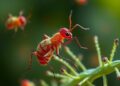
A scientist from the Lomonosov Moscow State University, Faculty of Biology, has, together with his Russian colleague, explained frequent occurrence of parthenogenesis – development of organisms from unfertilized egg cells — in insects. Studying this phenomenon is needed to successfully control species that cause damage to agriculture. The results were published in the Journal of Zoological Systematics and Evolutionary Research.
Winged insects of the superorder Holometabola pass four stages in their development: egg, larva, pupa and adult insect. Some members of Holometabola experience parthenogenesis. The MSU researcher in his survey article has described the modes of parthenogenetic development found in various groups of these insects.
There are three modes of parthenogenesis: arrhenotoky, thelytoky and deuterotoky. Arrhenotoky, which means that only males appear from unfertilized egg cells, is observed, e.g., in most hymenopterans, such as wasps, bees and bumblebees. Usually, the males in these species develop from unfertilized eggs and contain the single (haploid) chromosome set, while females appear diploid (with the double chromosome set) and from fertilized egg cells.
Thelytoky, on the other hand, means that females appear from unfertilized eggs, while males are absent. This mode of parthenogenesis is characteristic of separate species of insects, e.g., of some weevils and bagworm moths, as opposed to the large groups. As of the last type of parthenogenesis, deuterotoky, both male and female organisms develop from unfertilized egg cells. Deuteroky is found, for example, in many gall wasps of the family Cynipidae.
"It has been shown that parthenogenesis is favorable for appearance and further existence of groups when the population density is low, as well as in many cases when the necessity arises for rapid reproduction of a particular genotype in favorable conditions. On the other hand, sometimes populations of insects who reproduce sexually reach very large population sizes, and that can also cause the development of parthenogenetic lineages", – one of the authors, Vladimir Gokhman, Doctor of Biology, leading researcher of the MSU Botanical Garden, told us.
The scientists have identified the main cause of parthenogenesis, which is obvious: insects have a problem with finding sexual partners when the population density is low, which is often the case in extreme habitats. On the other hand, development of parthenogenesis in high-density populations can be explained by the theory that, especially in phytophagous insects, which feed on plants, mostly trees, when the population density is high, evidently, many evolutionary bans, which hamper parthenogenetic development, are lifted.
"Many serious pests of agriculture and forestry, as well as their natural enemies among insects, are parthenogenetic, and studying various types of parthenogenesis is therefore necessary to successfully control these pest species. Nowadays, world scientific literature is experiencing a rapid increase in studies dedicated to ecological, genetic and other aspects of parthenogenesis in insects. This information needs to be adequately and timely summarized and interpreted, but various surveys on this subject, as a rule, rapidly age", – the researcher added.
Phytophagous insects that reproduce by thelytoky can make much harm to agriculture and forestry, because a few females can quickly give rise to a fully functional pest population in the absence of males.
###
The work is done in collaboration with the researcher from the Zoological Institute of the Russian Academy of Sciences.
Media Contact
Yana Khlyustova
[email protected]
http://www.msu.ru
http://dx.doi.org/10.1111/jzs.12183