


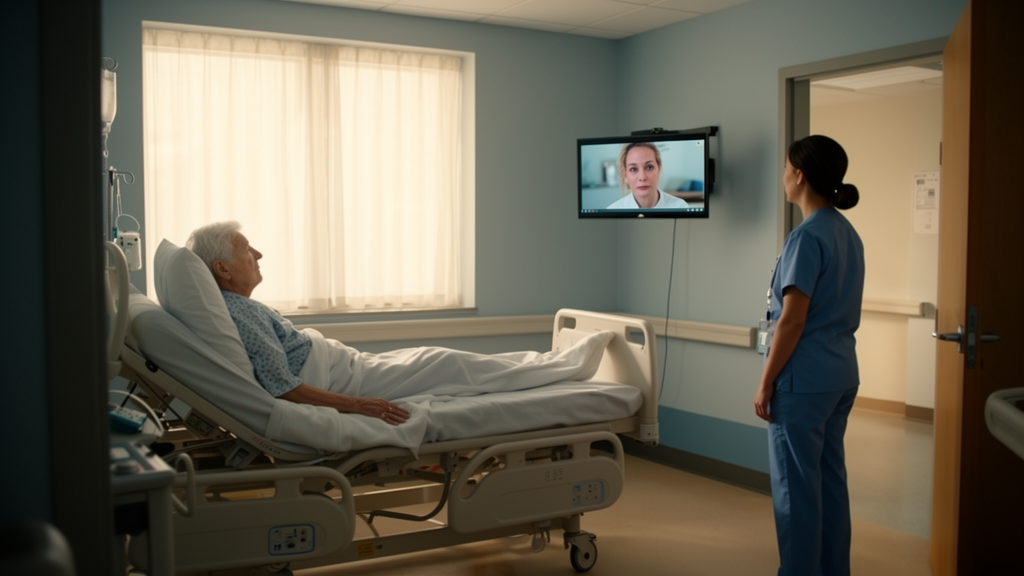
Hospitals that replace bedside sitters with camera-based remote observers can significantly reduce patient falls, but the evidence behind that promise is far weaker than the technology’s rapid spread might suggest. A scoping review published in Frontiers in Digital Health on 29 October 2026 mapped 25 studies of so-called electronic sitters—systems in which a trained technician watches several high-risk patients simultaneously through live, non-recording video feeds and intervenes by two-way audio before unsafe movement occurs. The review, led by Alexis Harerimana of Durban University of Technology and Gugu Mchunu, found statistically significant fall reductions ranging from 25.1 percent to 79 percent across the included studies, yet only two of the 25 used a concurrent comparison group, leaving the true effect of the technology difficult to isolate.
The review team searched five databases—CINAHL, Emcare, MEDLINE, Scopus and Web of Science—alongside manual gray-literature searches, covering publications from January 2016 to July 2026. Of 1,806 records identified, 25 studies met the inclusion criteria and were analyzed thematically. Twenty-one of the studies came from the United States, with one each from Malaysia, Italy, Australia and the United Kingdom. Settings ranged from medical-surgical wards and rehabilitation or brain-injury units to an emergency department and dementia care wards, with sample sizes spanning from 30 patients to more than 174,000 hospital visits. Quality-improvement and evidence-based practice projects predominated, followed by cohort and quasi-experimental designs.
The technology itself proved remarkably varied. Named platforms included Ocuvera’s automated video monitoring system built on Kinect depth cameras that predict bed exits using de-identified silhouettes, AvaSure’s TeleSitter with tiered escalation to a second responder, the SMART AI Patient Sitter evaluated in Malaysia, Verso Vision in Italy, Oxehealth’s contact-free infrared sensor in the United Kingdom, Artisight-enabled virtual patient observation, Epic Monitor systems integrated with the electronic health record, and even repurposed Uniden baby monitors used overnight in Australia. Most systems, however, relied on standard cameras with continuous, centralized, human-led observation; only seven of the 25 studies used AI-assisted detection of bed exits or falls.
Staffing economics define the model’s appeal. Patient-to-observer ratios ranged from 6:1 to 15:1, with 11:1 to 15:1 reported most frequently, and one system’s dashboard reached a maximum technical capacity of 16:1, though its actual average was 9.6:1. Escalation was typically tiered, moving from verbal redirection through two-way audio to notifying the bedside nurse and, if unresolved, triggering an alarm. Response times were fast where reported: one program recorded a mean technician response of 3.49 seconds, while automated systems showed a median staff response of 21 seconds and predictive systems gave a median warning of 28 to 28.5 seconds before an unattended bed exit.
Falls were the most frequently reported outcome, appearing in 22 studies, and most reported fewer falls after implementation. Significant reductions clustered between 28.5 and 48 percent, with the largest at 79 percent, and one study associated post-implementation admission with lower adjusted odds of falling. But the review’s authors were careful to flag the uneven quality beneath those headline numbers: reductions of 54 to 100 percent in some studies rested only on descriptive comparisons or post hoc analyses, one evaluation found a non-significant 25 percent reduction, and another showed essentially no change. Benefits also appeared concentrated among high-risk patients and particular wards, while residual falls clustered among unmonitored patients—in one study, 68.3 percent of falls involved patients who did not meet one-to-one sitter criteria.
Injury outcomes were less convincing. Ten studies reported falls with injury, but statistically significant reductions appeared in only four, ranging from 39.15 percent to 78 percent, and because injurious falls were rare events in mostly small, single-site samples, studies were generally underpowered. Only one UK study distinguished moderate-severity falls, reporting an 82 percent reduction using a facility-specific harm scale. Unattended bed exits showed how deployment configuration can flip results: exits fell by 89 percent at sites using mobile cameras that let staff intervene, but rose paradoxically by 649 percent at fixed-camera sites, which the authors attributed to expanded surveillance simply capturing more low-risk patients leaving bed.
The financial picture was large but largely projected. Sitter hours or full-time equivalents fell by 10 percent to as much as 90 to 91 percent across programs, and cost savings scaled with deployment: single-unit programs reported roughly $84,000 to $226,000 annually, while system-level projections reached $2.09 million per year and up to $3.2 million over 20 months when avoided fall-related costs were included. Yet net benefit was not universal—savings were partly or fully offset by the cost of new monitoring staff in some programs, a 12:1 central program required 51.6 full-time equivalents, and nurses were still pulled from staffing 65.45 percent of the time in one study. AI-augmented platforms, for their part, achieved detection sensitivities of 97.4 to 98.4 percent, with positive predictive value improving from the mid-50s to over 70 percent as algorithms matured with local use.
Implementation, the review found, mattered more than camera choice. The most cited facilitators were leadership engagement and multidisciplinary governance, structured staff training, and eligibility algorithms embedded in the electronic health record, alongside privacy-preserving designs such as non-recording cameras and clear escalation protocols. The barriers were equally consistent: limited device supply forced rationing and waitlisting, with some programs covering only 13 percent of beds or 20 to 25 percent of high-risk patients; staff resistance persisted, with only 12.73 percent of staff in one study considering video monitoring as effective as an in-person sitter; and technology limitations, software errors, and COVID-19 disruptions further constrained use. Where coverage was inadequate, the review concluded, surveillance documented risk without averting it.
The authors stress that their findings should be read as a map of the available evidence rather than definitive estimates of effectiveness. Heterogeneous outcome definitions, predominantly uncontrolled pre-post designs, and bundled interventions that combined monitoring with mobility assessment, medication review and hourly rounding make the independent contribution of monitoring hard to determine. Vendor involvement was notable, with financial relationships between authors or sponsors and technology vendors in at least five studies. The search was limited to English-language publications, and most included studies were American, limiting transferability. The review also gave limited attention to patient and family perspectives, informed consent, and equity of access—gaps the authors say future research using randomized or stepped-wedge designs, standardized definitions, and economic evaluations should address before electronic sitters are assumed to be broadly effective across all hospital settings.
Subject of Research: Electronic sitters and video monitoring for preventing falls and fall-related injuries in hospitalized patients
Article Title: Watching without walls: a scoping review of electronic sitters for preventing falls and fall-related injuries among hospitalized patients
Article References: Harerimana, A., & Mchunu, G. (2026). Watching without walls: a scoping review of electronic sitters for preventing falls and fall-related injuries among hospitalized patients. Frontiers in Digital Health, 8, 1969777. https://doi.org/10.3389/fdgth.2026.1969777
Image Credits: AI Generated
DOI: 10.3389/fdgth.2026.1969777
Keywords: electronic sitters, virtual sitters, fall prevention, hospitalized patients, video monitoring, patient safety, scoping review, AI-assisted detection, telehealth, nursing, health technology implementation, injurious falls
News Source: Ophelia Keating. (October 29, 2026). Virtual Sitters Cut Hospital Falls, but Evidence Remains Uneven, Review Finds. Scienmag.



