


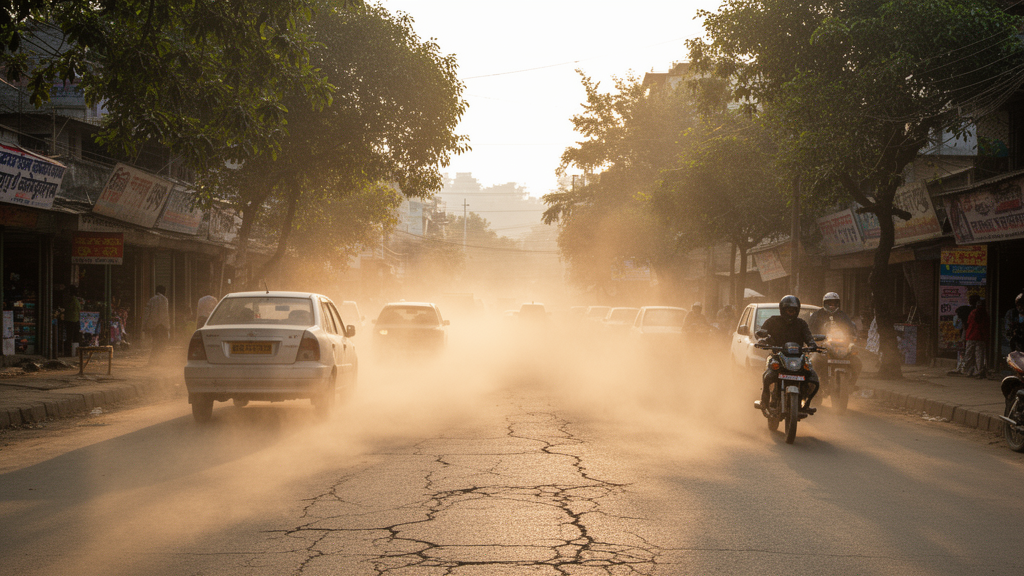
A modelling study of a 1-km urban traffic corridor in Imphal, Northeast India, reports that adding prescribed paved-road dust resuspension to a standard emissions inventory can substantially improve roadside PM10 predictions, but only at the right assumed road-surface silt loading. Rochitra Keisham and Nongthombam Premananda Singh used the AERMOD dispersion model to test how predicted PM2.5 and PM10 respond when dust resuspension is layered onto a baseline scenario that already included exhaust, tyre wear, brake wear and road-surface abrasion.
The team built weekday-hour emissions from a closed-circuit television-derived, class-resolved traffic profile, then compared a Reference scenario with three U.S. EPA AP-42 resuspension scenarios using prescribed silt loadings of 0.03, 0.06 and 0.20 grams per square metre. Model performance was evaluated against observations at the Canchipur roadside Continuous Ambient Air Quality Monitoring Station, using 3,439 common-valid hourly pairs and 343 complete daily daytime means.
At a silt loading of 0.06 grams per square metre, the predicted mean rose to 76.29 micrograms per cubic metre. Fractional bias improved from −0.206 to −0.022, mean absolute error fell from 18.33 to 15.11 micrograms per cubic metre, and the index of agreement increased from 0.855 to 0.894. On the daily daytime scale, mean absolute error dropped from 15.99 to 9.83 micrograms per cubic metre.
The response was not uniformly beneficial. Predicted concentrations increased monotonically as the prescribed silt loading rose, but model–observation performance proved metric-dependent. At the highest tested loading of 0.20 grams per square metre, the model produced substantial PM10 overprediction, showing that simply adding more dust emissions does not monotonically improve agreement with measurements.
To test whether the apparent improvement was statistically robust rather than an artefact of particular hours, the authors applied a paired moving-block bootstrap to the Reference-versus-sL 0.06 contrast. This analysis supported robust reductions in error and absolute bias even though the coefficient of determination was lower under the resuspension scenario, a reminder that correlation and bias metrics can move in opposite directions when a new emissions component is introduced.
The authors frame the conclusion carefully: the findings demonstrate conditional sensitivity to prescribed road-surface silt loading at the evaluated receptor, under otherwise fixed modelling assumptions.
The study’s scope is a single corridor and receptor, so the identified sensitivity is a site-specific modelling result rather than a general prescription, and the prescribed silt loadings were assumptions rather than measured road-surface values.
Subject of Research: Sensitivity of dispersion-modelled roadside particulate matter to paved-road dust resuspension assumptions in an Indian urban traffic corridor.
Article Title: Sensitivity of modelled roadside PM2.5 and PM10 to paved road dust resuspension under prescribed road surface silt loading in an urban traffic corridor in Imphal, India
Article References: Keisham, R., & Singh, N. P. (2026). Sensitivity of modelled roadside PM2.5 and PM10 to paved road dust resuspension under prescribed road surface silt loading in an urban traffic corridor in Imphal, India. Air Quality, Atmosphere & Health, 19(11), Article 247. https://doi.org/10.1007/s11869-026-02145-8
Image Credits: AI Generated
DOI: 10.1007/s11869-026-02145-8
Keywords: PM2.5, PM10, road dust resuspension, AERMOD, silt loading, Imphal, air quality modelling, AP-42, traffic emissions, model evaluation, Sensitivity, modelled
News Source: Russell Cooper. (October 29, 2026). Road Dust Resuspension Steers Modelled PM10 Along an Imphal Traffic Corridor. Scienmag.



