


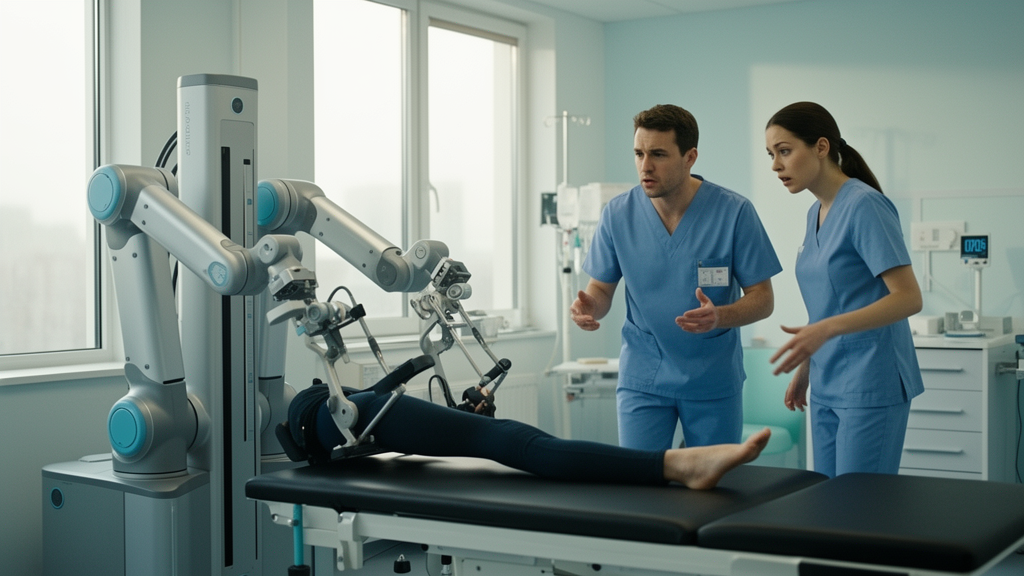
A robotic rehabilitation platform that ran without a single crash or emergency stop during its first deployment in a working hospital still scored poorly on usability, and the reason why says a great deal about what stands between laboratory robotics and real clinical practice. Researchers at the University of Pavia, working with the Istituti Clinici Scientifici Maugeri IRCCS in Montescano, Italy, have built AS-ULDAR, a ROS 2-based system built around a Franka Emika Panda collaborative robot that unifies motor and cognitive assessment exercises, force estimation without dedicated sensors, and two forms of therapist-guided trajectory tracking behind a single clinician-oriented graphical interface. In a formative usability study published in Frontiers in Robotics and AI, the standalone software earned a System Usability Scale score of 87.5 from five users with no robotics background, while the complete platform managed only 54, with high variability, from seven physiotherapists who ran the full clinical workflow. No patients were involved, and the authors are explicit that clinical efficacy lies outside the study’s scope.
The gap between those two numbers is the study’s central finding. The physiotherapists, none of whom had prior experience with robotic systems and each of whom received roughly thirty minutes of training, struggled not with the interface design but with everything around it: robot startup, establishing the connection to the Franka Control Interface, launching the ROS 2 communication framework, and verifying system readiness before any exercise could begin. Item-level analysis of the questionnaire showed the lowest contributions for statements about needing technical support and being able to learn the system quickly, while items about confidence and willingness to use the system frequently scored comparatively well once the robot was running. Feedback from open-ended questions pointed to the intuitiveness of three-dimensional robot motions, the slightly lateral placement of the monitor, the limited range of motion during exercises, and the physical bulk of the system.
Technically, the evaluation was unblemished. Across all sessions with both laboratory users and hospital staff, the researchers recorded no system crashes, software freezes, or unhandled middleware exceptions. Communication with the robot through the Franka Control Interface remained stable, no unplanned emergency stops occurred during physical interaction, and every participant completed all assigned workflow tasks without manual overrides or restarts. The authors caution, however, that each test covered only a brief execution window, so the results demonstrate short-term operational viability rather than long-term stability or durability.
The platform itself is an exercise in systems integration rather than new algorithms. Its components were each validated in the team’s earlier work: a ROS 2-based graphical interface for rehabilitation management, an observer-based method for estimating interaction forces without force sensors, and a Human Joint-based Trajectory Tracking strategy that converts therapist demonstrations into patient-specific robot motions. The present contribution lies in welding these pieces into one architecture on a single seven-degree-of-freedom Panda manipulator, which offers a workspace radius of roughly 855 millimetres, a 3-kilogram payload, integrated joint torque sensing, and real-time control at 1 kilohertz. A custom 3D-printed handle connects the patient’s hand to the robot, and wireless XSens MTw Awinda inertial sensors capture upper-limb motion for assessment and trajectory recording.
The system offers three main tasks. The first is a Center-Out Point-to-Point exercise in which the patient actively reaches from a central position toward eight targets arranged on a circle at chest height, while the robot remains fully transparent, offering no assistance or resistance. The platform computes quality metrics for each reaching movement, including duration, reaching error, mean speed, smoothness, and peak force. The same exercise has a cognitive mode in which the patient must memorize and reproduce a sequence of targets, with the sequence generated from the patient’s performance in previous sessions, concentrating practice on directions of poorer performance. This performance-driven adaptation is the auto-calibrating mechanism referenced in the platform’s name.
During this reaching task, interaction forces are estimated by a bank of Integral Sliding Mode unknown-input observers, one per joint, exploiting the fact that the robot’s torque sensors and dynamic model make dedicated force hardware unnecessary. The authors stress that the observer’s accuracy was characterized in prior work and is treated here as an integrated component rather than re-validated, and that the estimation is intended for monitoring patient effort rather than high-precision haptic rendering. The reaching metrics themselves draw on literature showing correlations with clinical scales such as the Fugl-Meyer assessment, but the authors emphasize that this assessment capability has not been validated on AS-ULDAR itself, since the present study involved no neurological patients and no comparison against clinical disability scores.
The second and third tasks address a known weakness of conventional robot rehabilitation. In standard Cartesian trajectory tracking, a therapist physically guides the robot along the desired motion, and the recorded hand path is replayed to the patient. This implicitly assumes therapist and patient share similar limb proportions; differences in arm lengths and joint mobility can produce joint configurations and muscle loads quite different from what the therapist intended. AS-ULDAR’s alternative, Human Joint-based Trajectory Tracking, records the therapist’s joint angles directly with the wearable sensors, requiring no robot at all during demonstration, and then uses a Human Joint-based Inverse Kinematics algorithm to convert that joint trajectory into a robot motion adapted to each patient’s anthropometry. In tests across five recorded trials totalling 2,624 frames, the algorithm converged with a median of two iterations per frame, a 100 percent success rate, and 0.7 milliseconds of processing per frame on a single generic CPU core. The authors note that the earlier validation of this method involved only two healthy subjects, that its statistical comparisons may suffer from pseudoreplication, and that the results should be read as preliminary evidence rather than proof of superiority over Cartesian tracking.
Under the hood, the platform switches between two torque-level controllers at 1 kilohertz. Zero-impedance control compensates gravity and other non-inertial dynamics without position feedback, rendering the robot fully backdrivable so patients and therapists can move it freely; this regime also provides the model on which the force observers operate. For guided trajectory reproduction, a model-free Suboptimal Second-Order Sliding Mode controller tracks the reference joints with finite-time convergence and, through time-integration of the control law, produces smooth torque commands free of chattering. During reproduction of both trajectory tasks the robot operates in a fully assisted paradigm, guiding the patient’s limb with no voluntary effort required, a mode the authors note is chiefly indicated in acute and early subacute stages of neurological recovery.
The intended patient population is adults aged 18 to 80 with chronic neurological conditions, specifically stroke, Parkinson’s disease, amyotrophic lateral sclerosis, or mild cognitive impairment, and mild-to-moderate upper-limb impairment defined by a QuickDASH score between 20 and 90. The planned clinical protocol spans four weeks at three sessions per week, combining baseline motor-cognitive assessment, therapist-demonstrated trajectory recording, and robot-guided exercise, alongside conventional physical therapy. A clinical trial with neurological patients has received ethical approval under protocol number 57875/2025 and is currently collecting data, but its results were not part of this study.
The authors are candid about the limitations. The sample sizes of five and seven are appropriate for formative usability work but carry high statistical uncertainty, and the scores cannot support generalized claims about clinical readiness. The two evaluation phases involved different participant cohorts, tasks, and settings, so the disparity between the interface and full-system scores reflects a combination of participant differences and task complexity rather than a purely causal effect of the robot hardware. No patients were evaluated, so patient usability, safety, and engagement remain unassessed, and the System Usability Scale does not capture cognitive workload or physical strain, which the team plans to measure with tools such as NASA-TLX in future work. The broader context is sobering: a recent narrative review found no studies of upper-limb impairment in stroke or spinal cord injury patients using industrial collaborative robots, and clinical evidence in this field remains scarce. Against that backdrop, AS-ULDAR’s message is double-edged. Integrating validated components into a stable, clinician-ready platform is demonstrably achievable, but usability must be engineered as a system-level property, encompassing startup procedures, physical ergonomics, and training, not merely a feature of the software on the screen.
Subject of Research: Systems integration and formative usability evaluation of a ROS 2-based collaborative robot platform for upper-limb neurological rehabilitation
Article Title: AS-ULDAR: a ROS 2-based collaborative robotic platform for upper-limb rehabilitation — systems integration and pilot usability evaluation in a clinical environment
Article References: Alessi, C., Sacchi, N., Fundarò, C., & Ferrara, A. (2026). AS-ULDAR: a ROS 2-based collaborative robotic platform for upper-limb rehabilitation — systems integration and pilot usability evaluation in a clinical environment. Frontiers in Robotics and AI, 13, Article 1914367. https://doi.org/10.3389/frobt.2026.1914367
Image Credits: AI Generated
DOI: 10.3389/frobt.2026.1914367
Keywords: robotic rehabilitation, collaborative robots, upper limb, ROS 2, Franka Emika Panda, usability, physiotherapists, stroke, force estimation, trajectory tracking, clinical workflow, System Usability Scale
News Source: Denise Maddox. (October 29, 2026). Robot rehabilitation platform works flawlessly but flusters physiotherapists in first hospital test. Scienmag.



