


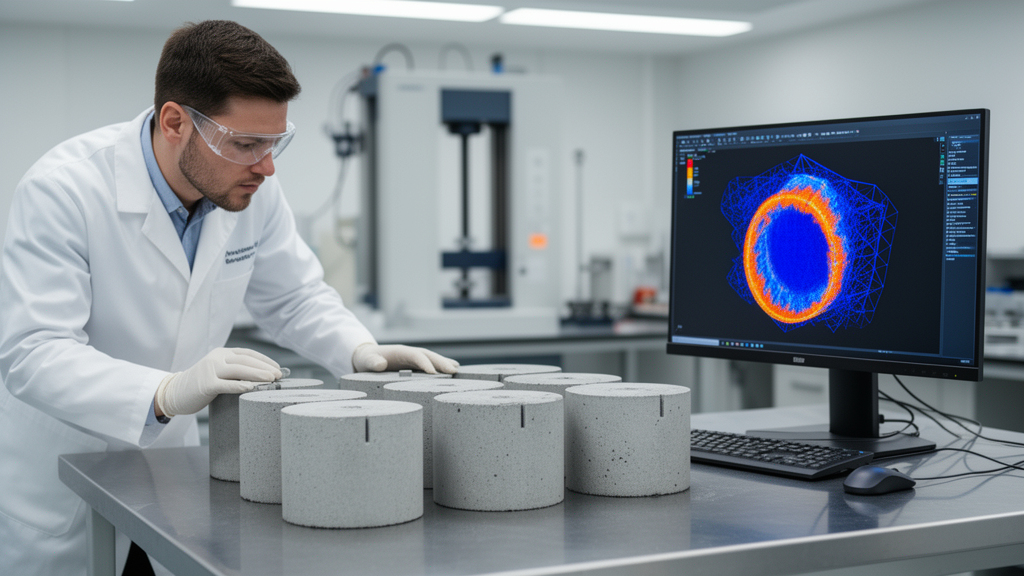
A new study published in AI in Civil Engineering on 11 June 2026 proposes an artificial intelligence framework intended to shorten that trial-and-error process by predicting the material’s uniaxial compressive strength directly from its mixture variables. The work, led by Yuefeng Li and Zhongmin Wang along with colleagues, combines a kernel extreme learning machine with a strengthened version of the whale optimization algorithm, a nature-inspired search method that the authors modified to explore the solution space more thoroughly.
The motivation is straightforward. Accurate strength prediction matters for efficient mix design, because it can reduce laboratory trial-and-error efforts and the associated time and cost in engineering practice. Machine learning methods such as artificial neural networks, support vector machines, and tree-based ensembles have increasingly been applied to this problem, but the authors note that UHPC strength prediction involves multi-factor coupling and pronounced nonlinearity, and that model performance can be sensitive to algorithm configuration and hyperparameter selection. An approach that is both accurate and computationally efficient has therefore remained desirable.
The kernel extreme learning machine at the heart of the framework builds on the extreme learning machine, a learning algorithm for single hidden-layer feedforward neural networks in which the input weights and biases of the hidden nodes are randomly generated and never adjusted during training. The output weights are instead determined analytically through a least-squares solution, which gives the method a significant speed advantage over traditional backpropagation networks that rely on iterative gradient descent. Backpropagation approaches are known to suffer from slow convergence, sensitivity to parameter settings, and entrapment in local minima, all of which the extreme learning machine sidesteps by eliminating iterative weight tuning.
The plain extreme learning machine has its own weaknesses, however. It still requires trial-and-error methods to determine the optimal number of hidden neurons, which can increase computational cost and destabilize performance, and the random assignment of weights and biases can produce inconsistent outcomes across different runs. The kernel version addresses these drawbacks by replacing the hidden layer output matrix with a kernel matrix constructed from a Mercer kernel function, which enhances model stability and generalization while retaining the computational efficiency. In this kernel formulation, two hyperparameters, the kernel parameter and the penalty coefficient, critically govern predictive performance, making reliable optimization of those settings essential.
That is where the whale comes in. The whale optimization algorithm, introduced by Mirjalili and Lewis in 2016, mimics the foraging behavior of whales, which ascend in a helical motion while gradually tightening their encirclement of prey. The algorithm simulates this through three core strategies: prey encirclement, in which each whale moves toward the population member nearest the prey and progressively contracts the search radius; helical updating, in which whales follow a spiral trajectory toward the target; and stochastic exploration, in which randomness is introduced to broaden the search space. A coefficient that decreases linearly from 2 to 0 governs the transition between exploration and exploitation.
The authors argue that the standard algorithm converges slowly and explores insufficiently, so they rebuilt it with three targeted modifications and named the result GSWOA. First, inspired by particle swarm optimization, they added a dynamic inertia weight that changes with the iteration count. Early in the search, the influence of the current best solution on individual whales is deliberately suppressed to promote broader exploration; as iterations proceed, that influence is progressively strengthened to guide the population toward convergence. The weight follows a nonlinear cosine-based trajectory within the interval from 0 to 1, staying low with a steeper slope early on and rising with a diminishing rate of change later, which the authors say promotes stable convergence.
Second, the team made the spiral itself variable. In the original algorithm, the constant controlling the spiral shape is typically fixed, which restricts whales to a single spiral path toward the target and makes the search prone to local optima. In the improved version, that parameter evolves with the iteration count through an exponential formulation, so the spiral radius shifts from wide to narrow over the run. Broad helical paths in early iterations encourage extensive global exploration, while narrower spirals in later stages refine local optimization accuracy. Third, the authors added an optimal neighborhood perturbation mechanism: because the best-known position is only updated when a superior candidate appears, standard updates become sparse, so the new method stochastically explores the area surrounding the best position and retains any perturbed point only if a greedy fitness comparison shows it is better, reducing the likelihood of premature stagnation.
Before applying the optimizer to concrete, the team benchmarked it against five standard test functions with a dimensionality of 30, comparing it with the Marine Predators Algorithm, Grey Wolf Optimizer, the original whale algorithm, particle swarm optimization, artificial bee colony, and the sparrow search algorithm under identical conditions: a population of 30, a maximum of 500 iterations, and 30 independent runs per function. Boxplots of the final objective outcomes showed that across most functions the improved algorithm exhibited lower medians and tighter interquartile ranges than the baselines, indicating smaller final errors and reduced run-to-run variability. Convergence curves further indicated that it generally converged faster than the other six algorithms while achieving higher optimization precision, and that several baselines became trapped in local optima on three of the test functions while the improved algorithm avoided that failure through its variable helix update.
The researchers then assembled three datasets of UHPC uniaxial compressive strength samples. The first, drawn from various research institutions, contains 1,030 samples described by cement, blast furnace slag, fly ash, water, superplasticizer, coarse aggregate, fine aggregate, and curing age. The second contains 23 steel fiber-reinforced UHPC samples from various research laboratories, characterized by water, cement, silica fume, fine and coarse aggregate, superplasticizer, accelerator, and steel fiber content. The third contains 100 kaolin-containing samples collected at the laboratory of Amirkabir University of Technology, with variables including age, cement, metakaolin or kaolin content, metakaolin type encoded with one-hot categories, water, aggregates, surface resistivity, and rapid chloride permeability test results. Because the indicators carry different units and dimensions, all features were normalized with a min-max transformation, with the minimum and maximum values estimated from the training set after a random 70:30 train-test split and the same transformation applied to the test set.
Across the three datasets, the framework achieved test-set coefficients of determination of 0.8823, 0.8906, and 0.8951 respectively, with the model executed 10 times under a fixed split and fixed random seed and the average taken as the final outcome. Evaluation used mean absolute error, mean square error, root mean square error, the coefficient of determination, residual prediction deviation, and mean absolute percentage error. The authors report that the residual prediction deviation approached 3 on the first dataset’s test set and remained robust at 4.8652 on the second, and that the training sets of the second and third datasets showed near-perfect fits, with training coefficients of determination approaching 0.99 and residual prediction deviation exceeding 11. An ablation study comparing the proposed model against a whale-optimized kernel machine, an unoptimized kernel machine, and a plain extreme learning machine found the proposed version consistently better across the metrics, particularly on the training and test sets of the first two datasets, which the authors attribute to more effective global and local search during hyperparameter tuning.
The authors are candid about a caveat: the gap between training coefficients near 0.99 and test values near 0.89 on the second and third datasets indicates a non-negligible generalization gap and a tendency toward mild overfitting. With only 23 samples in the second dataset, a single 70/30 hold-out split yields a small test set and may produce high-variance performance estimates, so those results should be read as indicative rather than conclusive. They suggest K-fold cross-validation, feature selection to address correlated inputs, and noise-aware training as remedies. They also caution that comparisons with other published models are indicative only, because those results came from different datasets and settings. Even so, the team concludes that the framework can serve as a practical surrogate model to support UHPC mix design by rapidly estimating strength, and future work will target additional performance targets, more robust validation for small samples, and multi-source datasets for field deployment.
Subject of Research: A hybrid machine learning framework using an improved whale optimization algorithm to predict the uniaxial compressive strength of ultra-high-performance concrete
Article Title: A heuristic optimization method based on a global search strategy for predicting ultra-high performance concrete’s uniaxial compressive strength using Kernel extreme learning machine
Article References: Li, Y., Song, J., Fang, B., Wang, T., Shen, T., & Wang, Z. (2026). A heuristic optimization method based on a global search strategy for predicting ultra-high performance concrete’s uniaxial compressive strength using Kernel extreme learning machine. AI in Civil Engineering, 5(1), Article 16. https://doi.org/10.1007/s43503-026-00098-6
Image Credits: AI Generated
DOI: 10.1007/s43503-026-00098-6
Keywords: ultra-high-performance concrete, compressive strength prediction, kernel extreme learning machine, whale optimization algorithm, machine learning, hyperparameter optimization, metaheuristic algorithms, civil engineering, mix design, global search strategy, overfitting, construction materials
News Source: Denise Maddox. (October 29, 2026). Smarter Whale Algorithm Sharpens AI Predictions of Ultra-High-Performance Concrete Strength. Scienmag.



