


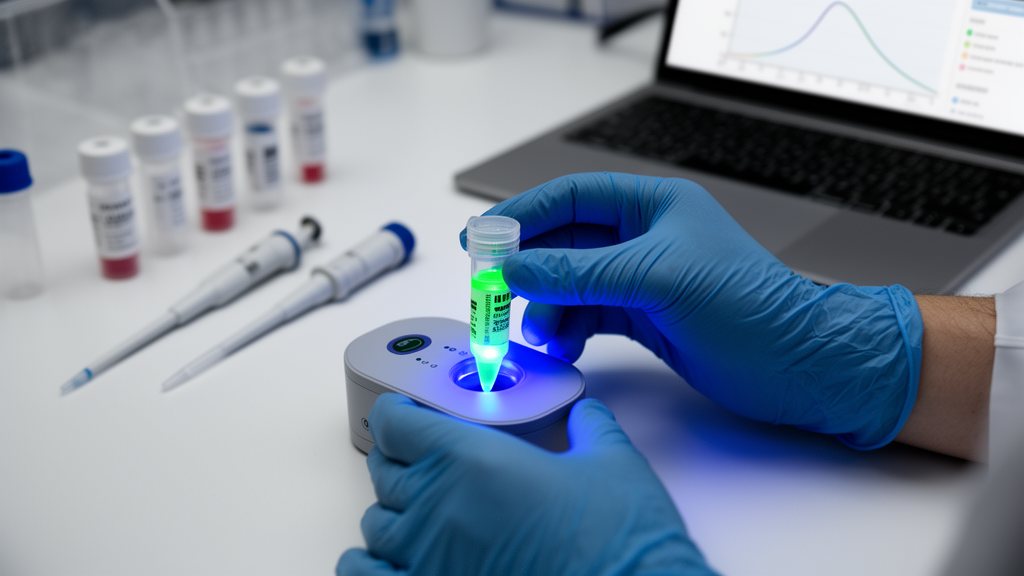
Researchers have developed a rapid, visual nucleic acid test for Schmallenberg virus that combines reverse transcription recombinase-aided amplification (RT-RAA) with the CRISPR/Cas12a system, and they report that the entire procedure can be completed within 50 minutes. The assay, described in a short communication in the journal Animal Diseases, targets conserved regions of the viral S gene and produces a green fluorescence signal that can be read by the naked eye under blue light or captured with a smartphone camera. Because the amplification and detection steps take place in a single closed tube, the design avoids opening tubes after amplification, which the authors say reduces the risk of cross-contamination from aerosolized amplification products and the false positives that follow from it.
Schmallenberg virus is an emerging arbovirus transmitted by Culicoides biting midges that affects ruminants. In adult animals it causes febrile illness, diarrhea and reduced milk production, and in pregnant animals it can cross the placenta and induce congenital malformations in fetuses or miscarriages. The virus was first identified in Germany in 2011 and by 2013 had spread rapidly across Europe, eventually reaching 27 countries in eastern and southern Europe, with recurrences observed every two to three years. According to studies cited by the authors, in 8 to 16 percent of confirmed or suspected SBV outbreaks, lamb mortality can reach or exceed 40 percent, a burden that significantly affects local livestock production. Viral RNA or antibodies have also been detected beyond domestic cattle and sheep, in wild and exotic species including European bison, alpacas and camels.
The diagnostic landscape for Schmallenberg disease motivated the new assay. Enzyme-linked immunosorbent assays, the primary serological method, have a significant window period and may miss early infection because viral antibodies cannot yet be accurately detected. Existing molecular methods such as RT-PCR and real-time fluorescent reverse transcription PCR (RT-qPCR) are sensitive but rely on expensive equipment and professional technicians, which limits their use in grassroots laboratories and on-site testing. An inactivated vaccine, Bovilis SBV, has been approved for use, but the market for vaccines and specific antiviral treatments remains underdeveloped, and no widely adopted specific therapeutic products are currently available. With international trade increasing the risk that the virus will expand its transmission range, the authors argue that simple, equipment-light and highly sensitive early detection tools are urgently needed.
The assay builds on the properties of the CRISPR/Cas12a system, which has gained attention in pathogen detection for its efficient and precise gene recognition. Cas12a’s trans-cleavage activity, once activated by binding of the guide RNA to its DNA target, cleaves nearby single-stranded DNA reporters, allowing the system to be coupled with fluorescent probes or lateral flow strips for visual readout. On its own, however, CRISPR detection is limited in sensitivity without prior nucleic acid amplification. Combining Cas12a with RT-RAA addresses this gap: RT-RAA exponentially amplifies the RNA target, and the CRISPR step then adds specificity that compensates for potential nonspecific results from the amplification alone. The two chemistries are also unusually compatible, because the optimal temperature range for RT-RAA, 37 to 42 degrees Celsius, aligns well with the activity of the Cas12a enzyme.
To build the test, the team retrieved 22 representative full-length S gene sequences of SBV from diverse geographical and temporal origins and confirmed a conserved region through multiple sequence alignment. Four crRNAs targeting this region all showed perfect sequence complementarity to the analyzed sequences, and a screening experiment found that the reaction guided by crRNA3 produced the strongest fluorescence signal, so it was selected for further work. The S gene was chosen because it is robustly conserved across SBV strains and is transcribed at high abundance during viral replication, providing ample template for detection. Three RT-RAA primer pairs were then evaluated with serial dilutions of an SBV-S plasmid, and the pair F1-R1 was selected on the basis of its banding pattern on agarose gel electrophoresis.
Reaction conditions were systematically optimized. Trans-cleavage activity of the CRISPR/Cas12a system was maximized at a crRNA3 concentration of 100 nanomolar, while the Cas12a protein concentration was set at 2.25 micromolar; although higher protein concentrations produced larger absolute fluorescence signals, they also raised background noise from nonspecific spontaneous cleavage, which could interfere with interpreting negative results. For the amplification step, three temperatures (37, 39 and 42 degrees Celsius) and three durations (10, 20 and 30 minutes) were tested, and the highest amplification efficiency was achieved at 42 degrees Celsius with a clearly stronger signal after 30 minutes than after shorter durations.
The final workflow is deliberately simple. The RT-RAA reaction mixture containing the sample is pipetted into the bottom of a 1.5 milliliter centrifuge tube, while the CRISPR/Cas12a reaction system sits in a PCR tube whose cap is removed; the PCR tube is inverted over the centrifuge tube and the assembly is sealed with parafilm. The RT-RAA reaction runs at 42 degrees Celsius for 30 minutes, after which the liquid is flicked or briefly centrifuged down to mix the two systems, and the CRISPR reaction proceeds at 37 degrees Celsius for 20 minutes. In positive samples, Cas12a guided by crRNA cleaves the single-stranded DNA reporter, generating green fluorescence visible under blue light. Quantitative interpretation can be done with ImageJ software, and the authors established a pixel-value threshold of 30, based on statistical analysis of positive and negative controls, above which samples were deemed positive.
Analytical performance was strong in the laboratory. Testing tenfold serial dilutions ranging from 8.6 x 10^3 to 10^-1 copies per microliter, the assay achieved a detection sensitivity of 8.6 copies per microliter for the SBV-S plasmid and 8.6 x 10^1 copies per microliter for RNA transcripts. In specificity testing against plasmids for Seoul orthohantavirus, infectious bovine rhinotracheitis virus, Rift Valley fever virus, Crimean-Congo hemorrhagic fever virus and bovine viral diarrhea virus, a distinct green fluorescence signal appeared exclusively in the SBV RNA transcript group, with no signal for the other pathogens or negative controls. The authors note that the reported sensitivity is comparable to or better than that of other published SBV detection methods, including an RT-RAA lateral flow assay reported at 5 copies per microliter and an RT-qPCR assay reported at 10^2 copies per microliter.
The assay was then evaluated against RT-qPCR on simulated clinical samples: 56 simulated positive samples, prepared by spiking serial dilutions of the SBV-S plasmid into SBV-negative bovine nasal swabs, along with eight negative controls. Under these conditions the limit of detection of the RT-RAA-CRISPR/Cas12a assay was 8.6 copies per microliter, whereas that of the RT-qPCR, run according to the national standard of the People’s Republic of China (GB/T 43159-2023), was 8.6 x 10^2 copies per microliter, making the new assay 100-fold more sensitive in this comparison. The authors attribute this improvement to the dual amplification strategy, in which exponential target amplification by RT-RAA is followed by additional signal enhancement as each target molecule triggers Cas12a to cleave multiple reporter probes.
Important limitations temper these results. Because no confirmed SBV cases were available in China, authentic clinical specimens could not be obtained, and the evaluation relied on viral plasmid-spiked negative bovine nasal swabs, a surrogate the authors describe as widely accepted for preliminary validation when field samples are inaccessible but one that cannot fully replicate natural infection. The abstract and conclusion both emphasize that the method’s diagnostic utility in authentic clinical specimens remains to be confirmed, and the authors call for future validation with true clinical specimens from SBV-endemic regions, along with further simplification of nucleic acid extraction and the development of portable detection devices to support routine surveillance and rapid response in resource-limited settings. If those confirmatory studies succeed, the closed-tube, equipment-light format could become a practical tool for early identification of Schmallenberg virus and for controlling outbreaks before they impose heavy losses on the livestock industry.
Subject of Research: Development of a rapid visual RT-RAA-CRISPR/Cas12a nucleic acid assay for detecting Schmallenberg virus
Article Title: A streamlined visual RT-RAA-CRISPR/Cas12a assay for rapid detection of Schmallenberg virus
Article References: Han, Z., Bai, Y., Huang, P., Li, H., Li, B., Zhang, Z., Huang, J., Jin, K., Wang, H., Jin, H., & Zhang, H. (2026). A streamlined visual RT-RAA-CRISPR/Cas12a assay for rapid detection of Schmallenberg virus. Animal Diseases, 6(1), Article 49. https://doi.org/10.1186/s44149-026-00263-5
Image Credits: AI Generated
DOI: 10.1186/s44149-026-00263-5
Keywords: Schmallenberg virus, CRISPR/Cas12a, RT-RAA, viral diagnostics, livestock health, nucleic acid amplification, RT-qPCR, point-of-care testing, ruminants, arbovirus, cross-contamination, simulated clinical samples
News Source: Kristina Jarvis. (October 29, 2026). Closed-Tube CRISPR Test Spots Schmallenberg Virus in Under an Hour. Scienmag.



