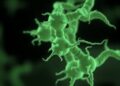
Helicobacter pylori is a widespread bacterial pathogen that infects the lining of the stomach, where it can cause ulcers and even cancer. As a new study shows, its genetic variability complicates efforts to develop an effective vaccine.
The bacterium Helicobacter pylori is responsible for one of the most prevalent infections in humans. The infection can give rise to a number of conditions ranging from gastritis to peptic or duodenal ulcers and ultimately to stomach cancer. Perhaps the most striking feature of Helicobacter is its genetic heterogeneity. Its mutability allows it to continuously adapt to the challenges presented by the acidic nature of its environment, allowing the bacterium to establish a persistent infection which, if untreated, can be lifelong. Ludwig-Maximilians-Universitaet (LMU) in Munich microbiologist Sebastian Suerbaum and his colleagues have now shown that this genetic variability, which had already been observed in the chronic phase of the infection, actually becomes manifest very early on, although the mutation rate at this stage is no higher than that seen in the later phases of infection. The new findings are reported in the latest issue of the journal Gastroenterology.
Suerbaum holds the Chair of Medical Microbiology and Hospital Epidemiology at LMU's Max von Pettenkofer Institute (of which he is also a Director). His research focuses on the role of genetic variability in mediating Helicobacter's ability to adapt and survive in human hosts. Up to now, little work has been done to assess the degree of bacterial heterogeneity in the period immediately after the initial infection, simply because the infection is normally diagnosed only after it has become chronic. Suerbaum and his colleagues were able to track the bacterium's early evolution from the very beginning of the infection by working with samples obtained from a small cohort of human volunteers who had been experimentally infected in the course of a clinical trial designed to assess the effects of a candidate vaccine. This experimental design enabled them to monitor, at the molecular level, the changes that the H. pylori genome undergoes as the pathogen adapts to conditions on the surface of the gastric epithelium: "Our study shows that bacterium's mutation rate is very high from the very beginning. Mutations in genes for antigens present in the experimental vaccine can actually inhibit their production, effectively blunting the immune response. Other genetic changes trigger the synthesis and secretion of a number of bacterial virulence factors that later play a role in pathogenesis," Suerbaum explains.
There is currently no demonstrably effective vaccine against Helicobacter. "The pathogen's high level of genetic diversity poses a significant challenge for vaccine developers," says Suerbaum. "The results of our study have definite implications for the choice of antigens that will be used as the basis for future vaccines," he adds.
###
The study was carried out in collaboration with Hannover Medical School, the German National Reference Center for Helicobacter pylori (which has been based at the Max von Pettenkofer Institute since January 2017 and is led by Sebastian Suerbaum) and Magdeburg University, together with other partners in Germany and elsewhere. The biopsies used were collected in the course of a clinical trial which was carried out under the supervision of Professor Peter Malfertheiner (one of the paper's authors), at Magdeburg University.
Media Contact
Luise Dirscherl
[email protected]
49-892-180-3423
http://www.uni-muenchen.de
http://www.en.uni-muenchen.de/news/newsarchiv/2017/suerbaum_helicobacter.html
Related Journal Article
http://dx.doi.org/10.1053/j.gastro.2017.10.014