


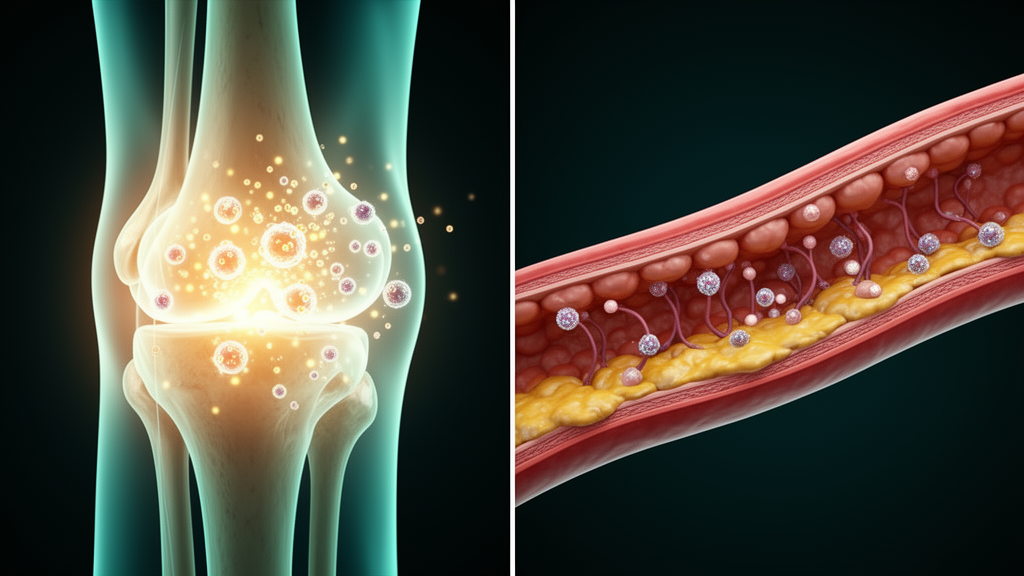
Rheumatoid arthritis does its worst damage quietly. While the joints announce themselves with pain and swelling, the arteries accumulate risk in ways that standard cholesterol tests routinely miss. A new case-control study from Iraq reports that two innate immune markers, the antimicrobial peptide cathelicidin LL-37 and the endosomal DNA sensor toll-like receptor 9, are dramatically elevated in people with rheumatoid arthritis, and that their rise runs parallel to a shift in blood lipids toward a pro-atherogenic profile even when total cholesterol looks unremarkable. The work, published in Egyptian Rheumatology and Rehabilitation, adds a piece to one of the most puzzling stories in cardiovascular medicine: the so-called lipid paradox.
The paradox is well documented but poorly resolved. In the general population, atherogenesis is driven largely by elevated total cholesterol and LDL-C, so lipid panels are a reasonable first screen. In active rheumatoid arthritis, the relationship breaks down. Systemic inflammation frequently lowers circulating total cholesterol, LDL-C and HDL-C, yet patients still develop atherosclerosis at roughly twice the rate of the general population and die of cardiovascular disease more often than people without the condition. The composition of the lipids, not just their quantity, appears to change: HDL loses its protective function, and the remaining cholesterol is packaged in ways that favor plaque growth. Traditional panels, decoupled from actual risk by inflammation, fail to capture this.
To probe whether innate immune signaling might be part of that decoupling, researchers at Al-Sader Teaching Hospital in Najaf recruited 120 rheumatoid arthritis patients aged 50 to 65, all diagnosed by a specialist rheumatologist under both the 1987 ACR and 2010 ACR/EULAR classification criteria and all on stable methotrexate monotherapy. Sixty healthy volunteers, frequency-matched for age and sex and comparable in body mass index, served as controls. The design was deliberately restrictive: smokers, people with hypertension, diabetes, cardiovascular disease, kidney or liver impairment, malignancy, other autoimmune conditions, and anyone taking corticosteroids, statins or biologic therapies were excluded. That scrubbed away most conventional cardiovascular confounders, though it also makes the cohort unusually clean compared with real-world patients.
The inflammatory contrast between the groups was stark. Patients showed markedly higher high-sensitivity C-reactive protein, erythrocyte sedimentation rate, platelet counts, neutrophil-to-lymphocyte ratio, systemic immune-inflammation index and anti-cyclic citrullinated peptide antibodies, all statistically significant, and a mean DAS28-CRP score of 6.01, placing most of the cohort in the high disease activity category. Against that inflammatory backdrop, the lipid story unfolded exactly as the paradox predicts. Total cholesterol and triglycerides did not differ significantly between patients and controls. Yet HDL cholesterol was significantly lower in patients, at 46.07 versus 53.40 milligrams per deciliter, and every derived atherogenic index pointed the other way: the atherogenic index of plasma reached 0.306 in patients versus 0.200 in controls, and the Castelli risk indices and atherogenic coefficient were all significantly elevated.
That combination matters because the atherogenic index of plasma, a logarithmic ratio of triglycerides to HDL cholesterol, is an established surrogate marker for the small, dense LDL phenotype when it exceeds 0.24. The authors frame this as inflammation-driven lipid remodeling: in active disease, inflammatory cytokines such as interleukin-6 and tumor necrosis factor alpha displace apolipoprotein A-I on HDL particles with serum amyloid A, converting HDL from a vasoprotective scavenger into a dysfunctional, pro-inflammatory one. The result is a lipid environment that promotes atherosclerosis while evading conventional screening.
The immune markers were the study’s most eye-catching numbers. Serum LL-37 averaged 1.06 nanograms per milliliter in patients versus 0.137 in controls, and TLR-9 reached 5.088 versus 0.133 nanograms per milliliter, both differences highly significant. LL-37 is a cathelicidin antimicrobial peptide released abundantly by neutrophils, and in the context of atherosclerosis it has a proposed darker role: it binds self-DNA released from dying cells, protecting the complexes from degradation and ferrying them into macrophages and dendritic cells. Once inside, those complexes engage TLR-9, an endosomal receptor that normally senses microbial DNA, mistaking the self-DNA for a pathogen and triggering type I interferons and pro-inflammatory cytokines. In the arterial wall, this persistent signaling is thought to impair endothelial repair, drive macrophages toward foam cell formation and destabilize plaques.
Receiver operating characteristic analysis gave the markers a diagnostic dimension. TLR-9 distinguished patients from controls with an area under the curve of 0.953, at a cut-off of 0.119 nanograms per milliliter yielding 88.4 percent sensitivity and 85.2 percent specificity within this cohort. LL-37 performed more modestly, with an area under the curve of 0.705, 66.1 percent sensitivity and 63.7 percent specificity at a cut-off of 0.130 nanograms per milliliter, a difference the authors attribute to LL-37’s dynamic turnover during phases of neutrophil activation and possible sequestration in immune complexes. A multivariate general linear model adjusting for age, sex and body mass index confirmed that disease status, not demographics, explained the biomarker differences, accounting for a very large share of the variance in the combined marker levels.
But the correlation analyses complicate any simple causal narrative, and the authors are candid about this. Serum LL-37 and TLR-9 showed no significant correlation with each other, and neither marker correlated significantly with the inflammatory measures or the atherogenic lipid indices. TLR-9 showed only very weak associations with body mass index and HDL cholesterol, both below the threshold of meaningful effect size. In other words, the two markers rose in parallel with unfavorable lipids at the group level, but individual biomarker levels did not statistically track individual lipid derangement. The authors conclude that LL-37 and TLR-9 operate as independent markers of innate immune activation, and that the term LL-37/TLR-9 axis here describes their parallel involvement in the disease’s immunopathology rather than a demonstrated regulatory loop or a proven mechanism linking immunity to lipid change.
The limitations are substantial and mostly acknowledged by the study team. The cross-sectional case-control design cannot establish causality in either direction: elevated TLR-9 may contribute to atherogenic lipid remodeling, may result from it, or may simply co-occur with it. The cohort came from a single center, and although the sample size was formally powered, generalizability to ethnically diverse populations and to patients with the comorbidities deliberately excluded here is untested. All patients were on methotrexate, and subtle treatment effects cannot be excluded. The ROC cut-offs lack external validation, and the diagnostic performance reflects separation of patients from healthy controls, not prediction of cardiovascular events. No longitudinal follow-up existed to see how the markers behave across flares, remissions or treatment changes.
What the study does offer is a baseline observation with a clear implication for future work: in rheumatoid arthritis, the combination of innate immune activation and derived atherogenic indices may reveal vascular risk that standard lipid panels suppress. The authors suggest that monitoring the systemic immune-inflammation index alongside LL-37 and TLR-9, together with the atherogenic index of plasma, could form a more comprehensive risk stratification framework than cholesterol alone. That proposal remains exploratory, and the mechanistic link between the LL-37/TLR-9 axis and the lipid paradox is, as the authors themselves note, a hypothesis requiring longitudinal and mechanistic confirmation. But if subsequent studies bear it out, the joint-to-artery pathway implied by the title may eventually explain why so many rheumatoid arthritis patients suffer heart attacks with deceptively normal cholesterol numbers.
Subject of Research: Associations between the innate immune markers LL-37 and TLR-9 and atherogenic lipid indices in rheumatoid arthritis
Article Title: From joint to artery: association of cathelicidin LL-37 and toll-like receptor 9 with inflammatory markers and atherogenic lipid indices in rheumatoid arthritis
Article References: Al-Hilo, M. A., & Alhillawi, Z. H. (2026). From joint to artery: association of cathelicidin LL-37 and toll-like receptor 9 with inflammatory markers and atherogenic lipid indices in rheumatoid arthritis. Egyptian Rheumatology and Rehabilitation, 53(1), Article 79. https://doi.org/10.1186/s43166-026-00450-9
Image Credits: AI Generated
DOI: 10.1186/s43166-026-00450-9
Keywords: rheumatoid arthritis, LL-37, TLR-9, lipid paradox, atherogenic index of plasma, cardiovascular risk, innate immunity, hs-CRP, case-control study, HDL cholesterol, small dense LDL, Iraq
News Source: Drew Townsend. (October 29, 2026). Research report: From joint to artery: association of cathelicidin LL-37 and toll-like receptor 9 with inflammatory markers and atherogenic lipid indices in rheumatoid arthritis. Scienmag.



