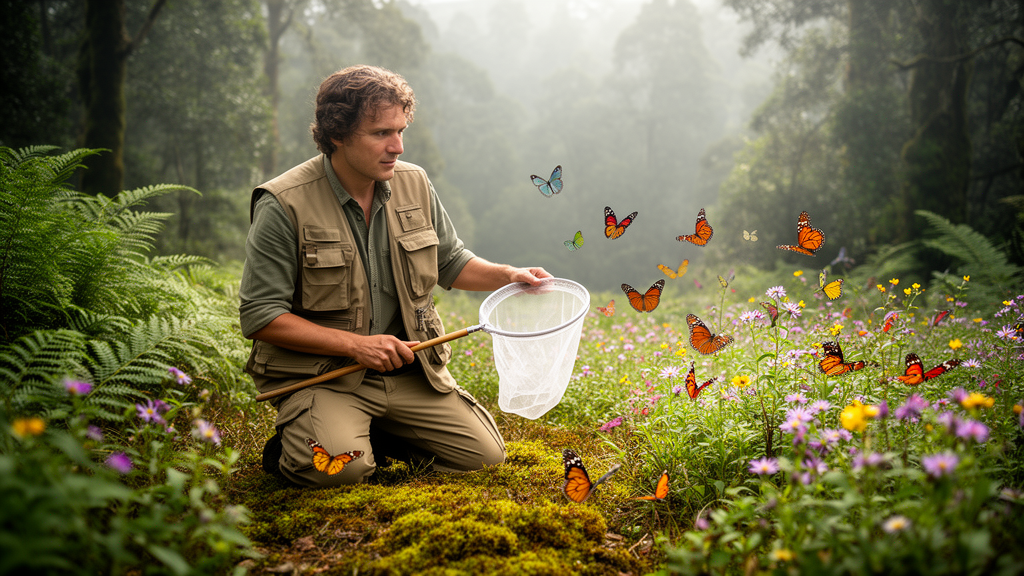
A single montane forest in central Ethiopia has yielded its first scientific inventory of butterflies, and the results sketch a mountain where every vegetation belt carries its own distinct community of pollinators. Researchers walking standardized transects through Hambericho Mountain Forest recorded 32 butterfly species from five families, totaling 2,037 individuals, in what the authors describe as the first baseline assessment of butterfly diversity for this Afromontane landscape. The survey, published in the journal Ecological Processes, found that a lower-elevation forest site supported the greatest species richness, a mid-elevation shrubland followed closely behind, and a high-elevation grassland trailed well behind both. Yet the grassland was not empty of scientific interest: each of the three zones hosted a statistically distinct butterfly assemblage, and no species was exclusive to the grassland alone, a pattern the authors interpret as evidence that all three habitats contribute uniquely to the mountain’s regional diversity.
Hambericho Mountain Forest sits in the Central Ethiopia Region between roughly 2,300 and 3,000 meters above sea level, within a tropical montane climate receiving 1,200 to 1,500 millimeters of annual rainfall and temperatures ranging from 8 to 22 degrees Celsius, with frequent mist at higher elevations. The mountain is managed as an integrated conservation and ecotourism destination, complete with a 777-step staircase, and receives several thousand visitors annually. That status aims to balance biodiversity protection with sustainable use, but it also introduces potential pressures from human visitation and associated infrastructure. The authors note that the area’s habitats face pressure from local grazing, firewood collection, trail trampling from tourism, and broader climate change, all of which can alter the habitat structure and microclimates that butterflies depend on for survival.
The fieldwork concentrated on three purposively selected sites, each separated by approximately five kilometers. A forest site at lower elevations of 2,315 to 2,471 meters featured closed canopy and tree cover exceeding 80 percent. A shrubland site at mid elevations of 2,651 to 2,804 meters was dominated by shrubs covering 70 to 85 percent of the ground. A grassland site at higher elevations of 2,902 to 2,981 meters carried herbaceous cover above 70 percent with sparse trees. At each site, the team established five transects of 100 meters, each divided into three sampling points at the start, middle, and end, with circular plots of 5-meter radius marking the data collection zones. Transects ran perpendicular to elevation contours, were randomly located within each site, and were kept at least 200 meters apart to prevent double-counting of individual butterflies moving between adjacent routes.
Sampling followed the standardized Pollard walk transect method, adapted for montane conditions, over 28 consecutive days from May 10 to June 6, 2025. Surveys took place on 10 pre-scheduled days, roughly every third day, during two windows of peak butterfly activity: mornings from 9:00 to 11:00 and afternoons from 13:00 to 15:00, under suitable weather defined as sunny conditions with wind below 10 kilometers per hour. Observers walked each transect slowly at a consistent pace of about 30 minutes per 100 meters, recording every butterfly sighted within 5 meters to the side, front, and above. Species were identified visually using field guides for Ethiopian Lepidoptera, with difficult specimens photographed from dorsal and ventral views for later verification. Both authors participated in every sampling event at all three sites to ensure consistent identification and counting, and three local residents were trained to assist with netting, navigation, and interpretation in the local language. Each transect was sampled 10 times, yielding 150 survey events in total.
The family-level results underline how heavily Nymphalidae dominated the mountain’s butterfly fauna. Nymphalidae contributed 16 species and 859 individuals, accounting for 42.2 percent of total abundance. Pieridae followed with 5 species and 26.1 percent of individuals, then Lycaenidae with 4 species and 13.8 percent, Hesperiidae with 4 species and 13.1 percent, and Papilionidae with 3 species and 4.8 percent. The most abundant species overall were Catopsilia florella with 178 individuals, Colias electo with 152, and Belenois aurota with 112, with Catopsilia florella dominant across all habitats. Importantly, species accumulation curves did not reach asymptotes at any of the three sites, a statistical signal that additional sampling would likely reveal more species. The authors therefore frame the 32 species as a baseline inventory rather than a complete species list for Hambericho Mountain.
Diversity metrics told a consistent story across the elevation gradient. Species richness differed significantly among the three sites according to a Kruskal-Wallis test, with the forest site highest, shrubland intermediate, and grassland lowest. Post-hoc comparisons showed that forest differed significantly from grassland, whereas shrubland did not differ significantly from either. Shannon diversity followed the same pattern: forest averaged 2.59 plus or minus 0.26 and shrubland 2.49 plus or minus 0.21, both comparably high, while grassland was significantly lower at 1.35 plus or minus 0.14. Simpson diversity mirrored this result. In contrast, Pielou’s evenness did not differ among sites, remaining high at 0.96 to 0.97 everywhere, indicating that the grassland’s lower diversity stems from having fewer species rather than from uneven abundances. Rarefaction to a common sample of 26 individuals, the smallest transect abundance recorded, confirmed the pattern with rarefied richness of 17.1 species in forest, 15.4 in shrubland, and 6.3 in grassland, ruling out unequal sampling effort as an artifact.
Habitat structure emerged as a powerful correlate of these diversity patterns. Herb cover showed the strongest negative correlation with butterfly metrics: r equals negative 0.698 with species richness, negative 0.608 with abundance, and negative 0.798 with Shannon diversity, all statistically significant. Herb height was also negatively correlated with richness and Shannon diversity. Canopy cover and tree cover, by contrast, showed positive correlations with Shannon diversity, with coefficients of 0.526 and 0.528 respectively. A generalized linear model combining site and herb cover explained 58.9 percent of the deviance in species richness, but neither predictor was statistically significant in the combined model, a result the authors attribute to strong collinearity between site and herb cover. Because each site occupied a non-overlapping elevation range, elevation was completely confounded with site and had to be excluded from all models, meaning the study presents descriptive comparisons among sites rather than causal evidence of elevation or vegetation effects.
Community composition analysis reinforced the picture of three distinct butterfly assemblages. Non-metric multidimensional scaling, with a stress value of 0.097 indicating excellent ordination quality, showed forest and shrubland communities overlapping while grassland separated distinctly. Analysis of similarity confirmed significant differences among sites with a global R of 0.595 and p of 0.002. Pairwise tests showed grassland differed significantly from both forest and shrubland, whereas forest and shrubland did not differ from each other. A permutational multivariate analysis of variance supported these findings. Indicator species analysis identified seven significant indicator species with indicator values above 0.7. Charaxes brutus and Charaxes kirki were forest specialists, a notable result because Charaxes species are widely recognized as indicators of relatively intact forest. Four species, Actizera stellata, Eretis lugens, Uranothauma nubifer, and Spialia spio, were forest-shrubland generalists, and Colias electo was a shrubland-grassland generalist with the strongest association of all, an indicator value of 0.923. No species were exclusive to grassland or shrubland alone.
The 32 species recorded at Hambericho are fewer than counts reported from other Ethiopian montane systems, including 64 species in the Jimma Highlands, 50 at Wolaita Sodo University, and 79 in Chebera Churchura National Park. The authors attribute this difference likely to methodological constraints, particularly the short 28-day sampling duration and focus on a single seasonal window, since seasonal turnover strongly influences apparent richness in Afrotropical montane butterflies. Ecological factors may also contribute: Hambericho is a relatively small and isolated Afromontane forest patch, and forest size, isolation, and edge effects are known to reduce butterfly richness and favor generalist species. The dominance of widespread generalists such as Catopsilia florella and Belenois aurota, both tolerant of disturbed and open habitats, supports this interpretation. The authors also acknowledge further limitations: the small sample size of 15 transects limits statistical power, and repeated samples were pooled across days under the assumption of constant detectability.
For conservation, the message is that no single zone can safeguard Hambericho’s butterflies on its own. The forest site holds the greatest richness, but the grassland, though least diverse, contains unique assemblages and should not be neglected, while shrublands appear to function as transition zones and connecting corridors that support many forest-shrubland generalists and facilitate movement across the mountain. The authors recommend that all three vegetation zones be considered in conservation planning to maintain local butterfly diversity. Looking forward, they outline four priorities: sampling multiple sites at overlapping elevations to separate vegetation from elevation effects, extending sampling across multiple seasons to capture temporal variation, directly measuring tourism impacts to assess potential threats to butterfly communities, and increasing sample size to improve statistical power. As the first butterfly inventory for this ecotourism landscape, the study provides the baseline against which future change, whether from tourism pressure, habitat degradation, or a shifting climate, can now be measured.
Subject of Research: Baseline inventory of butterfly diversity and community structure across three vegetation zones in an Ethiopian montane forest
Article Title: Butterfly diversity and community structure across three vegetation zones in Hamericho Mountain Forest, Central Ethiopia
Article References: Gebremariam, G. H., & Goshime, B. (2026). Butterfly diversity and community structure across three vegetation zones in Hamericho Mountain Forest, Central Ethiopia. Ecological Processes, 15(1), Article 91. https://doi.org/10.1186/s13717-026-00732-2
Image Credits: AI Generated
DOI: 10.1186/s13717-026-00732-2
Keywords: butterflies, Ethiopia, montane forest, biodiversity, ecotourism, species richness, habitat structure, community ecology, Afromontane, Pollard walk, indicator species, conservation
News Source: Margaret Porter. (October 29, 2026). First Butterfly Survey Reveals 32 Species Across Ethiopian Mountain Forest Zones. Scienmag.