


Urban segregation is often pictured as a fixed feature of residential neighborhoods, but a new study argues that it is reproduced daily as people move through the city — and that the degree of mixing depends heavily on which layer of the transport system they occupy. Writing in EPJ Data Science, Yitao Yang, Erjian Liu, Bin Jia and Ed Manley present a framework for quantifying what they call multi-layered segregation, applied to a mobile phone dataset covering 11 million individuals in Beijing, with core analyses based on the 6.05 million people for whom stable residential and workplace anchors could be inferred.
The researchers point out that sidewalks, roads, buses and rail frequently traverse the same physical corridors while carrying distinct residential socioeconomic status (SES) groups, creating parallel layers of mixing and isolation that conventional approaches miss. Existing methods typically treat cross-group encounters as occurring within a single or aggregated mobility layer, obscuring these differences. To capture them, the team introduces two indices: the mode-specific mixing index (MMI), which measures within-mode diversity, and the multimodal uniformity index (MUI), which summarizes how evenly mixing is distributed across transport layers.
The analysis shows that segregation varies sharply by transport mode. Rail produces the highest observed mixing, because it links disparate neighborhoods across the city, while active travel — walking and cycling — remains locally sorted, keeping encounters within more homogeneous local populations. To test whether this pattern is simply a byproduct of how Beijingers already travel, the authors built an origin–destination-preserving null model that holds the city’s existing origin–destination structure, timing, routing and mode choices fixed. Against that benchmark, rail shows the smallest mixing deficit relative to the level expected under the existing mobility structure, whereas other layers display stronger residential SES sorting than their travel patterns alone would predict.
The study also finds that this layered segregation is not static. It fluctuates with daily rhythms, becoming more pronounced in peripheral zones and during commuting hours, when directionally organized mobility flows amplify social divergence between groups. In other words, the same urban transport system can produce different degrees of social exposure depending on the time of day and the part of the city, with peak-period commuting concentrating directional flows that sharpen separation across layers.
Beyond measurement, the authors run exploratory mode-choice simulations suggesting that changes in generalized travel costs — the combined time, money and effort of a journey — can redistribute residential SES groups unevenly across mobility layers. The researchers stress the exploratory nature of these simulations, which model how altered costs might shift mode use rather than demonstrating observed behavioral change.
The broader contribution of the work is conceptual as much as technical: it reframes segregation as a property distributed across the transport system rather than concentrated in neighborhoods alone. By providing metrics that capture modal stratification, the authors aim to give urban planners and policymakers tools to incorporate the social dimensions of transport systems into planning and policy evaluation. The article, published open access on 8 September 2026, is being shared early as a peer-reviewed, accepted, citable version carrying a permanent DOI, subject to further edits before the final Version of Record. The authors note that the framework’s application is specific to Beijing’s mobility structure and the inferred residential and workplace anchors of the 6.05 million individuals in the core analysis, so extending the approach to other cities will require comparable data on stable activity anchors across transport modes.
Subject of Research: Quantifying how socioeconomic segregation differs across layers of an urban transportation system using Beijing mobile phone data
Article Title: Multi-layered segregation in urban transportation systems
Article References: Yang, Y., Liu, E., Jia, B., & Manley, E. (2026). Multi-layered segregation in urban transportation systems. EPJ Data Science. https://doi.org/10.1140/epjds/s13688-026-00697-4
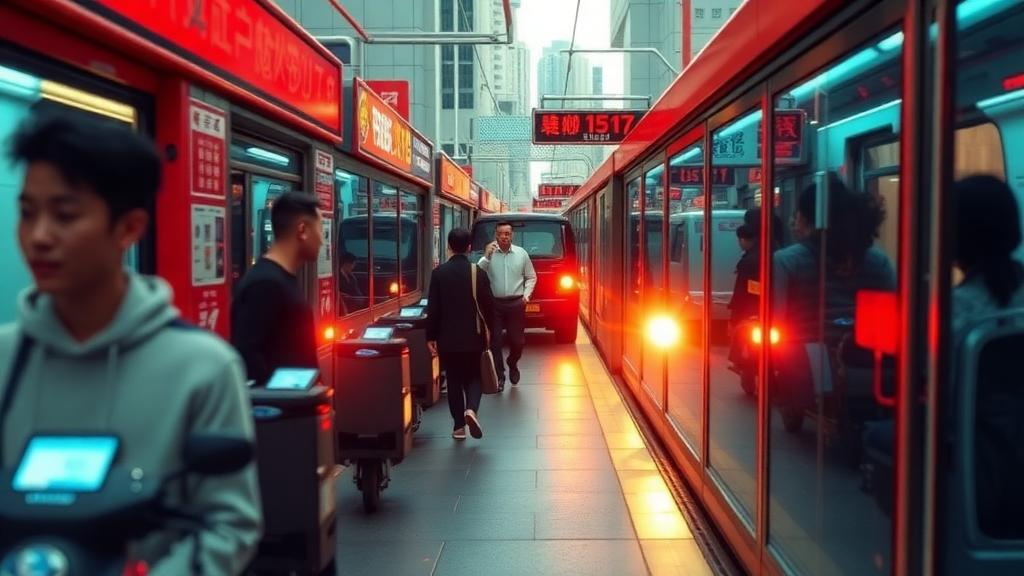
Image Credits: AI Generated
DOI: 10.1140/epjds/s13688-026-00697-4
Keywords: urban segregation, transport modes, mobility, Beijing, mobile phone data, socioeconomic status, rail transit, active travel, commuting, null model, urban planning, EPJ Data Science
News Source: Denise Maddox. (October 29, 2026). Beijing phone data reveal segregation varies sharply across transport modes. Scienmag.



