


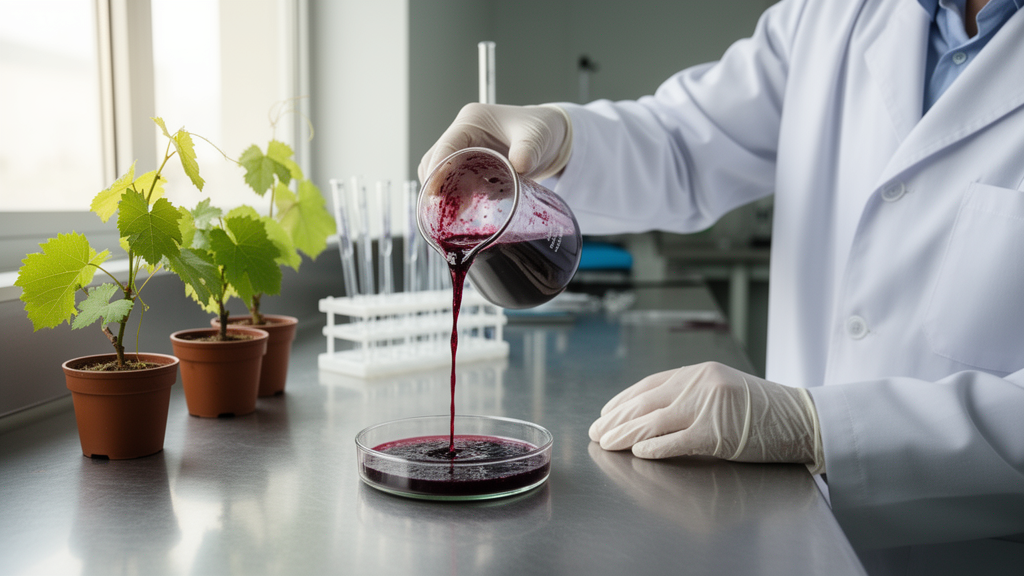
Wine lees, the sediment that collects at the bottom of fermentation tanks and barrels, have long been treated as little more than a disposal problem. Now they are emerging as a raw material for protecting vineyards. A research team reports that an integrated bioprocess can upgrade these winery by-products into peptide-enriched mixtures that show antifungal activity against two of the most damaging grapevine trunk disease pathogens, Phaeomoniella chlamydospora and Phaeoacremonium minimum.
Grapevine trunk diseases, and Petri disease in particular, rank among the most severe problems facing viticulture. The two fungi colonize the wood tissue of young grapevines, causing wood discoloration, necrosis, tiger-striped leaves, stunted growth, wilting and even plant death. Effective chemical control has been lacking since sodium arsenite was banned because of its risks to human health, which has made biocontrol strategies an increasingly attractive alternative.
Lees are a promising but highly variable raw material. They represent the second major winery by-product, accounting for about 25 percent of the total, and consist mainly of dead and living yeast cells containing proteins and peptides, polysaccharides, lipids and polyphenols. Their composition depends on numerous parameters, including the yeast species and strains used and the grape cultivars, which is why the researchers treated composition control as a central part of the process design.
To link the waste problem with the disease problem, the team built an integrated bioprocess from a defined sequence of unit operations: fermentation design using Saccharomyces monocultures and sequential inoculations with non-Saccharomyces strains, ultrasound-assisted autolysis, enzymatic hydrolysis, and 3 kDa ultrafiltration. The resulting product streams were then tested both in vitro and in vivo against both pathogens.
The results drew a sharp line between the product streams. High-molecular-weight autolysates showed no inhibition of fungal growth. In contrast, the post-hydrolysis fractions reduced mycelial growth of Phaeoacremonium minimum by 45 to 75 percent and of Phaeomoniella chlamydospora by 40 to 57 percent, and decreased conidiation by up to 92 percent and 61 percent, respectively.
The fractions also performed in the plant assays. They reduced symptoms of wood discoloration by 47 to 52 percent and 35 to 73 percent, and endophytic fungal growth by 63 to 84 percent and 80 to 91 percent, respectively. The authors note that this pattern indicates an association between hydrolysis and the appearance of antifungal activity, suggesting that breaking down yeast proteins into smaller peptides is what unlocks the effect.
Beyond the activity assays, the study mapped the chemistry behind the differences. Untargeted metabolomics using UHPLC–ESI–TIMS–QTOF highlighted strain- and fermentation-dependent secondary metabolite signatures, with 448 features differentiating across fermentation conditions. Activity-based correlation fingerprinting then identified 49 putative biomarkers negatively associated with pathogen growth, providing a starting point for understanding which molecules matter most.
The authors conclude that fermentation design functions as a controllable upstream quality parameter. By choosing yeast strains and inoculation sequences deliberately, producers could in principle steer the composition of the lees-derived products toward stronger antifungal activity, turning biological variability from a liability into a design lever.
For the wine industry, the approach offers a scalable circular economy pathway: a major by-product that is currently underexploited becomes the feedstock for antifungal bioproducts aimed at a disease complex that has lacked effective chemical options for years. The work, entitled “Yeast-derived biomolecule mixtures from wine lees display antimicrobial activity: an integrated bioprocess approach against grapevine pathogens,” was published in Systems Microbiology and Biomanufacturing on August 12, 2026.
The findings remain at the experimental stage, established through in vitro and in vivo assays against the two pathogens rather than through large-scale field trials. Even so, the study frames a concrete route from winery waste to vineyard protection, in which the same fermentation choices that shape wine character could also shape the next generation of biocontrol products for young grapevines.
Subject of Research: Upgrading wine lees into antifungal biomolecule mixtures against grapevine trunk disease pathogens
Article Title: From winery waste to vineyard shield: Wine lees yield peptide mixtures active against grapevine trunk disease
Article References: From winery waste to vineyard shield: Wine lees yield peptide mixtures active against grapevine trunk disease. Original publication (Bibliographic details unavailable.)
Image Credits: AI Generated
DOI: Not provided
Keywords: wine lees, grapevine trunk diseases, Petri disease, Phaeomoniella chlamydospora, Phaeoacremonium minimum, antifungal peptides, fermentation, circular economy, biocontrol, viticulture, Systems Microbiology and Biomanufacturing, ultrafiltration
News Source: Ophelia Keating. (October 29, 2026). Wine lees transformed into antifungal mixtures against grapevine trunk disease. Scienmag.



