


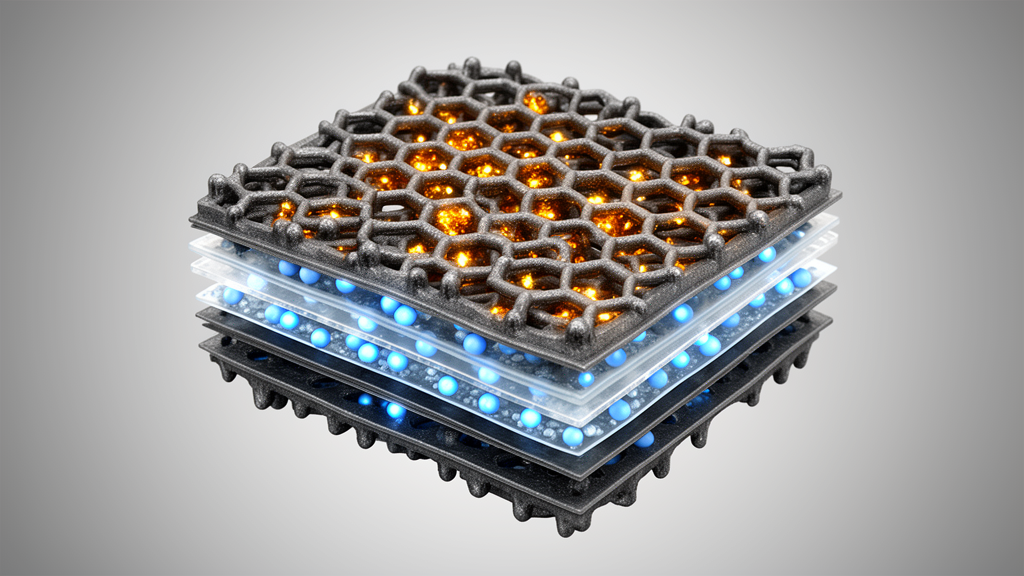
Researchers have developed a 3D-printable anode material for lithium-ion batteries that combines sulfur-vacancy-rich tungsten disulfide with a defect-rich titanium dioxide interphase, reporting substantial gains in lithium storage capacity over the individual components. The work, published in Advanced Composites and Hybrid Materials, describes a heterostructure designated WS2/TiO2@C, in which a carbon-coated composite is integrated into a three-dimensionally printed electrode architecture.
Tungsten disulfide is considered a promising anode material because of its high theoretical capacity, but two long-standing problems have limited its practical use: poor intrinsic electrical conductivity and severe volume changes during repeated charging and discharging. The new design addresses both issues simultaneously. According to the study, the sulfur vacancies introduced into the WS2 provide abundant lithium-ion adsorption sites and accelerate reaction kinetics, while the surrounding phases mitigate structural degradation during cycling.
A key feature of the synthesis is in-situ interphase engineering. The team reports that Ti3C2Tx MXene undergoes partial transformation to form a defect-rich TiO2 interphase, accompanied by Ti–S-related interfacial interactions. These interactions promote coupling between the WS2 and the titanium-containing phase, which the authors say enables efficient electron transport and rapid lithium-ion diffusion across the heterostructure. The defect-rich interphase thus acts as a bridge that ties the electrochemically active WS2 into a conductive, mechanically resilient network.
The second half of the strategy lies in the electrode architecture itself. By integrating the interphase-regulated material into a 3D-printed electrode, the researchers created interconnected conductive pathways, shortened ion diffusion distances, and a structure capable of supporting high mass loading.
Performance-wise, the 3D-printed anode, termed 3DP-WTCN, exhibited a 200 to 500 percent improvement in areal capacity compared with the unprinted WTCN composite, pristine WS2, and Ti3C2Tx MXene anodes. The WTCN anode delivered a reversible capacity of 697.1 mAh g⁻¹ at 0.2 A g⁻¹ with 80.2 percent capacity retention, corresponding to improvements of roughly 248 percent over pristine WS2 and about 365 percent over Ti3C2Tx MXene. The 3D-printed version added a further average increase of approximately 50 percent in specific capacity over the WTCN anode.
The study, published as an open-access article on 28 October 2026, was authored by Jialin Li, Saima Batool, Xiaoke Dai, Muhammad Idrees, Junguo Xu and colleagues. The results suggest that combining defect engineering at the atomic scale, through vacancies and interfacial bonding, with architectural engineering at the electrode scale, through additive manufacturing, offers a route to anodes that store more lithium while withstanding the mechanical stress of cycling. As with all reported battery materials, the findings describe laboratory-scale electrochemical measurements, and the published version is a peer-reviewed accepted manuscript that remains subject to final editorial edits.
Subject of Research: Defect engineering and 3D printing of a WS2/TiO2@C heterostructure anode for enhanced lithium-ion storage
Article Title: In-situ engineering of a defect-rich TiO₂ interphase coupled with sulfur vacancies in WS2/TiO2@C heterostructures for enhanced Li⁺ storage in 3D-printed anodes
Article References: Li, J., Batool, S., Dai, X., Idrees, M., & Xu, J. (2026). In-situ engineering of a defect-rich TiO₂ interphase coupled with sulfur vacancies in WS2/TiO2@C heterostructures for enhanced Li⁺ storage in 3D-printed anodes. Advanced Composites and Hybrid Materials. https://doi.org/10.1007/s42114-026-02152-4
Image Credits: AI Generated
DOI: 10.1007/s42114-026-02152-4
Keywords: lithium-ion batteries, anode materials, tungsten disulfide, TiO2 interphase, MXene, sulfur vacancies, 3D-printed electrodes, heterostructures, capacity retention, energy storage, In-situ, engineering
News Source: Denise Maddox. (October 29, 2026). Defect-rich TiO2 interphase and sulfur vacancies boost lithium storage in 3D-printed WS2 anodes. Scienmag.



