


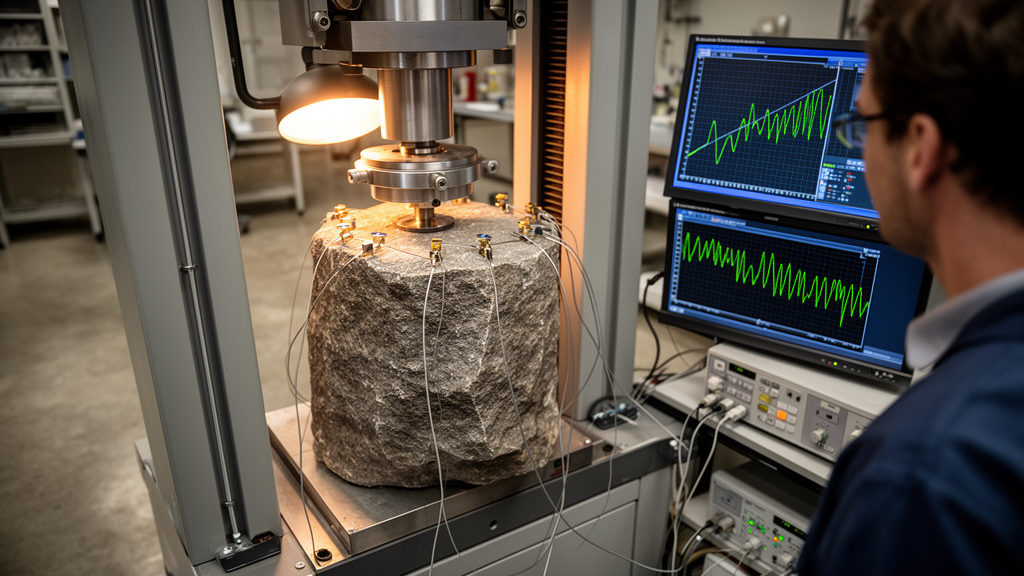
Predicting the moment a brittle rock will break has long been one of the most stubborn problems in geotechnical engineering and mining safety. Rockbursts, landslides and gas outbursts all involve the sudden failure of stressed rock, and short-term prediction of that failure remains an unsolved challenge. A study published in GeoEnergy Communications now reports a step toward a quantitative answer: a real-time forecasting method built on acoustic emission monitoring that was validated on an unusually large laboratory dataset of 403 sandstone specimens subjected to uniaxial compression. In every specimen tested, the method issued a warning signal before failure occurred, with warnings triggered on average when the applied load reached 76.7 percent of the specimen’s ultimate compressive strength.
The new indicator, named WIb, is the b-value change rate per unit time. The b-value itself comes from seismology: Gutenberg and Richter first described how the frequency of earthquakes decreases exponentially with magnitude, and the same amplitude-based relation has long been applied to acoustic emission signals from cracking rock. At the laboratory scale, the b-value is negatively correlated with differential stress and tends to decline as loading approaches peak strength, reflecting a shift toward larger fracture events. The authors of the new study argue, however, that simply watching for a downward trend in the b-value is too subjective. There has been no objective way to identify the turning point of the trend, a falling b-value does not reliably indicate imminent failure, and most existing indicators can only be identified retrospectively, after the entire loading record is available.
WIb was designed to overcome those limitations by quantifying how violently the b-value fluctuates rather than where it is heading. Mathematically, it is the sum of the absolute slopes between consecutive b-value data points within a one-second window. A high WIb therefore captures two things at once: frequent oscillations in the b-value, corresponding to rapid alternation between small and large microcracking events, and large jumps between successive values, indicating significant changes in the scale of active fracturing. Both behaviors intensify as a specimen transitions from stable to unstable crack propagation, giving the indicator a physical rationale as a failure precursor.
The experimental campaign behind the validation was substantial. The 403 sandstone specimens were drawn from formations in the Ordos Basin, Junggar Basin, Sichuan Basin, the Huainan coalfield and several eastern Chinese sedimentary units, providing broad geological heterogeneity. Each specimen measured 50 by 50 by 100 millimeters and was loaded at a constant axial stress rate of 0.5 megapascals per second in a purpose-built apparatus that injects extra strain energy at failure, ensuring unstable strainburst-type collapse rather than quiet quasi-static breakdown. The specimens varied enormously in mechanical properties: uniaxial compressive strength ranged from 27.4 to 142.5 megapascals, a fivefold spread, while elastic modulus ranged from 2.42 to 74.04 gigapascals, a ratio of more than 30 between the stiffest and most compliant samples.
Acoustic emission was recorded continuously with a Physical Acoustics PCI-2 system at 40 decibels of preamplification and a 40-decibel capture threshold, synchronized to load and deformation data by GPS time-stamping accurate to a microsecond. Thirty-six specimens carried eight sensors arranged diagonally for full three-dimensional event localization using the Geiger method; the remaining 367 carried two opposed sensors. The recorded signals traced the classic four-stage deformation sequence. During compaction, activity was sparse and low-energy, typically below 10 to the fifth attojoules. In the elastic stage the event rate rose only slightly. Stable crack propagation brought intermittent high-energy events and AE clusters that migrated toward the future fracture plane, and in the unstable stage immediately before peak stress, events exceeding 10 to the sixth attojoules became frequent as microcrack clusters coalesced into macroscopic fractures.
The b-value evolution mirrored this progression. Early in loading, values generally exceeded 1.5, indicating dominance of small-magnitude events, with only minor statistical fluctuations. A consistent decline typically began when axial stress reached roughly 60 to 70 percent of ultimate strength, marking the onset of distributed damage, and then accelerated sharply just before peak stress, accompanied by high-frequency, large-amplitude oscillations. It is precisely this oscillatory escalation that WIb captures. In representative specimens, WIb stayed low and quiet through compaction and elastic loading, climbed gradually during stable cracking, and then surged dramatically in the unstable stage, well before peak load was reached.
Converting that escalation into an actionable warning required a threshold, and the authors rejected any fixed absolute value because WIb naturally fluctuates, especially early in loading when acoustic emission activity is sparse. Instead, the threshold is statistically adaptive: at any moment it equals the mean of all WIb values recorded so far plus two standard deviations. When real-time WIb exceeds this moving threshold, a warning fires. The choice of two standard deviations was validated across the full dataset as the best balance between early detection and false alarms. In the two representative specimens, Sample A crossed the threshold 21.4 seconds before failure at 83.4 percent of its strength, and Sample B crossed 33 seconds before failure at 84.1 percent of its strength.
Applied to all 403 specimens, the method issued a warning before failure in every case. The ratio of warning load to ultimate compressive strength followed a normal distribution with a mean of 0.7669 and a standard deviation of 0.08818, and about 77.2 percent of warnings fell between 65 and 90 percent of ultimate strength. A kurtosis of 4.059 indicated that warnings clustered tightly around the mean, suggesting consistent performance across specimens whose strengths varied fivefold. Not every case was clean: 38 specimens, fewer than 10 percent, produced unusually early warnings traced to imperfect end-face preparation that generated elevated early acoustic activity and strong b-value oscillations. The authors note such deviations are inherent to testing heterogeneous rock and do not undermine the overall statistical relationship.
Sensitivity analyses addressed whether the result depends on arbitrary parameter choices. Window sizes from 50 to 1000 events were tested, with 200 events optimal: smaller windows produced noisy b-value trends, while sizes beyond 500 over-smoothed the signal and delayed precursor detection. Sliding step lengths of 20 to 160 events had minimal impact on warning timing, and reducing the sensor array from eight to two changed event counts but preserved the shape of the b-value trends and the timing of WIb escalation. Across all parameter combinations tested on the representative specimen, the standard deviation of the warning load was 0.823 megapascals, only 1.5 percent of its mean. Threshold sensitivity tests with scaling factors from one to five confirmed two standard deviations as the most dependable setting.
The authors also emphasize practicality. WIb and its threshold are computed solely from data collected before the warning, requiring no knowledge of the full loading path, and need only AE amplitude data and event timestamps rather than waveform features or source localization. Benchmark tests showed each update cycle took less than 50 milliseconds on a standard desktop computer, negligible compared with typical acoustic emission event rates. Because the method was validated only on laboratory specimens of sandstone under uniaxial compression with an added strain-energy source, field performance remains to be demonstrated, but the authors argue its minimal data requirements and computational simplicity make it a candidate for integration into field-scale acoustic emission and microseismic monitoring systems for geotechnical, mining and civil engineering applications.
Subject of Research: A real-time acoustic emission method for forecasting brittle sandstone failure in laboratory compression tests.
Article Title: Real-time forecasting of brittle rock failure: a robust acoustic emission approach validated on a large experimental dataset
Article References: Gao, F., Yang, L., Lu, Z., Wu, R., Liu, W., & Xi, C. (2026). Real-time forecasting of brittle rock failure: a robust acoustic emission approach validated on a large experimental dataset. GeoEnergy Communications, 2(1), Article 1. https://doi.org/10.1007/s44421-025-00014-1
Image Credits: AI Generated
DOI: 10.1007/s44421-025-00014-1
Keywords: acoustic emission, rock failure, b-value, early warning, uniaxial compression, sandstone, geotechnical engineering, mining safety, microcracking, forecasting, strainburst, laboratory testing
News Source: Denise Maddox. (October 29, 2026). Acoustic Emission Warning Signal Flags Rock Failure Before Collapse in 403 Lab Tests. Scienmag.



