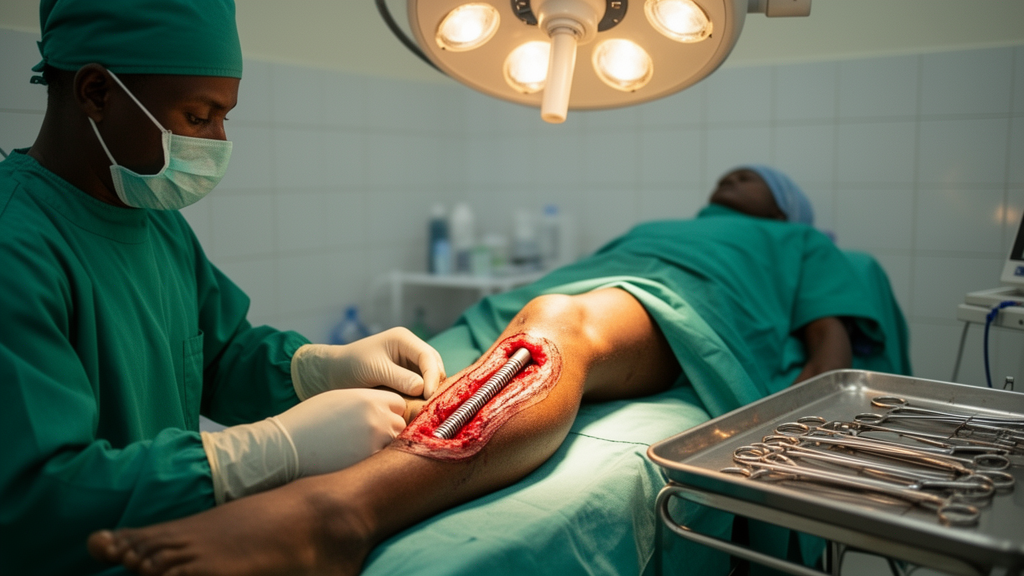
Surgeons at the University of Gondar Comprehensive Specialized Hospital, a tertiary referral center in northwest Ethiopia, have documented an overall implant-associated infection rate of 8.46% among patients who received intramedullary nailing for femoral or tibial fractures. The figure, drawn from a retrospective cross-sectional study of 260 operations performed between January 2021 and December 2023, sits well above the crude rates of 0.8% to 1.5% reported in a large multicenter analysis of more than 46,000 intramedullary nailing procedures across low- and middle-income countries, and above the roughly 2.5% overall rate estimated in a multicenter prospective cohort of tibial and femoral nailing. The researchers report that 22 of the 260 patients developed an infection around the metal rod and screws used to stabilize the broken bone, with 12 cases classified as deep infections involving the implant, bone, or fracture site, and 10 confined to the skin and subcutaneous tissues.
The study, published in Archives of Orthopaedic and Trauma Surgery, set out to fill a gap that has long frustrated infection-control efforts in resource-limited settings. Intramedullary nailing is the preferred surgical technique for stabilizing femoral and tibial fractures because of its favorable biomechanical properties and relatively low complication rates, yet infections around the implant remain a serious postoperative complication that can drive prolonged hospitalization, higher costs, revision surgery, and in severe cases limb loss. Existing Ethiopian studies had reported infection rates between 4% and 9% after nailing of lower extremity long bones, but few had examined in detail which patient, injury, and perioperative factors drive that risk, or which microbes are responsible.
The analytic sample was assembled carefully. Of 295 patients initially identified, six were excluded—three with pathological fractures and three referred from other hospitals after nailing elsewhere—leaving 289 eligible cases. A further 29 patients were dropped because of incomplete data in the registry, producing the final cohort of 260. The population was overwhelmingly young, male, and rural: nearly 60% were adults aged 18 to 30, only 17 patients were 61 or older, 83.46% were male, and 75.38% lived in rural areas.
The injury burden in the cohort was severe. Bullet injuries were the leading mechanism, affecting 119 patients, or 45.77%, followed by road traffic accidents at 78 cases. Among those open fractures, 80% were high-grade injuries classified as Gustilo-Anderson IIIA, IIIB, or IIIC, categories associated with extensive soft-tissue damage and heavy contamination. The median time from injury to hospital presentation was 12 hours, though the distribution was heavily right-skewed, and 14.23% of patients arrived more than two days after their injury.
Delays extended into surgical care. The median time from injury to definitive nailing was 180 hours, with more than half of patients undergoing late surgery beyond 168 hours after injury and only 31.92% receiving early intervention within 48 hours. Among patients with open fractures, 56.36% received prophylactic antibiotics more than six hours after injury, and 67.27% underwent initial surgical debridement more than 24 hours after injury. Hospital stays were long as well: the median was 13 days, and 40.77% of patients remained hospitalized for more than two weeks.
When the researchers ran a multivariable logistic regression model, two factors emerged as independently associated with infection. Patients whose nailing was performed as emergency surgery had roughly eight times the odds of developing an infection compared with those treated electively, with an adjusted odds ratio of 8.075 and a 95% confidence interval of 1.356 to 48.067. Patients hospitalized for more than 14 days had about 27 times the odds of infection compared with those discharged within seven days, an adjusted odds ratio of 27.542 with a confidence interval stretching from 1.567 to 484.227. The authors caution that these intervals are wide because only 22 infection events occurred, limiting statistical power, and that reverse causality cannot be excluded for the hospital-stay variable—an infection itself may prolong hospitalization rather than the reverse. The retrospective cross-sectional design means neither association should be read as causal.
The emergency-surgery finding is consistent with prior work showing higher postoperative infection risk after emergency nailing of femoral and tibial shaft fractures, possibly reflecting greater wound contamination and limited preoperative preparation, though other studies of orthopedic operations have not identified emergency surgery as an independent predictor. The prolonged-stay finding echoes reports that hospitalization beyond ten days or two weeks predicts orthopedic surgical site infections, potentially through extended exposure to hospital pathogens, repeated invasive procedures, and comorbidity-related vulnerability. Because prophylactic antibiotics were administered routinely under a standardized Ethiopian treatment guideline, with cefazolin-based regimens for closed and low-grade open fractures and added gram-negative coverage for type III open fractures, there was no meaningful variation in prophylaxis status to test as a predictor.
The microbiological results were striking but rest on a very small base. Culture and sensitivity testing was performed on only 9 of the 22 infected cases, and just 4 of those cultures yielded growth. All isolates were gram-negative organisms: Escherichia coli accounted for half, Klebsiella pneumoniae for a quarter, and non-lactose-fermenting gram-negative rods for the remainder. That pattern contrasts sharply with other settings, where Staphylococcus species typically dominate implant-associated infections. The authors suggest several possible explanations, including cultures obtained after antibiotics had already started, which may suppress gram-positive growth; limited availability of culture media; and possible contamination during specimen collection or processing. The isolates showed sensitivity to agents including meropenem, imipenem, gentamicin, and ceftazidime, while resistance was observed against ceftriaxone, ampicillin, and several other drugs. With only four positive cultures, the team stresses these findings cannot represent the full microbiological spectrum at the institution.
The reported rate compares in nuanced ways with the wider literature. It is substantially higher than the 4.18% reported by a prior Ethiopian long-bone nailing study, a gap the authors attribute partly to their cohort’s much higher proportion of open fractures, roughly 64% versus 24%. It aligns closely with a 9.3% rate reported at Saint Paul’s Hospital Millennium Medical College in Addis Ababa, although the deep-infection proportion in Gondar, 4.62%, exceeded that cohort’s 3.45%, possibly because grade IIIA injuries predominated in Gondar while grade II fractures were most common in Addis Ababa. Conversely, some studies confined to open tibial shaft fractures or combined open femoral and tibial fractures have reported still higher rates of 11.9% and 12.9%. The authors also note that the low crude rates from the large LMIC database likely underestimate the true burden, because incomplete follow-up means many patients never return unless complications arise; when only patients with documented follow-up were counted, rates rose to as much as 6.9% for tibial fractures.
The study carries the limitations inherent to retrospective chart review: reliance on secondary records that may have incompletely captured nutritional status, glycemic control, and smoking history; infection diagnoses accepted as recorded by operating surgeons under fracture-related infection consensus criteria; variable follow-up that may have missed late infections; and a single-center design that limits generalizability. Still, the authors argue the findings point to concrete priorities: timely culture sampling before antibiotics, expanded microbiological capacity, optimization of perioperative protocols, faster surgical management of open fractures, and strategies to minimize unnecessary hospital stays. They call for prospective cohort studies and multicenter work across Ethiopia and similar low-resource settings to establish causality, capture late-onset infections, and test interventions aimed at lowering the burden of implant-associated infection.
Subject of Research: Implant-associated infections after intramedullary nailing of femoral and tibial fractures at an Ethiopian tertiary hospital
Article Title: Epidemiology, determinants, and microbiological profile of implant-associated infections following intramedullary nailing in a tertiary hospital in Ethiopia
Article References: Zegeye, A. M., Belay, S. A., Kebede, E. B., Alemayehu, B. T., Zeleke, S. S., & Molla, Y. D. (2026). Epidemiology, determinants, and microbiological profile of implant-associated infections following intramedullary nailing in a tertiary hospital in Ethiopia. Archives of Orthopaedic and Trauma Surgery, 146(1), Article 369. https://doi.org/10.1007/s00402-026-06535-6
Image Credits: AI Generated
DOI: 10.1007/s00402-026-06535-6
Keywords: intramedullary nailing, implant-associated infection, fracture-related infection, Ethiopia, orthopedic surgery, surgical site infection, Escherichia coli, gram-negative bacteria, open fractures, hospital stay, emergency surgery, low- and middle-income countries
News Source: Ophelia Keating. (October 29, 2026). Implant Infections After Bone Nailing Hit 8.5% in Ethiopian Tertiary Hospital. Scienmag.