


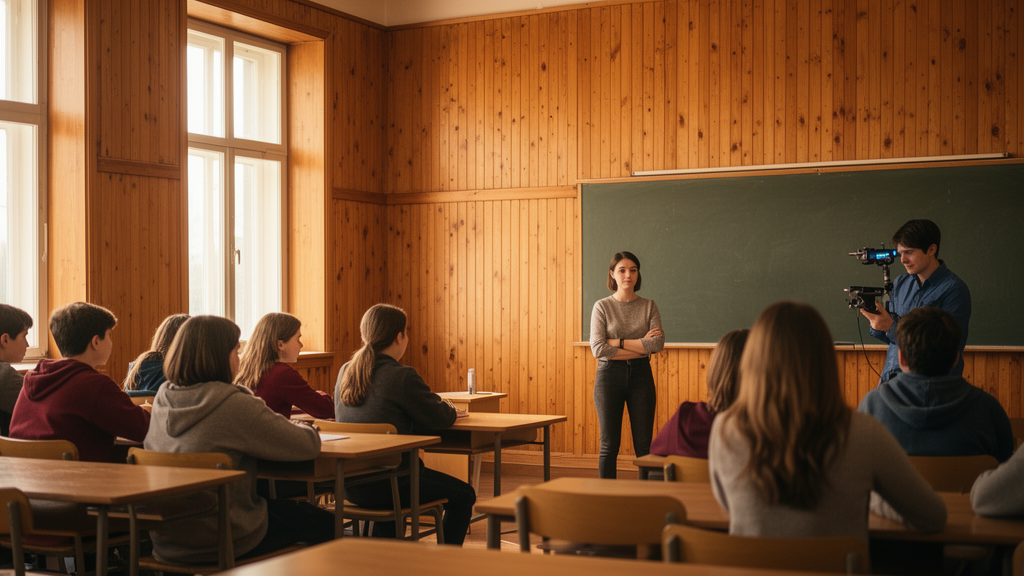
How much wood on a classroom wall changes where students look — and how consistently they look there — according to a new eye-tracking study of university students published in Architectural Research. Researchers at Yonsei University in Seoul found that indoor wood coverage ratios of 0%, 30%, 60%, and 90% measurably altered total fixation duration and fixation count during lecture viewing, although the effects did not increase neatly with the amount of wood on display.
The experiment involved 32 university students, each of whom experienced all four classroom conditions in a within-subject design. The researchers manipulated wood coverage by masking portions of an existing wood-finished classroom wall with white panels, keeping the classroom geometry, lighting, furniture arrangement, lecture content, and viewing distance identical across conditions. Participants wore a Tobii Pro Glasses 3 wearable eye tracker sampling at 100 Hz, watched an identical 120-second lecture video on an electronic display, and completed a 30-second adaptation phase beforehand and a 30-second recovery phase afterward, with the order of the four conditions randomized to guard against learning or fatigue effects.
Visual attention was quantified with three fixation-based metrics computed within the display area of interest: total fixation duration (TFD), the cumulative time gaze remained on the instructional content; fixation count (FC), the number of fixation events; and fixation ratio (FR), the proportion of valid tracking time spent in a fixation state. Heatmaps of fixation density and participant-level temporal trajectories supplemented these statistics, and inter-individual variability was assessed by comparing the standard deviations of the metrics across conditions.
The statistical core of the study was a two-factor repeated-measures analysis of variance with wood coverage and experimental interval as within-subject factors, analyzed in SPSS with Greenhouse–Geisser corrections where sphericity was violated and Bonferroni-adjusted post hoc comparisons. For total fixation duration, the main effect of wood coverage was significant (F(2.19, 67.90) = 14.14, p < 0.001, partial η² = 0.313), as were the effects of experimental interval and the coverage-by-interval interaction. The 60% condition produced the highest TFD, and pairwise comparisons showed that the 30% and 60% conditions were significantly higher than the 0% condition, while the 60% condition also exceeded both the 30% and 90% conditions. Notably, no significant difference separated the 0% and 90% conditions — a clearly non-linear relationship.
Fixation count told a different story. The main effect of wood coverage was again significant (F(2.62, 81.33) = 4.99, p = 0.005, partial η² = 0.139), but Bonferroni-corrected pairwise tests revealed that only the 0%–90% comparison reached significance, with the fully wood-covered room yielding 14.34 fewer fixation events than the wood-free room. The remaining pairwise differences were not statistically significant, so the data do not support a uniform decline in fixation count as wood coverage rises. Fixation ratio, by contrast, showed no significant main effect of wood coverage (p = 0.325), differing only across the experimental intervals, meaning the proportion of time spent fixating stayed relatively stable regardless of wall finish.
Across all four conditions, participants shared a common temporal signature: visual engagement climbed from the adaptation phase to the lecture-viewing phase and then fell during recovery. The significant interaction effects for both TFD and FC indicate that the differences among wood coverage conditions varied across these intervals rather than holding uniformly throughout the session. Temporal trajectory plots showed that the 90%, 60%, and 30% conditions maintained higher mean TFD throughout lecture viewing than the 0% condition, and that gaze trajectories were more compact around the group mean in the higher-coverage classrooms.
Qualitative heatmap analysis added a spatial dimension. Under the 0% condition, fixations spread across both the instructional display and the surrounding bare walls, producing a relatively dispersed gaze pattern. In the wood-covered conditions, fixation density concentrated more heavily on the display, particularly around the instructor and central lecture content, with the 90% condition showing the most compact cluster. The authors stress that these heatmaps were descriptive only — no quantitative comparison among spatial subregions was performed — so the spatial patterns should be read as observed tendencies rather than statistically verified effects.
Perhaps the most striking result concerned consistency between individuals. The standard deviation of total fixation duration shrank progressively as wood coverage increased, falling from 18.7 seconds in the wood-free room to 17.0, 12.0, and 11.6 seconds in the 30%, 60%, and 90% conditions respectively. In other words, students not only looked differently in wood-lined rooms; they looked more alike. The authors caution, however, that because the same participants were observed repeatedly, these variability comparisons were treated as descriptive and exploratory, and future work should apply statistical methods that explicitly account for the dependence of repeated observations.
The study’s limitations temper any rush to line classrooms in timber. The experiment took place in a single university classroom with a homogeneous student sample, and because wood coverage was created by masking wood surfaces with white panels, the wood and panels may have differed in surface reflectance and luminance. Since condition-specific luminance was not measured, the observed gaze responses reflect the overall visual configuration of each room rather than the intrinsic properties of wood alone. Visual attention was also the sole outcome measure, with no physiological, cognitive, or learning-performance indicators.
Within those bounds, the findings offer designers a multidimensional, evidence-based framework for evaluating educational interiors: fixation magnitude, spatial distribution, temporal dynamics, and inter-individual consistency together paint a richer picture than any single metric. The results suggest that moderate wood coverage — around 60% in this setup — may best sustain visual attention, while higher coverage narrows the spread of gaze and tightens group consistency. For architects weighing interior material guidelines, the message is that wall finish is not merely aesthetic; it is an active parameter shaping how occupants visually engage with learning content.
Subject of Research: Effects of indoor wood coverage ratios on the visual attention of university students in classroom environments measured by eye tracking.
Article Title: Effects of Indoor Wood Coverage Ratios on Visual Attention in Educational Environments
Article References: Kang, S. T., Jung, J. H., & Kim, S. (2026). Effects of Indoor Wood Coverage Ratios on Visual Attention in Educational Environments. Architectural Research, 28(1), Article 19. https://doi.org/10.1007/s44515-026-00023-z
Image Credits: AI Generated
DOI: 10.1007/s44515-026-00023-z
Keywords: eye tracking, visual attention, wood coverage, classroom design, interior materials, fixation duration, educational environments, repeated-measures ANOVA, gaze behavior, architectural research, learning environments, inter-individual variability
News Source: Denise Maddox. (October 29, 2026). Wood-Covered Classroom Walls Steer Students’ Gaze, Eye-Tracking Study Finds. Scienmag.



