


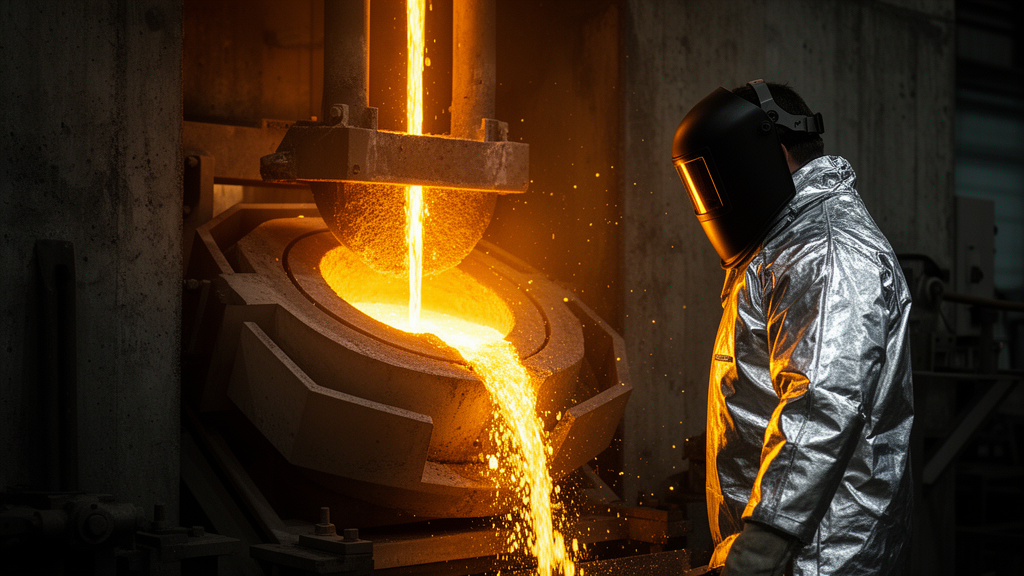
Zine Rezgui, Ammar Tibouche and Nabil Ikhlef modeled a two-dimensional, axisymmetric induction crucible furnace in which a cylindrical charge of pure gold sits inside an alumina ceramic crucible, heated by a single-turn copper inductor operating at the standard grid frequency of 50 hertz. Rather than relying on the finite element methods common in this field, the team built their simulation on the finite volume method, discretizing the coupled magneto-thermal equations over a mesh of small control volumes and solving the resulting algebraic systems with a Gauss-Seidel iteration scheme.
The model deliberately stops at the melting threshold. Gold melts at 1337.33 kelvin, and the simulation tracks the charge up to that temperature without explicitly modeling the phase transition itself. The authors explain that their primary objective was to predict the time and power required to reach the melting point, not to simulate the dynamics of melting. That choice carries a clear limitation: the model cannot predict the behavior of partially molten material, which would demand a multiphase formulation incorporating latent heat and fluid dynamics—work the researchers leave for future studies.
The physics at the heart of the model is a two-way conversation between electricity and heat. An oscillating magnetic field from the coil induces eddy currents within the gold, generating heat internally according to the material’s temperature-dependent electrical conductivity. That conductivity falls as the gold warms, which in turn alters the current distribution, which changes the heating pattern—an inherently nonlinear feedback loop. The team coupled the electromagnetic and thermal solvers weakly, treating them sequentially rather than simultaneously, a compromise they selected to balance computational efficiency against physical accuracy.
The simulated furnace is specific and fully parameterized: a crucible with an internal diameter of 0.1 meters and a wall thickness of 10 millimeters, holding a gold charge of the same diameter and 90 millimeters in height, with a 5-millimeter air gap separating the charge from a 50-millimeter-tall single-turn coil carrying a current density of 6.17 × 10⁸ amperes per square meter. The researchers verified that their configuration sits in the favorable regime for efficient induction heating: the ratio of the crucible’s inner radius to the electromagnetic penetration depth was calculated at 4.716 at the first time step, comfortably above the threshold of 1.5 needed for effective power delivery. For non-ferrous metals at 50 hertz, load diameters above roughly 75 millimeters are typically recommended; the 100-millimeter charge used here meets that criterion.
The parametric sweep of crucible thickness produced one of the study’s most actionable findings. A thinner, 10-millimeter crucible wall allows the magnetic field to penetrate more effectively into the charge, boosting induced current and power densities near the surface and producing a more even temperature distribution that helps reduce thermal gradients. Thinner walls also shorten the overall heating time by transferring energy to the load more efficiently. Yet the improvement is partial: because induced currents concentrate near the surface of the gold—a manifestation of the skin effect—the outer layers inevitably heat faster than the interior, and achieving uniform heating in the radial direction remains difficult even with the thinnest practical crucible.
Coil geometry emerged as equally consequential. With the 50-millimeter coil shorter than the 90-millimeter load, the electromagnetic field concentrates its influence on the middle section of the charge, leaving the top and bottom relatively untouched. The hottest zone aligns precisely with the coil’s position, creating a pronounced axial temperature gradient: the midsection heats rapidly while the extremities lag, forcing the furnace to run longer until the cooler regions catch up. The authors recommend adjusting the coil-to-load height ratio into the range of 1.1 to 1.3, which would distribute induced currents more evenly along the full length of the charge and likely shorten processing times. The single-turn design used in the model exacerbates these non-uniformities, and the researchers note that temperature stratification is particularly evident with such inductor configurations.
The air gap between coil and crucible tells a story of compromise. A modest 5-millimeter separation intensifies the electromagnetic field near the crucible wall, heightening current induction and power concentration within the load, which accelerates heating and reduces energy consumption. The trade-off is a field that clusters near the coil, concentrating energy at the load’s outer surface and producing localized hotspots. Peripheral regions of the gold typically run hotter than its core, and while the temperature profile is more homogeneous than with larger gaps, some thermal gradients persist no matter what.
Frequency and current density round out the physical parameters explored. Lower frequencies drive the electromagnetic field deeper into the workpiece, spreading induced currents more uniformly across the cross-section and softening the skin effect—but at the cost of longer heating times, since power is dispersed through the bulk rather than concentrated near the surface. Deeper penetration at low frequency also raises the risk of subsurface overheating, shifting the peak temperature into the material’s interior rather than leaving it at the surface. Raising the source current density, by contrast, amplifies power density and speeds the temperature rise, but it widens the thermal disparity between exterior and interior, making homogeneous heating nearly impossible without a soaking period to let conduction even things out.
The material properties themselves complete the picture. Gold’s exceptional thermal conductivity swiftly propagates heat from the surface toward the core, but the alumina crucible’s insulating character works against it, impeding heat transfer and contributing to temperature heterogeneity at the boundaries. Convective losses from the crucible and load surfaces—modeled with a heat transfer coefficient of 10 watts per square meter per kelvin—exacerbate axial temperature gradients, and above roughly 850 degrees Celsius the balance between induced heating and losses becomes increasingly precarious. Surface losses even shift the radial temperature profile, pushing the peak temperature beneath the surface of the charge rather than at its periphery. The authors conclude that successful optimization of induction melting hinges on careful consideration of coil geometry and placement, and they point toward alternative coil configurations, frequency-dependent studies, and eventually full multiphase models of the melting transition as the next steps toward more efficient gold processing.
Subject of Research: Numerical simulation of electromagnetic and thermal fields during induction heating of gold in a crucible furnace
Article Title: Numerical investigation of gold melting in an induction crucible furnace: a parametric study of electromagnetic and thermal characteristics using finite volume method
Article References: Rezgui, Z., Tibouche, A., & Ikhlef, N. (2025). Numerical investigation of gold melting in an induction crucible furnace: a parametric study of electromagnetic and thermal characteristics using finite volume method. Gold Bulletin, 58(1), Article 11. https://doi.org/10.1007/s13404-025-00365-x
Image Credits: AI Generated
DOI: 10.1007/s13404-025-00365-x
Keywords: induction heating, gold melting, finite volume method, electromagnetic simulation, heat transfer, crucible furnace, magneto-thermal coupling, skin effect, coil geometry, numerical modeling, Numerical, investigation
News Source: Denise Maddox. (October 29, 2026). Simulated Gold Melting Reveals How Furnace Geometry Shapes Heating. Scienmag.



