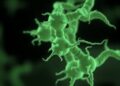
Credit: UMass Amherst
AMHERST, Mass. – As part of the long effort to improve treatment of tuberculosis (TB), microbiologists led by Yasu Morita at the University of Massachusetts Amherst report that they have for the first time characterized a protein involved in making a glycolipid compound found in the TB cell wall, which is critical for the disease-causing Mycobacterium to become infectious.
Doctoral candidate and first author Kathryn Rahlwes, working with a non-pathogenic form of the bacterium in Morita's lab, says, "We found mutant bacteria that were unable to express this protein. If they don't have it, the enzymatic machinery they use to biosynthesize the glycolipid won't work, and they cannot become infectious. We investigated a protein that had not been characterized before, nobody knew its role." Details appear in the Journal of Biological Chemistry.
The Morita lab is expert in investigating the multi-layered cell envelope components that surround mycobacteria, including several glycolipids known or predicted to be essential for the overall viability of disease-causing Mycobacterium tuberculosis (Mtb), which have impermeable cell walls that block antibiotics. Morita sees the biosynthesis pathways that cells use to form these envelope layers as a promising path in the search for new drug targets in TB, a disease that has seen increasing multi-drug resistance.
He explains, "The protein that Kathryn characterized is part of the process by which these molecules trick the human immune system so that it doesn't attack the bacteria as hard as it should, so they survive in the body. TB has many, many tricks and this is one of them. Understanding how the bacteria make these glycolipids might provide us a way to interfere with them and stop them from being able to infect us."
For this work, Rahlwes used genetic screening methods to explore the mutant of Mycobacterium that contains the protein known as PimE. It had been identified earlier in the Morita lab and was known to have some unusual properties.
Morita explains, "We were growing some of the mutant Mycobacterium in a Petri dish, and they grew very poorly; the mutant colonies had a growth disadvantage. Then we isolated a mutant of the mutant, and these suddenly began growing well again. It didn't make sense, and we became curious about what was going on. Why did one defect make them grow slowly and poorly, but two defects made them run normally again?"
It turns out that the "mutant mutant" has an initial growth defect plus another mutation in the same glycolipid biosynthesis pathway and the second mutation allows these bacteria to enjoy more normal growth. "This led us to the discovery of a new gene in the biosynthesis of this glycolipid, which we termed lipomannan elongation factor or LmeA," Rahlwes says. "The mutated gene caused the production of different glycolipids in the mutant of the mutant."
Next steps include trying to duplicate the mutant of this gene in the pathogenic form of mycobacteria, to demonstrate that the gene is indeed essential as predicted for infection to take place, the microbiologists say.
Rahlwes also plans to further investigate the protein's role in the enzymatic pathway and which parts it is interacting with. "We know it's involved, but not exactly what it's doing," she says. "We'd like to confirm its function in the pathogen and its impact on the pathogen's growth. If it is essential for the pathogen to grow, and if we are able to deplete it in the pathogen, we will be able to interfere in the infection process."
###
This work was funded by the American Lung Association and the Pittsfield Anti-Tuberculosis Association. Also, mass spectrometry support came from the UMass Amherst Institute for Applied Life Sciences.
Media Contact
Janet Lathrop
[email protected]
413-545-0444
@umassscience
http://www.umass.edu
Original Source
http://www.umass.edu/newsoffice/article/umass-amherst-microbiologists-contribute http://dx.doi.org/10.1074/jbc.M117.804377