


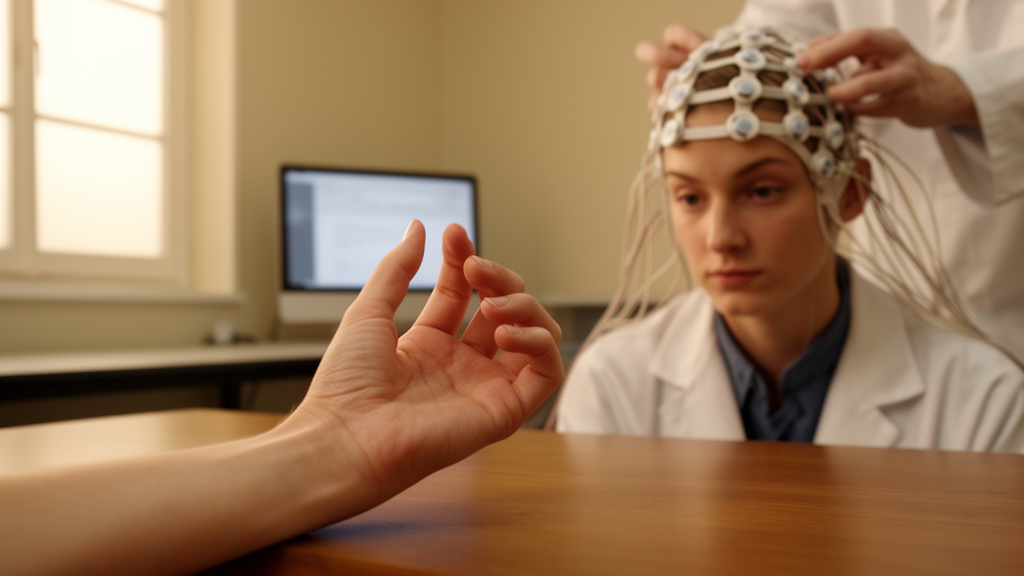
When people look at a digit, their brain’s response may depend on how they learned to count on their fingers as children. That is the central finding of a new study published in Behavioral and Brain Functions, which used electroencephalography to trace how learned motor associations influence neural processing of numerical symbols.
The research team, led by Saied Sabaghypour and colleagues including Mohammad Ali Nazari and Mojtaba Soltanlou, set out to test an embodied cognition account of number processing. Embodied cognition holds that numbers are linked to physical actions and sensory experiences, and the researchers asked whether covert attention to these motor associations shapes brain responses when people passively view digits.
Participants were classified by their finger-counting habits, and the researchers recorded event-related potentials (ERPs) together with time-frequency analysis of brain activity. They focused on the P2 component, an early electrical response linked to attentional processing, and asked whether it correlates with motor habits and with alpha wave activity, a brain rhythm often associated with attentional control.
The results showed a stronger P2 component when the association between a number and a hand was aligned with the participant’s habitual finger-counting pattern. In other words, digits that matched the hand a person habitually uses in counting elicited a larger attention-related response, even though the task was passive viewing of symbolic numbers.
By contrast, the researchers observed no significant changes in alpha wave activity. This suggests that the attentional modulation captured by the P2 component was not accompanied by measurable shifts in the alpha rhythm under the conditions of this experiment.
A second key finding concerned individual differences. Participants described as right-starters, who begin counting with the right hand, showed enhanced attention and number processing overall: they exhibited higher P3 amplitudes, a later component associated with attention and stimulus evaluation, and faster behavioral responses for all digits, not only for particular magnitudes.
The authors interpret these results within a theoretical framework they propose, termed Feature-based Attention to Learned Motor (FALM) processing. In this account, attention directed at learned motor features of number symbols can shape how the brain responds to numerical information, extending embodied accounts of number cognition from motor systems into attentional processing.
The researchers are careful to describe their findings as preliminary support for this idea. The study examined neural responses during passive viewing, and the reported effects concern ERP components and response speed rather than any clinical or educational outcome. As the authors state in the abstract, the findings provide preliminary support for the notion that attention to learned motor associations may influence neural responses to numerical information.
The study, published open access on 2 August 2026, adds to a growing body of work connecting numerical cognition with the body. Related recent articles in the same journal have explored the role of motor effort in the sensorimotor number system and proposed a number sense as an emergent property of the manipulating brain, reflecting sustained interest in how counting on fingers and other bodily habits may leave lasting traces in how the adult brain processes digits.
Subject of Research: Neural responses to number symbols and their link to learned finger-counting habits
Article Title: The journey of numbers from attention to motor processing: an embodied account of neural response to number magnitudes
Article References: Sabaghypour, S., Farkhondeh Tale Navi, F., Fischer, M. H., Yeganeh, P. A., Nazari, M. A., & Soltanlou, M. (2026). The journey of numbers from attention to motor processing: an embodied account of neural response to number magnitudes. Behavioral and Brain Functions. https://doi.org/10.1186/s12993-026-00361-x
Image Credits: AI Generated
DOI: 10.1186/s12993-026-00361-x
Keywords: embodied cognition, numerical cognition, event-related potentials, P2 component, P3 amplitude, alpha waves, finger counting, attention, EEG, time-frequency analysis, right-starters, Behavioral and Brain Functions
News Source: Cassandra Pierce. (October 29, 2026). Finger-counting habits shape the brain’s electrical response to digits. Scienmag.



