


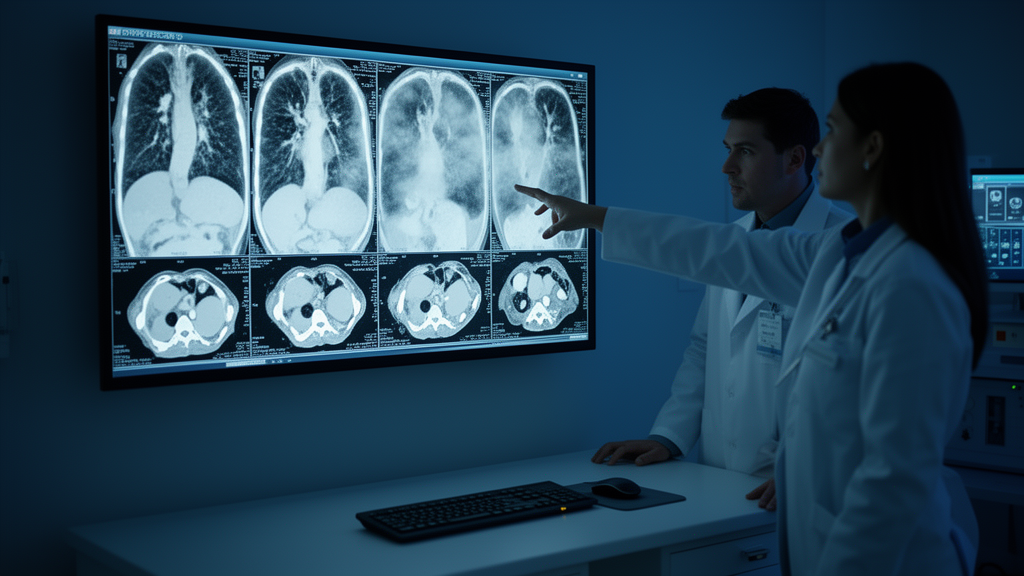
A multimodal deep-learning framework can segment pneumonia lesions on chest CT scans, classify radiological findings, and grade the overall burden of disease in patients with ventilator-associated pneumonia, according to a retrospective study published in Frontiers in Medicine. In a cohort of 512 patients clinically diagnosed with the condition, the model’s radiological burden grade remained significantly associated with 28-day mortality even after adjustment for clinical covariates including APACHE II score, with a hazard ratio of 2.34 (P < 0.001).
Ventilator-associated pneumonia is a major complication in the intensive care unit, and the study’s authors argue that objective computed tomography assessment is needed to complement clinical evaluation. The framework was designed to perform three tasks simultaneously: voxel-level lesion segmentation, multi-label classification of radiological findings, and grading of radiological burden.
Technically, the system combines several components. Anatomical priors from TotalSegmentator help the network understand lung and thoracic structure. A three-dimensional Swin UNETR multi-task network carries out the segmentation and classification work, and a cross-attention fusion mechanism integrates CT image features with ventilation parameters drawn from the patients’ clinical monitoring.
Internal validation produced a Dice score of 0.847 for lesion segmentation, a macro-average area under the receiver operating characteristic curve of 0.919 for the classification tasks, and a weighted kappa of 0.826 for burden grading. External validation on separate data yielded a Dice score of 0.821, and the researchers report no significant differences in performance across scanner manufacturers, suggesting the segmentation component is reasonably robust to hardware variation.
The prognostic finding is the study’s central clinical claim. After adjusting for clinical covariates, including the APACHE II severity score, patients at higher radiological burden grades showed a significantly higher hazard of death within 28 days, with the model-derived grade independently associated with mortality. The authors present this as evidence of the grade’s potential prognostic relevance rather than as proof that the tool changes outcomes.
Several limitations frame these results. The study was retrospective and enrolled only patients already clinically diagnosed with ventilator-associated pneumonia, so the findings do not establish diagnostic performance in undifferentiated ICU patients. The reported associations are observational; the model’s burden grade is a measured imaging feature, and the mortality link is a statistical association from a hazard model, not a demonstrated causal effect or a validated prediction tool deployed at the bedside.
External validation, while performed, covered segmentation performance, and the full generalizability of the classification and grading components across institutions, patient populations, and ventilation practices would require further prospective testing. The article is an original research publication by Fuwen Zheng and Andee Dzulkarnaen Zakaria of Universiti Sains Malaysia, received in August 2026 and accepted in September 2026.
A reproducible burden grade that carries prognostic information beyond established severity scores could help stratify patients in future studies, though any clinical use would depend on validation beyond this retrospective cohort.
Subject of Research: Deep-learning analysis of chest CT for lesion segmentation and prognostic burden grading in ventilator-associated pneumonia
Article Title: Deep learning–based CT lesion analysis and radiological burden stratification in clinically diagnosed ventilator-associated pneumonia
Article References: Zheng, F., & Zakaria, A. D. (2026). Deep learning–based CT lesion analysis and radiological burden stratification in clinically diagnosed ventilator-associated pneumonia. Frontiers in Medicine, 13, Article 1966805. https://doi.org/10.3389/fmed.2026.1966805
Image Credits: AI Generated
DOI: 10.3389/fmed.2026.1966805
Keywords: ventilator-associated pneumonia, deep learning, chest CT, image segmentation, intensive care unit, Swin UNETR, TotalSegmentator, radiological burden, 28-day mortality, APACHE II, medical imaging, prognosis
News Source: Ophelia Keating. (October 29, 2026). Deep learning maps ventilator-associated pneumonia on CT and predicts mortality risk. Scienmag.



