


The Department of Energy’s Oak Ridge National Laboratory is helping lead a new national consortium that aims to move energy storage innovations out of the laboratory and into United States manufacturing far faster than the current pipeline allows. The effort, called the Battery Manufacturing Accelerator, or BattMan, combines four national laboratories, leading universities and industry partners to attack what organizers describe as the critical barriers standing between promising battery chemistries and commercially viable production lines.
The consortium is led by Pacific Northwest National Laboratory and includes Argonne National Laboratory and the National Laboratory of the Rockies, alongside founding university partners that include the University of Washington, Binghamton University, the University of Alabama, Arizona State University and the University of Michigan-Dearborn. Its stated goals are to lower manufacturing costs, shorten development timelines and strengthen American leadership in advanced energy storage for the electric grid, data centers, electric mobility and national security applications.
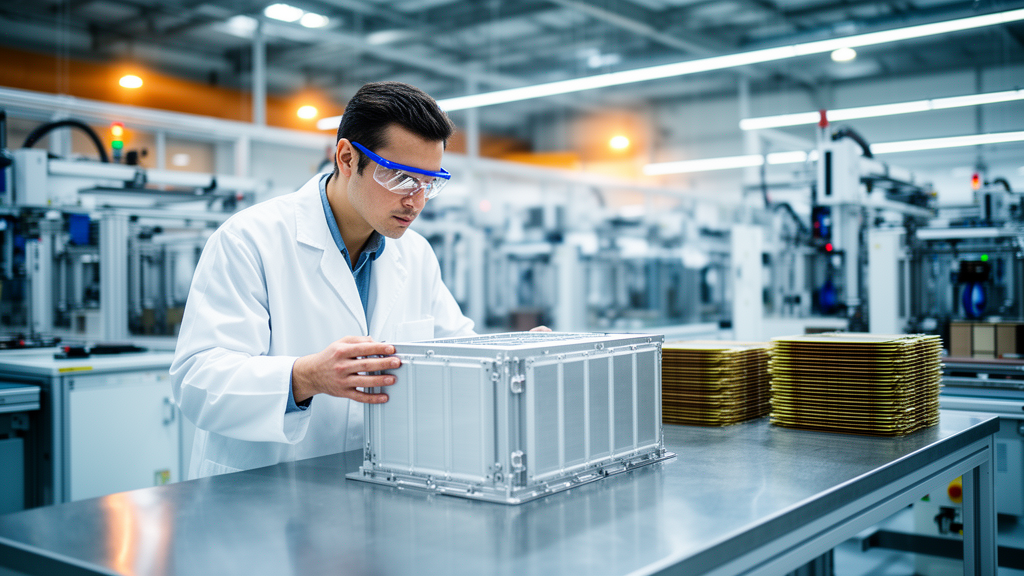
At the center of the technical vision is what the laboratories call Super Intelligence, or SI, driven smart manufacturing. Rather than treating production as a fixed process that is tuned by hand after problems appear, the BattMan concept embeds sensing, real-time monitoring and automated feedback directly into the manufacturing line. In one planned configuration, an electrode manufacturing machine will be outfitted with visual, temperature and pressure sensors that feed information to an SI-enhanced analysis platform, with the results returned as feedback to improve the process as it runs.
“The BattMan Accelerator is exactly the kind of coordinated national effort that turns scientific breakthroughs into economic and energy security advantages,” said Chins Chinnasamy, consortium lead for ORNL. “With our combination of expertise in Super Intelligence-driven smart manufacturing, real-time defect detection, and advanced electrode processing, ORNL is in a unique position to reduce commercialization risks for the American battery industry.”
The scrap problem is one of the consortium’s most concrete targets. Electrode manufacturing is unforgiving: if electrodes are not produced correctly, the material is wasted, including critical materials such as lithium and cobalt. According to Chinnasamy, up to 40 percent of material can end up as scrap in current processes. Working jointly with battery manufacturers, ORNL plans to design first-of-its-kind electrode manufacturing equipment that identifies even the smallest errors and corrects them in real time. The stated goal is to reduce scrap to less than 5 percent, which would also cut costs tied to construction and supply chain bottlenecks.
BattMan will build on the autonomous laboratory concept by advancing autonomous pilot lines. These integrate sensing, process monitoring and intelligent control systems to improve product quality and reduce variability in manufacturing. The logic is that pilot-scale demonstration proves manufacturing readiness, which in turn speeds scale-up and reduces commercialization costs. In the longer term, the consortium aims to develop self-optimizing manufacturing systems that use real-time data, automated feedback and digital twins, virtual replicas linked to physical systems that can safely model ways to improve performance before changes are made on the real line.
Much of the ORNL-side research will take place in the Battery Manufacturing Facility, described as the country’s largest open-access battery manufacturing research and development center. Ruhul Amin, who leads electrode materials optimization for BattMan at ORNL, said companies work with ORNL battery experts at the facility to incorporate and test new materials and designs in batteries made onsite with modular, reconfigurable commercial equipment.
As part of BattMan, the Battery Manufacturing Facility will vertically integrate a smart test bed incorporating advanced sensing, real-time monitoring and data analysis. In collaboration with the National Laboratory of the Rockies, which will focus on advanced characterization and SI-driven quality control, ORNL will develop a digital twin to further optimize and refine process performance. The intended outcome is an SI-based manufacturing platform capable of detecting production irregularities as they occur and autonomously adjusting parameters to prevent defects before they propagate through a production run.
The system is being designed to be adaptable across energy storage technologies. That includes conventional lithium-ion batteries used in vehicles, drones, electronics and grid storage, but the same platform could in principle apply to solid-state batteries, flow batteries or next-generation chemistries. This flexibility matters for the consortium’s supply chain ambitions: BattMan also aims to strengthen the critical mineral supply by advancing battery materials made from more abundant domestic elements, reducing dependence on geographically concentrated raw materials.
The accelerator is actively establishing collaborations with companies across the battery and materials manufacturing sector, and the laboratories plan to work with university partners and industry to test and validate manufacturing processes at increasing scales toward commercially viable production. Universities will also contribute processing and integration capabilities and develop workforce training on the new technologies, with Parans Paranthaman leading battery industry collaboration for ORNL. The effort is supported by DOE’s Advanced Materials and Manufacturing Technologies Office within the Office of Critical Minerals and Energy, and institutions and companies interested in participating are being directed to the consortium’s website as partnerships are formed.
Subject of Research: A DOE national laboratory consortium applying super-intelligence-driven smart manufacturing to scale battery production in the United States
Article Title: New DOE consortium advances SI-driven battery manufacturing to strengthen US competitiveness
Article References: New DOE consortium advances SI-driven battery manufacturing to strengthen US competitiveness. Original publication (Bibliographic details unavailable.)
Image Credits: AI Generated
DOI: Not provided
Keywords: battery manufacturing, Department of Energy, Oak Ridge National Laboratory, energy storage, smart manufacturing, electrode production, digital twins, critical minerals, lithium-ion batteries, supply chain, automation, industrial consortium
News Source: Faith Mcneil. (October 29, 2026). DOE-led BattMan Accelerator aims to push battery innovation from lab to US factory floor. Scienmag.



