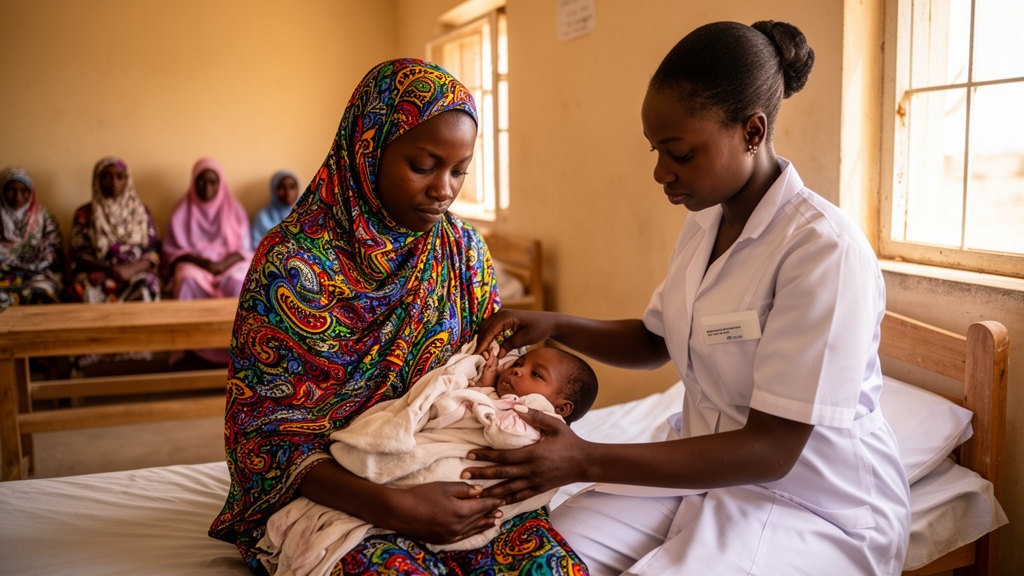
Among the 5,160 women included in the study, the estimated completion proportion was 12.7 percent, with a 95 percent confidence interval of 11.4 to 14.1 percent, underscoring how rarely women in this resource-limited setting move through all three stages of care for a single pregnancy.
The researchers, Abdirahman Ahmed Jama, Ahmed Mohamoud Jama, and Li-Nien Chien, analyzed data from ever-married women whose most recent birth was a live birth, measuring completion across the three service stages.
Several characteristics were associated with markedly higher odds of completion. Women with secondary education or higher had more than double the odds of completing the continuum compared with less-educated women (adjusted odds ratio 2.78; 95 percent CI 1.66–4.64). Media exposure showed the strongest positive association in the analysis (AOR 3.75; 95 percent CI 2.35–5.99), while women from the richest households (AOR 2.48; 95 percent CI 1.46–4.20) and those whose husbands had secondary education or higher (AOR 2.67; 95 percent CI 1.80–3.96) were also significantly more likely to complete all three stages. Together, these associations point to the role of information access, household resources, and household decision-making environments in whether care continues from pregnancy through the postnatal period.
Other factors were linked to lower odds of completion. Women aged 35 years or older had about half the odds of younger women (AOR 0.50; 95 percent CI 0.31–0.82), and women with high parity had 60 percent lower odds (AOR 0.40; 95 percent CI 0.22–0.73). Residence mattered as well: women living in rural areas (AOR 0.59; 95 percent CI 0.43–0.82) and in nomadic settings (AOR 0.49; 95 percent CI 0.35–0.68) were significantly less likely to complete the continuum than women in other residence categories, a pattern consistent with the geographic and logistical barriers that mobile and remote populations face in reaching scheduled antenatal visits, facility-based delivery, and postnatal check-ups.
The analysis also revealed substantial regional disparities. After adjustment, women in the Sool (AOR 0.43; 95 percent CI 0.30–0.62), Sanaag (AOR 0.36; 95 percent CI 0.18–0.72), and Sahil (AOR 0.41; 95 percent CI 0.18–0.96) regions were significantly less likely to complete the continuum of care than women in the reference regions.
The authors conclude that completion of the continuum of care remained low in Somaliland and was associated with a set of individual and community-level factors, including women’s age, education, media exposure, husband’s education, parity, household wealth, residence, and region. They frame these results as evidence of socioeconomic and geographic disparities in the continuity of maternal health care and as support for efforts to improve equitable access to maternal health services. Because the continuum of care across pregnancy, childbirth, and the postnatal period is described in the study as a vital strategy for reducing maternal and neonatal mortality, the finding that roughly one in eight women completes it highlights a substantial gap between the ideal of continuous care and the services women in Somaliland actually receive.
Subject of Research: Determinants of completion of the maternal health continuum of care in Somaliland based on the 2020 demographic and health survey
Article Title: Individual-and-community level factors associated with completion of continuum of care in maternal health services in Somaliland: a multilevel analysis of the 2020 Somaliland demographic and health survey
Article References: Jama, A. A., Jama, A. M., & Chien, L.-N. (2026). Individual-and-community level factors associated with completion of continuum of care in maternal health services in Somaliland: a multilevel analysis of the 2020 Somaliland demographic and health survey. Archives of Public Health. https://doi.org/10.1186/s13690-026-02115-7
Image Credits: AI Generated
DOI: 10.1186/s13690-026-02115-7
Keywords: Somaliland, maternal health, continuum of care, antenatal care, postnatal care, demographic and health survey, multilevel analysis, health disparities, rural health, reproductive health, Individual-and-community, level
News Source: Ophelia Keating. (October 29, 2026). Only One in Eight Women in Somaliland Completes Maternal Care Continuum, Survey Analysis Finds. Scienmag.