Laboratory-reared embryos of the Pharaoh cuttlefish (Sepia pharaonis) developed poorly, formed smaller and paler ink sacs, and showed sharply altered expression of melanin-synthesis genes when their seawater was acidified, according to a new study published in Frontiers in Physiology. The research, conducted at Lingnan Normal University in Zhanjiang, China, exposed cuttlefish eggs to four pH levels — 8.0 as a control, plus 7.7, 7.3 and 6.5 — and tracked their growth, survival, organ formation and gene activity day by day. The results point to the embryonic stage as a particularly sensitive window in the life of a cephalopod, an animal whose adults are known to buffer external pH changes reasonably well.
The experimental design was straightforward but demanding. Live egg masses were collected from coastal waters off Zhanjiang in April 2021 and pre-cultured for three days at 28 degrees Celsius and a salinity of 23 parts per thousand to synchronize developmental stages. Eggs from 15 different females were mixed and evenly distributed across four treatment systems, each with three replicate tanks, so that every group contained offspring from all parental sources. Acidified seawater was produced by equilibrating filtered water with a high-purity carbon dioxide and air mixture, with pH adjusted solely by regulating gas flow rather than adding chemical acids. Water chemistry was monitored daily, and the carbonate system parameters were calculated with CO2SYS software. The treatments spanned a wide chemical range: mean pCO2 rose from about 415 microatmospheres in the control to roughly 1,350 at pH 7.7, 3,150 at pH 7.3 and 17,500 at pH 6.5, while the aragonite saturation state fell from 3.75 to 0.15 across the same gradient.
The developmental consequences followed the severity of acidification. On day one, embryos in all treatments looked alike, corresponding roughly to stage 17 of cuttlefish development, with a large transparent yolk sac and a well-defined mantle. By day four, divergence appeared: control embryos and those at pH 7.7 and 7.3 progressed normally, showing mantle expression, yolk absorption and the appearance of chromatophores, while embryos at pH 6.5 showed clear retardation, no visible chromatophores and a persistently large yolk sac. By day seven the gap had widened further, and by day nine the pH 6.5 group had suffered complete mortality, with yolk sac degeneration and tissue deterioration. Control embryos hatched by day 11. Embryos at pH 7.3 remained alive until that point but were markedly developmentally delayed and suffered increased mortality, while the pH 7.7 group showed pronounced developmental delay and failed to hatch, with data collection ending on day nine.
Quantitative morphometrics reinforced the visual observations. Mantle length increased continuously in the control group, but acidification produced non-monotonic, pH-dependent effects on growth. Severe acidification strongly suppressed somatic growth, with embryos at pH 6.5 showing minimal mantle elongation throughout the experiment. Interestingly, the pH 7.7 group accelerated after day five and transiently outpaced controls between days seven and nine, whereas the pH 7.3 group grew consistently more slowly than the control. Yolk sac area told the mirror-image story: control embryos absorbed their yolk reserves fastest, consistent with normal development, while yolk utilization was delayed in a pH-dependent manner. Embryos at pH 7.3 retained relatively large yolk sacs until late stages, and those at pH 6.5 showed minimal absorption, with yolk reserves remaining largely intact alongside developmental arrest and severe morphological abnormalities.
The ink sac, the organ at the heart of the study, proved especially vulnerable. On day one, nascent ink sac primordia appeared as tiny pigmented dots in all four groups, and the acidified groups actually showed earlier and more distinct pigment deposition than the fainter control structures. By day four, distinct oval ink sacs had formed in every treatment except pH 6.5. By day seven, control embryos displayed enlarged, pigmented ink sacs with a characteristic metallic sheen indicative of active melanogenesis; the pH 7.7 and 7.3 groups showed similar but less pronounced development, while pH 6.5 embryos had small, pale, poorly developed ink sacs lacking reflective pigmentation. Quantitative measurements confirmed that ink sac area increased steadily in controls but was progressively reduced under decreasing pH, with only minimal growth and eventual stagnation at pH 6.5.
Behind these morphological defects lay changes in gene expression. The researchers quantified transcript levels of three melanin-related genes in ink sac tissue using quantitative real-time PCR, normalized to the ribosomal protein gene rpl23a, whose stability they validated across all 108 samples with a coefficient of variation of 8.27 percent. Both tyrosinase (tyr), the rate-limiting enzyme of melanin biosynthesis, and peroxidase (per), which contributes to the polymerization of downstream melanin intermediates, displayed a broadly biphasic response: transient induction early in exposure followed by pronounced suppression during mid-development. On day one, tyr was significantly elevated at pH 7.7 and 7.3, though not at pH 6.5, while per was significantly upregulated in all three acidified groups. From day three onward, tyr expression in the pH 7.3 and 6.5 groups fell markedly and stayed significantly below controls for most of the remaining period. By day nine, tyr in the pH 6.5 group had dropped to roughly 45 percent of the control value, while per in the pH 7.7 and 7.3 groups recovered and rose significantly above control levels.
The regulatory gene spNOS, encoding nitric oxide synthase, behaved differently. Nitric oxide signaling is known from related cuttlefish species to participate in the regulation of tyrosinase-mediated melanogenesis in ink gland cells. In this experiment, spNOS was significantly upregulated in all three acidified groups on day one, consistent with an acute transcriptional stress response, but from day two onward the trajectories diverged with acidification severity. Embryos at pH 6.5 showed progressive downregulation, reaching their lowest transcript levels on day eight and remaining significantly reduced on day nine. The moderate groups fluctuated without a unidirectional trend: pH 7.3 transiently rose above controls on day five before declining, and pH 7.7 remained moderately suppressed through most of the window before a pronounced, significant upregulation to the peak value across all sampling points on day nine. In short, only severe acidification produced sustained repression of spNOS, while moderate acidification triggered a dynamic biphasic pattern.
The authors are careful about what these transcriptional patterns can and cannot show. A significant salinity difference emerged among treatments, ranging from 23 to 26 parts per thousand, and an analysis of covariance confirmed that pH remained the primary driver of the responses in yolk sac area, mantle length and all three genes after controlling for salinity — yet the possibility of combined pH and salinity effects cannot be entirely excluded. A subtler confound is developmental staging: because acidification altered developmental rates, embryos sampled on the same chronological day may have been at different developmental stages, and melanogenesis genes are tightly linked to organogenic progression. The authors argue that pH still plays a role, noting that the day-one upregulation of per and spNOS occurred when embryos were at comparable early stages, and that sustained suppression at pH 6.5 persisted beyond developmental arrest. They also measured mRNA abundance only, not melanin content or enzyme activities, so the gene changes suggest an association with, but do not confirm direct functional causation of, impaired pigmentation. Survival and hatching outcomes are presented as qualitative descriptions rather than precise rates, because the destructive daily sampling of embryos prevented individual tracking.
The ecological implications, if the laboratory patterns hold in nature, are considerable. Ink release is a central defense for newly hatched cuttlefish, and hatchlings with smaller, less pigmented ink sacs may be less capable of deploying effective ink clouds against predators, potentially raising predation rates and reducing recruitment. The authors frame the lower pH treatments of 7.3 and 6.5 — which exceed most open-ocean projections — as representative of episodic acidification events in coastal and eutrophic systems, where eutrophication and anthropogenic carbon dioxide emissions can intensify acidification locally. They also situate the findings among earlier observations: juvenile S. pharaonis previously tolerated moderate pH reductions but showed reduced pigmentation at far lower pH, and delayed organogenesis under acidification has been documented in squid and octopus embryos. Whether the transcriptional changes observed here translate into genuinely defense-impaired hatchlings in the wild remains to be tested directly, and the authors call for studies using synchronized developmental staging, multiple reference genes, enzymatic and melanin assays, multi-stressor designs and behavioral tests of predation vulnerability to close those gaps.
Subject of Research: Effects of ocean acidification on embryonic development, ink sac formation and melanin gene expression in the Pharaoh cuttlefish
Article Title: Ocean acidification impairs embryonic development and disrupts ink sac gene expression in the pharaoh cuttlefish (Sepia pharaonis)
Article References: Li, S., Liang, J., Liu, J., Lv, Y., Peng, J., Zeng, M., Guo, C., Zhang, H., Yuan, J., & Wang, L. (2026). Ocean acidification impairs embryonic development and disrupts ink sac gene expression in the pharaoh cuttlefish (Sepia pharaonis). Frontiers in Physiology, 17, Article 1979863. https://doi.org/10.3389/fphys.2026.1979863
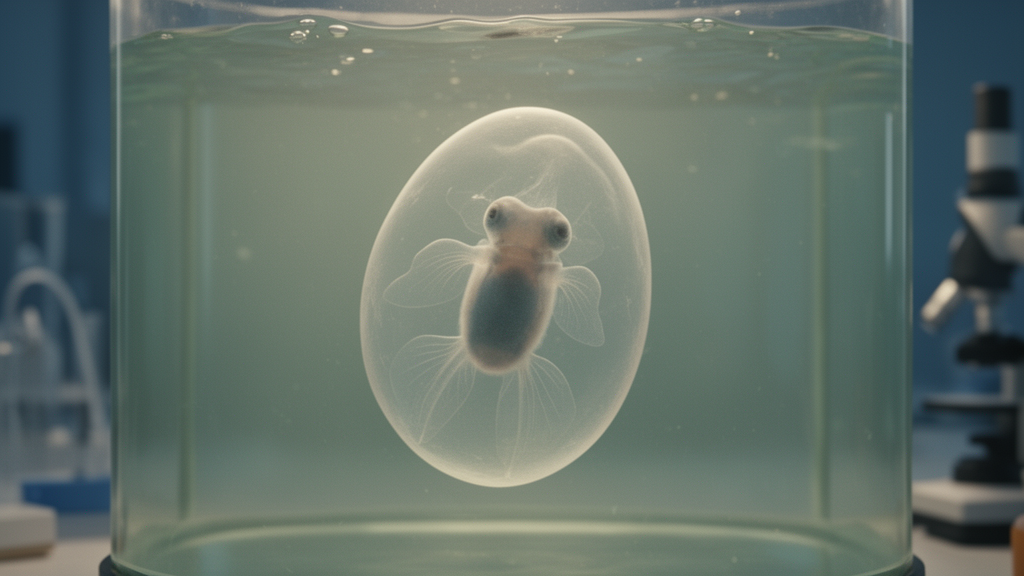
Image Credits: AI Generated
DOI: 10.3389/fphys.2026.1979863
Keywords: ocean acidification, Sepia pharaonis, cuttlefish, embryonic development, ink sac, melanin, gene expression, cephalopods, pH, qRT-PCR, marine biology, hatching
News Source: Juliet Wilcox. (October 29, 2026). Acidified Seawater Stalls Cuttlefish Embryo Growth and Ink Sac Gene Activity in Lab Study. Scienmag.