• HOME
  • NEWS
  • EXPLORE
    • CAREER
      • Companies
      • Jobs
    • EVENTS
    • iGEM
      • News
      • Team
    • PHOTOS
    • VIDEO
    • WIKI
  • BLOG
  • COMMUNITY
    • FACEBOOK
    • INSTAGRAM
    • TWITTER
Friday, October 30, 2026
BIOENGINEER.ORG
No Result
View All Result
  • Login
  • HOME
  • NEWS
  • EXPLORE
    • CAREER
      • Companies
      • Jobs
        • Lecturer
        • PhD Studentship
        • Postdoc
        • Research Assistant
    • EVENTS
    • iGEM
      • News
      • Team
    • PHOTOS
    • VIDEO
    • WIKI
  • BLOG
  • COMMUNITY
    • FACEBOOK
    • INSTAGRAM
    • TWITTER
No Result
View All Result
Bioengineer.org
No Result
View All Result
Home NEWS Science News Technology

One-step 3D nanoprinting creates humidity-driven microactuators that lift 800 times their weight

by
October 29, 2026
in Technology
Reading Time: 2 mins read
0
One-step 3D nanoprinting creates humidity-driven microactuators that lift 800 times their weight

One-step 3D nanoprinting creates humidity-driven microactuators that lift 800 times their weight

Share on FacebookShare on TwitterShare on LinkedinShare on RedditShare on Telegram

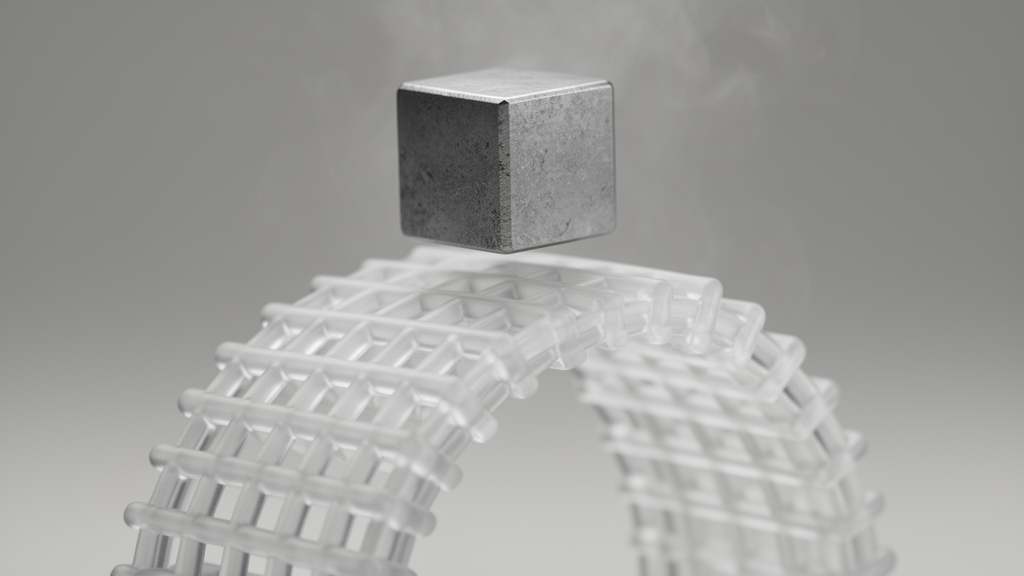
Researchers have fabricated bioinspired microactuators using a one-step meniscus-guided 3D nanoprinting technique that directly produces a freestanding three-dimensional composite architecture. The process integrates a rigid nanoparticle framework with a hygroscopic polymer matrix in a single, assembly-free step, according to the study published in Advanced Composites and Hybrid Materials.

The design draws on the functional integration of rigid and compliant components in the insect exoskeletal joint. In the resulting microscale pillar, these two roles are combined in a single structure: the nanoparticle scaffold provides mechanical support, while the polymeric phase provides volumetric expansion. This pairing yields large reversible elongation under humidity while preserving structural integrity, the authors report.

Comprehensive experiments, including comparative control structures and microscopic analysis, were used to elucidate the actuation mechanism. The resulting AuNP–PVP microactuator shows humidity-responsive actuation at the microscale, with representative demonstrations of repeated humidity cycling and load lifting up to approximately 800 times its estimated own weight under the tested conditions.

Variant geometries extend what the basic pillar can do. Hinged pillars demonstrate how axial swelling can be converted into bending motion, and an optical configuration shows how actuation can modulate reflected light signals. These demonstrations suggest routes toward microscale sensing, optical modulation, and adaptive microdevices, the authors note.

The nanoprinting approach is presented as a simple strategy for constructing bioinspired soft microactuators with humidity-responsive deformation. Because the freestanding composite architecture forms directly in a single process, the technique avoids separate assembly steps, and the reported results are limited to the tested laboratory conditions described in the study.

Subject of Research: Fabrication of bioinspired humidity-responsive microactuators by one-step meniscus-guided 3D nanoprinting

Article Title: Bioinspired microactuators fabricated via one-step meniscus-guided 3D nanoprinting

Article References: Eom, S.-J., Devaraj, V., Kwak, S., Seo, H.-S., Zentgraf, T., Kim, W.-G., & Lee, J.-M. (2026). Bioinspired microactuators fabricated via one-step meniscus-guided 3D nanoprinting. Advanced Composites and Hybrid Materials. https://doi.org/10.1007/s42114-026-02151-5

Image Credits: AI Generated

DOI: 10.1007/s42114-026-02151-5

Keywords: microactuators, 3D nanoprinting, meniscus-guided printing, bioinspired materials, gold nanoparticles, PVP polymer, humidity response, hygroscopic swelling, soft robotics, optical modulation, composite architecture, microscale actuation

News Source: Denise Maddox. (October 29, 2026). One-step 3D nanoprinting creates humidity-driven microactuators that lift 800 times their weight. Scienmag.


Tags: 3D nanoprintingbioinspired materialscomposite architecturegold nanoparticleshumidity responsehygroscopic swellingmeniscus-guided printingmicroactuatorsmicroscale actuationoptical modulationPVP polymersoft robotics
Share12Tweet7Share2ShareShareShare1

Related Posts

Gold Recovered from Electronic Waste Using Only Salt Water and AC Electrolysis

Gold Recovered from Electronic Waste Using Only Salt Water and AC Electrolysis

October 30, 2026
Buildings Could Store Heat for the Grid, but Digital Readiness Lags Behind

Buildings Could Store Heat for the Grid, but Digital Readiness Lags Behind

October 30, 2026

Italy Builds a National Superconductivity Network to Power Future Colliders and Grids

October 30, 2026

Mirror-Image DNA Strands Turn a Single PCR Tube Into Its Own Control

October 30, 2026

POPULAR NEWS

  • Clove-based gels and nanoformulations show promise against gum disease

    Clove-based gels and nanoformulations show promise against gum disease

    29 shares
    Share 12 Tweet 7
  • Knowledge Graph Boosts AI Extraction of Drug Side Effects from Patient Narratives

    29 shares
    Share 12 Tweet 7
  • Electron imaging reveals atomic structure of strengthening precipitates in high-silicon aluminum alloy

    29 shares
    Share 12 Tweet 7
  • New Model Predicts Extreme Traffic Loads on Chinese Bridges from WIM Data

    29 shares
    Share 12 Tweet 7

About

We bring you the latest biotechnology news from best research centers and universities around the world. Check our website.

Follow us

Recent News

Anti-TNF Therapy Leaves Thyroid Function Largely Unchanged in Psoriatic Arthritis Patients

Gold Recovered from Electronic Waste Using Only Salt Water and AC Electrolysis

Older Adults Adapt Chewing Muscle Activity Phase by Phase, Food by Food

Subscribe to Blog via Email

Enter your email address to subscribe to this blog and receive notifications of new posts by email.

Join 86 other subscribers
  • Contact Us

Bioengineer.org © Copyright 2023 All Rights Reserved.

Welcome Back!

Login to your account below

Forgotten Password?

Retrieve your password

Please enter your username or email address to reset your password.

Log In
No Result
View All Result
  • Homepages
    • Home Page 1
    • Home Page 2
  • News
  • National
  • Business
  • Health
  • Lifestyle
  • Science

Bioengineer.org © Copyright 2023 All Rights Reserved.