


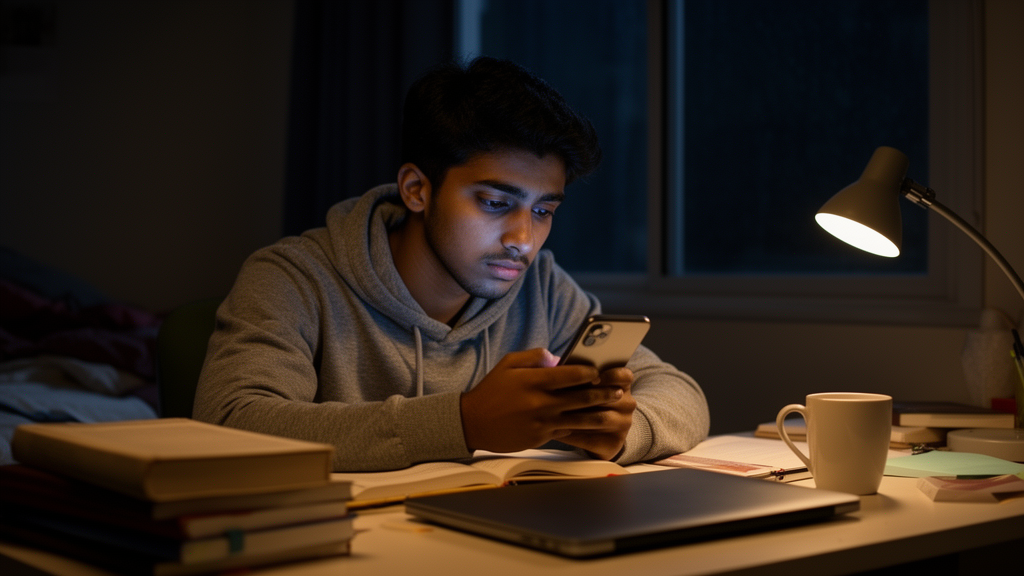
Seventeen percent of university students in Bangladesh show signs of social media addiction, according to a new cross-sectional study of 374 students, and those affected were far more likely to report short sleep, poor sleep quality, hypertension, and diabetes. The research, published in Discover Mental Health, also reports the first validation of the Brief Resilient Coping Scale for use in Bangladeshi culture, finding the short resilience measure to be psychometrically sound in this student population.
The study team, led by Md. The sample included 48.4 percent male and 51.6 percent female students, with a mean age of 21.86 years. Participants completed self-report questionnaires measuring social media addiction, life satisfaction, and resilience, and the researchers analyzed the data using descriptive statistics, chi-square tests, binary logistic regression, and multiple linear regression.
Social media addiction was classified using the Bergen Social Media Addiction Scale, with a score of 24 or higher indicating addiction. Using this threshold, 17.1 percent of the students met the criteria. The researchers then examined which socio-demographic, behavioral, and health-related variables were associated with this outcome in a fully adjusted statistical model.
Four factors emerged as significantly associated with social media addiction after adjustment. Students who slept less than six hours had more than three and a half times the odds of addiction compared with others (adjusted odds ratio of 3.81, with a 95 percent confidence interval of 1.13 to 12.87). Poor sleep quality was associated with nearly five times the odds (adjusted odds ratio of 4.98, 95 percent confidence interval of 1.53 to 16.16). Students reporting hypertension had an adjusted odds ratio of 5.15 (95 percent confidence interval of 1.60 to 16.62), and those reporting diabetes had an adjusted odds ratio of 5.13 (95 percent confidence interval of 1.05 to 25.02).
Life satisfaction showed a more complicated pattern. In the crude analysis, life satisfaction was significantly associated with social media addiction, with an odds ratio of 2.07 (95 percent confidence interval of 1.18 to 3.66). However, once the researchers adjusted for other study variables, this association was no longer statistically significant, with an adjusted odds ratio of 1.97 and a confidence interval of 0.87 to 4.46 that crossed the null value of one.
Resilience, by contrast, remained negatively associated with social media addiction in the multiple logistic regression model, with a standardized coefficient of -0.176 and a p-value below 0.01. The researchers interpreted this inverse relationship as evidence of the resilience scale’s concurrent validity, meaning the instrument behaved as expected in relation to a theoretically linked outcome.
On the psychometric side, the Brief Resilient Coping Scale performed well in this population. The researchers used exploratory and confirmatory factor analysis, independent-samples t-tests, and correlational analyses to evaluate the scale, noting that no prior study had assessed its psychometric properties in Bangladeshi culture. The confirmatory factor analysis showed acceptable fit indices: a chi-square of 3.860 with a non-significant p-value, a chi-square to degrees of freedom ratio of 1.93, an RMSEA of 0.069 with a 90 percent confidence interval of 0.061 to 0.076, a CFI of 0.99, a TLI of 0.98, and an SRMR of 0.020.
The authors caution that the findings on hypertension and diabetes come with an important limitation. The subgroup of students reporting these chronic conditions was exceptionally small, which may limit the generalizability of that association among university students in Bangladesh. The wide confidence intervals around the odds ratios for both conditions reflect this uncertainty, and the cross-sectional design means the study cannot establish whether social media addiction contributes to these health problems or whether the reverse is true.
As an accepted, peer-reviewed article shared ahead of the final version of record, the study is citable and carries a permanent DOI, though it remains subject to further edits. The authors conclude that social media addiction was associated with self-reported poor sleep quality and shorter sleep duration among Bangladeshi university students, and that the Brief Resilient Coping Scale is a psychometrically sound tool for assessing resilience in this student population, offering researchers in the region a validated instrument for future work on coping and digital wellbeing.
Subject of Research: Associations between social media addiction, sleep, health conditions, and resilience among Bangladeshi university students
Article Title: Social media addiction, resilience, and life satisfaction among Bangladeshi university students: a cross-sectional study with validation of the Brief Resilient Coping Scale
Article References: Mondal, M. A. H., Noori, M., Pal, S. K., Farhana, S., Islam, M. S., Siddique, M. N.-E.-A., & Shaikot, M. H. (2026). Social media addiction, resilience, and life satisfaction among Bangladeshi university students: a cross-sectional study with validation of the Brief Resilient Coping Scale. Discover Mental Health. https://doi.org/10.1007/s44192-026-00618-x
Image Credits: AI Generated
DOI: 10.1007/s44192-026-00618-x
Keywords: social media addiction, Bangladesh, university students, sleep quality, sleep duration, hypertension, diabetes, resilience, life satisfaction, Brief Resilient Coping Scale, cross-sectional study, psychometric validation
News Source: Glenn Wilkins. (October 29, 2026). Poor Sleep and Chronic Conditions Linked to Social Media Addiction in Bangladeshi University Students. Scienmag.



